Updated and legally reviewed: 17 August 2026
Extradition from India in 2026: Complete Legal Process from Foreign Request to Arrest, Inquiry, Bail and Surrender
Supreme Court of India | Patna High Court | Allahabad High Court at Prayagraj | Jharkhand High Court at Ranchi | Calcutta High Court | Delhi High Court and Delhi Courts/Tribunals | Matters concerning Bhopal, Madhya Pradesh | Multiple District Courts
Direct Answer: What Happens When a Foreign Country Seeks Extradition of a Person from India?
A foreign country's request does not, merely by arriving in India, automatically result in the person's immediate surrender. Extradition from India is governed principally by the Extradition Act, 1962, the applicable extradition treaty or arrangement, notified orders and the facts of the particular request.
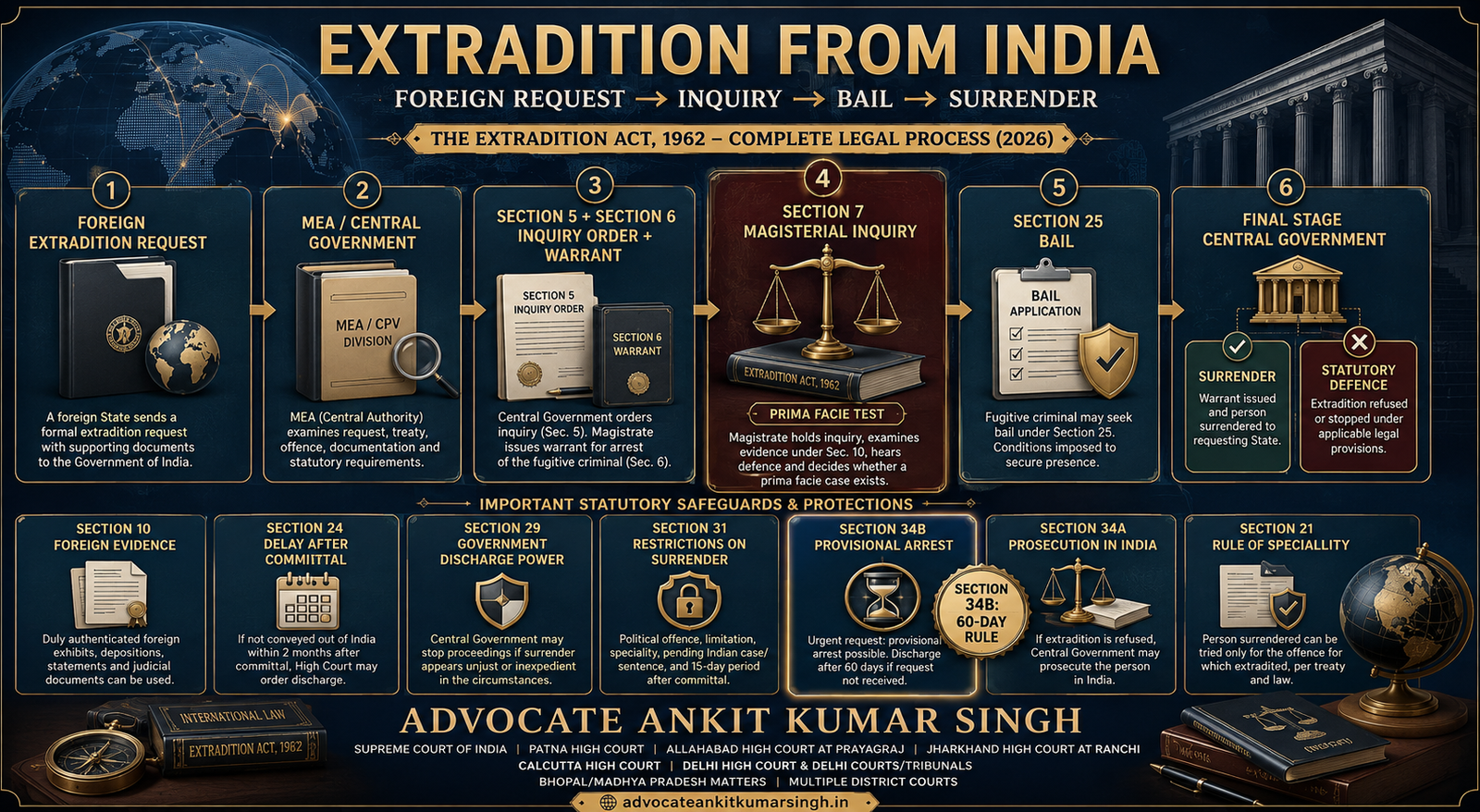
In the ordinary Chapter II route, the request reaches the Central Government; the Government considers whether an extradition inquiry should be initiated; a Magistrate may then be directed under Section 5 to inquire into the case; a warrant follows under Section 6; the person may be arrested and brought before the Magistrate; and a Section 7 inquiry examines whether the statutory threshold for surrender is satisfied.
If the Magistrate finds sufficient material amounting to the statutory prima facie threshold, the person may be committed to prison to await the Central Government's decision and the Magistrate reports the result. If the necessary case is not made out, the statutory scheme permits discharge. Even a committal does not itself amount to the final diplomatic surrender: the Central Government retains the statutory role contemplated by Section 8 and the other provisions of the Act.
Bail is expressly contemplated by Section 25. Separate statutory protections may arise under Sections 24, 29 and 31. In urgent situations, provisional arrest may also be invoked under Section 34B, subject to its statutory requirements.
The Most Important Concept: Extradition Is Not the Foreign Criminal Trial
An extradition proceeding answers a narrower question than the eventual criminal trial in the requesting country. The Indian extradition forum does not ordinarily conduct the full foreign prosecution, decide guilt after a complete trial or impose the foreign sentence.
The central questions include whether the person and offence fall within the extradition framework, whether the request and supporting material satisfy the applicable Act and treaty, whether the Section 7 evidentiary threshold is met, and whether any statutory or treaty restriction prevents surrender.
This distinction is crucial. A defence strategy should therefore not mechanically reproduce the defence that would be taken at the eventual foreign trial. It should identify defects relevant specifically to extradition.
Who Are the Main Authorities in an Extradition Case in India?
| Authority | Principal Role |
|---|---|
| Foreign/requesting State | Makes the extradition request and supplies the supporting material required by the applicable legal framework. |
| Ministry of External Affairs | Acts as India's Central Authority in extradition matters. |
| CPV Division, MEA | Functions as the nodal division within MEA dealing with extradition matters. |
| Central Government | Exercises statutory functions including consideration of the requisition, ordering an inquiry where appropriate and taking the eventual statutory decision concerning surrender. |
| Inquiry Magistrate | Conducts the statutory inquiry when directed and examines the material under the applicable provisions of the Extradition Act. |
| High Court | May become relevant for constitutional/judicial review and for the specific remedy contemplated by Section 24, depending on the procedural stage and facts. |
| Indian investigating/police authorities | May execute a lawful Indian extradition warrant or perform functions assigned under the Indian process. |
The Ministry of External Affairs states that it is the Central Authority for extradition matters and that the CPV Division is the nodal division handling them.
Stage 1 — The Foreign Extradition Request Reaches India
Section 4 deals with a requisition for surrender. The statutory route recognises formal governmental or diplomatic communication to the Central Government.
This is important because extradition is an inter-State legal process. A foreign complainant, private lawyer or ordinary private communication does not by itself perform the statutory function of a sovereign extradition requisition.
What should be examined immediately?
- Which country is requesting extradition?
- Is an extradition treaty or arrangement in force?
- What exact offence is alleged?
- Is the person accused or already convicted?
- What foreign warrant or judicial order exists?
- What conduct is alleged, rather than merely what foreign section number is mentioned?
- Is the alleged offence an extradition offence under the applicable framework?
- Is the prosecution time-barred under the relevant rule?
- Are political-offence, speciality or other statutory restrictions engaged?
Stage 2 — MEA and Central Government Scrutiny
Receipt of a request and issuance of an extradition order are different stages. The Central Government must examine the request within the statutory and treaty framework.
The applicable treaty can be decisive. Two extradition cases involving different countries may have materially different documentary requirements, offence thresholds, speciality provisions, nationality provisions, evidentiary formulations or assurances.
Therefore, the correct defence question is not simply, “Has another country sent a warrant?” It is: “What legally valid extradition request has reached India, under which treaty/statutory route, supported by what authenticated material?”
Stage 3 — Section 5: Order for Magisterial Inquiry
Section 5 is one of the central procedural gateways. Where the Central Government considers it appropriate under the statutory framework, it may direct a competent Magistrate to inquire into the case.
This order is legally significant because it moves the matter from executive examination into the formal judicial inquiry contemplated by the Act.
What should defence counsel examine at this point?
- The Section 5 order itself.
- The identity of the requesting State.
- The treaty/notified order relied upon.
- The offences mentioned in the request.
- The foreign warrant and procedural status of the foreign case.
- Identity particulars of the requested person.
- The supporting foreign evidence and authentication.
- Whether the request alleges facts capable of satisfying the applicable extradition test.
Stage 4 — Section 6: Warrant for Arrest
Under Section 6, upon receipt of the Central Government's Section 5 order, the Magistrate issues a warrant for arrest of the fugitive criminal.
Arrest therefore needs to be analysed by identifying the exact statutory route. A foreign arrest warrant, an INTERPOL communication, an Indian warrant under the Extradition Act and an immigration restriction are not interchangeable legal instruments.
Practical rule: Never advise a person about “extradition arrest risk” without first identifying the actual instrument presently operating in India.
Can a Foreign Arrest Warrant Automatically Be Executed in India?
Not simply because it exists abroad. Indian law contains mechanisms through which foreign extradition material may lead to arrest in India, but the lawful Indian route must be identified.
Depending on the applicable chapter, treaty and circumstances, the Act contains mechanisms concerning a Section 6 warrant, warrants under Sections 9, 14–16 and provisional arrest under Section 34B.
A client who says, “There is a warrant against me overseas,” should therefore obtain the actual warrant, foreign case number, offence provisions, date of issue, current status, requesting authority and any Indian communication before conclusions are drawn.
Stage 5 — Section 7 Extradition Inquiry: What Does the Magistrate Actually Decide?
Section 7 requires the Magistrate to inquire into the extradition case. The statute gives the Magistrate powers and jurisdiction, as nearly as may be, comparable to the specified higher criminal-court framework for the purposes of the inquiry.
The crucial statutory question is whether the material produces a prima facie case in support of the requisition.
This should not be confused with deciding guilt beyond reasonable doubt after a full criminal trial. The underlying foreign prosecution remains for the competent foreign court if extradition eventually occurs.
Possible areas of contest in a Section 7 inquiry
- Identity of the requested person.
- Whether the alleged offence qualifies for extradition.
- Whether the factual conduct corresponds with the applicable treaty/statutory requirement.
- Whether the foreign warrant and supporting material are legally sufficient.
- Authentication under Section 10.
- Whether the material actually connects the requested person to the alleged conduct.
- Whether the material is internally contradictory on a matter relevant to the prima facie threshold.
- Whether a statutory restriction on surrender is attracted.
Section 10 — Can Foreign Documents Be Used Without Calling Every Foreign Witness in India?
Yes, the Extradition Act has a special evidentiary mechanism. Section 10 deals with receipt and authentication of foreign exhibits, depositions, statements, certificates, judicial documents and related material.
That makes authentication a technically important part of extradition litigation. Defence examination should not stop at reading the allegation. It should ask whether the relevant document is the document it purports to be, whether it comes through the legally recognised route, and whether the statutory authentication requirements applicable to that document have been satisfied.
The significance of a defect depends upon the particular document, applicable treaty, statutory provision and complete record.
Ingredient Matrix for the Section 7 Inquiry
| Issue | Question to Test | Possible Defence Examination |
|---|---|---|
| Identity | Is this the person actually sought? | Name, date of birth, passport, photograph, aliases, addresses and identification material. |
| Extradition offence | Does the alleged conduct fall within the applicable extradition framework? | Treaty definition, statutory definition and conduct alleged. |
| Foreign proceeding | What is the actual status abroad? | Accusation, charge, conviction, warrant, appeal, quashing or closure status. |
| Evidentiary nexus | Is there material connecting the person to the alleged offence? | Witness statements, documents, electronic material and contradictions relevant to the prima facie test. |
| Authentication | Can the foreign material be received under Section 10? | Signatures, certifications, seals and statutory authentication route. |
| Limitation | Is prosecution barred by time within the relevant Section 31/treaty framework? | Offence date, procedural interruptions and foreign limitation law. |
| Political character | Does a statutory political-offence restriction genuinely arise? | Actual nature and purpose of prosecution, subject to statutory exclusions. |
| Speciality | Will the person be tried only within permissible bounds after surrender? | Treaty and Section 31 safeguards. |
What Happens If the Magistrate Finds a Prima Facie Case?
Where the statutory threshold is satisfied, the Section 7 framework permits committal of the fugitive criminal to prison to await the Central Government's decision and requires the Magistrate to report the result of the inquiry.
This is an important procedural distinction: committal is not itself the final executive act of surrender.
What Happens If the Prima Facie Threshold Is Not Satisfied?
The statutory scheme provides for discharge where the necessary case in support of the requisition is not established at the inquiry stage.
Consequently, the Section 7 inquiry is not an empty formality. The requesting case, the supporting evidence and the statutory requirements must actually be examined.
Stage 6 — Section 8 and the Central Government's Surrender Decision
Section 8 deals with surrender after the Magistrate's report and committal. The Central Government may, if it considers it appropriate within the statutory framework, issue the warrant necessary for custody and delivery of the fugitive criminal.
This illustrates the dual character of Indian extradition procedure:
- Judicial stage: statutory inquiry before the Magistrate.
- Executive stage: Central Government's statutory decision concerning surrender.
A strong extradition strategy therefore preserves objections relevant to both stages rather than treating the Magistrate's inquiry as the entire process.
Can You Get Bail in an Extradition Case in India?
Yes. Section 25 expressly provides a bail framework for a fugitive criminal arrested or detained under the Extradition Act.
The current published text of Section 25 still refers expressly to the Code of Criminal Procedure, 1973 and states, in substance, that bail provisions apply as though the person were accused in India of the offence for which extradition is sought. It further gives the Magistrate, for the purpose of bail, powers and jurisdiction corresponding as far as may be to those of a Court of Session under that Code.
Since India's general criminal procedure has subsequently transitioned to the Bharatiya Nagarik Suraksha Sanhita, 2023, the precise procedural application in a live matter should be checked against the current statutory saving/transition framework and the court's current practice rather than casually rewriting Section 25's published words.
What may become relevant to bail?
- Nature and gravity of the alleged foreign offence.
- Risk of absconding.
- Past compliance with proceedings.
- Passport and travel restrictions.
- Residence and roots in India.
- Medical or humanitarian circumstances where genuinely supported.
- Stage of the extradition inquiry.
- Likelihood of interference with the process.
- Conditions capable of securing presence.
Bail is case-specific. No responsible legal assessment can guarantee its grant merely because the extradition case is at an inquiry stage.
Section 34B Provisional Arrest: Can Someone Be Arrested Before the Full Extradition Request Arrives?
Yes, in the circumstances specified by Section 34B. On receipt of an urgent request from a foreign State for immediate arrest of a fugitive criminal, the Central Government may request the competent Magistrate to issue a provisional warrant.
Section 34B also contains an important statutory protection: a person arrested through this provision is to be discharged upon expiration of 60 days from arrest if the request for surrender or return has not been received within that period.
Provisional arrest should therefore be distinguished from detention after a full Section 5/Section 7 process and from the separate mechanisms contained elsewhere in the Act.
Section 24: What If the Person Has Been Committed but Is Not Surrendered?
Section 24 creates a separate post-committal protection. Where a fugitive criminal committed to prison awaiting surrender is not conveyed out of India within two months after committal, an application may be made to the High Court after reasonable notice of the intended application to the Central Government.
The High Court may order discharge unless sufficient cause is shown to the contrary.
This is different from Section 34B's 60-day provisional-arrest provision. The starting event, statutory stage and remedy are different, so the two should not be conflated.
Section 29: Central Government's Power to Stop an Extradition
Section 29 gives the Central Government a distinct protective power. Where, for reasons contemplated by the provision—including the trivial nature of the case, lack of good faith, interests of justice, political reasons or other circumstances—it appears unjust or inexpedient to surrender or return the fugitive criminal, the Government may stay proceedings, cancel the relevant warrant and direct discharge.
This provision confirms that an extradition case is not reducible to the existence of a foreign warrant alone.
Section 31: Major Statutory Restrictions on Surrender
Section 31 is one of the most important defence provisions in the Act. Depending on the facts and applicable treaty, statutory restrictions include issues concerning political character, limitation in the requesting State, speciality protections, pending Indian accusations or sentences and the mandatory statutory waiting period after committal.
| Section 31 Issue | Why It Matters |
|---|---|
| Political character | Certain politically characterised requests may face a statutory bar, subject to the Act's express exclusions. |
| Request actually intended to punish for political offence | The substance and purpose of the prosecution can matter where the statutory test is genuinely engaged. |
| Limitation | Surrender is restricted where prosecution is barred by time according to the relevant foreign law within Section 31. |
| Speciality | The person requires protection against being tried beyond the legally permitted offence framework after extradition. |
| Separate Indian case/sentence | An existing Indian accusation or sentence can affect when surrender may take place. |
| 15-day post-committal period | The statute prevents surrender until expiration of fifteen days from committal by the Magistrate. |
Is Every Political Allegation Protected by the Political-Offence Exception?
No. Section 31 itself must be read with its Schedule and the applicable treaty. The Schedule identifies categories that are not to be treated as offences of political character for the statutory purpose.
A defence based merely on saying that a prosecution is “political” is therefore insufficient. The actual offence, facts, treaty, statutory Schedule and alleged prosecutorial purpose must be analysed.
Dual Criminality: Must the Foreign Section Number Exist in India?
The analysis ordinarily focuses on the underlying conduct and the applicable treaty/statutory definition rather than requiring foreign and Indian penal statutes to carry identical section numbers or labels.
Section 2 of the Extradition Act defines “extradition offence” differently depending upon whether the foreign State is a treaty State or another foreign State. For a treaty State, the applicable treaty is therefore central.
Counsel should compare the alleged conduct, ingredients and punishment threshold under the correct legal instruments rather than merely putting two offence titles side by side.
What Is the Rule of Speciality?
Speciality protects the integrity of the extradition bargain. Broadly, surrender for specified extradition conduct should not become an unrestricted licence to prosecute the extradited person for unrelated matters outside the legally permitted framework.
Section 31 incorporates speciality-related protection for extradition from India. Section 21 separately addresses the position where a person is surrendered or returned by a foreign State to India.
Treaty wording remains critical because the scope of consent, lesser offences and subsequent prosecution must be assessed against the exact legal instrument.
Does an INTERPOL Red Notice Automatically Mean Extradition?
No. INTERPOL cooperation and formal extradition are connected in some cases but are not identical legal processes.
A Red Notice, diffusion, foreign arrest warrant, Indian extradition warrant, Section 34B provisional warrant, Look Out Circular and passport action can have different legal sources and consequences.
When a client reports an “international warrant”, the first task is to establish precisely what instrument exists and which Indian authority is acting upon it.
What Documents Should a Person Facing Extradition Collect Immediately?
- Passport and identity documents.
- Foreign arrest warrant, if available.
- Foreign complaint, indictment, charge sheet or equivalent pleading.
- Foreign court orders.
- Copy/details of the extradition request, where lawfully available.
- Section 5 order.
- Indian warrant.
- Notice or summons from the Inquiry Magistrate.
- Any INTERPOL communication.
- LOC/passport/immigration communication, if any.
- Complete chronology of the foreign case.
- Documents showing acquittal, discharge, compromise, quashing, limitation or appeal, where relevant.
- Documents relevant to identity.
- Treaty relied upon by the requesting State.
- Material showing residence and roots in India for bail.
- Medical records where a genuine medical issue exists.
Defence Audit: 15 Questions to Ask Before the First Effective Hearing
- Which foreign country is requesting extradition?
- What exact treaty or arrangement applies?
- Is the person actually the person named in the foreign request?
- What is the current status of the foreign prosecution?
- What warrant exists and is it presently operative?
- What is the exact Section 5 order?
- Which statutory route is being invoked?
- Is the alleged offence extraditable?
- What evidence creates the alleged prima facie nexus?
- Has the foreign material been properly authenticated?
- Is prosecution barred by limitation?
- Does Section 31 prohibit or defer surrender?
- Is Section 29 representation appropriate?
- What bail conditions could practically secure appearance?
- Has any constitutional or jurisdictional defect arisen requiring High Court review?
Common Mistakes in an Extradition Case
- Assuming that a foreign warrant equals automatic surrender.
- Ignoring the extradition treaty.
- Arguing the entire foreign criminal trial instead of the extradition test.
- Failing to inspect the Section 5 order.
- Failing to challenge identity where identity is genuinely disputed.
- Ignoring Section 10 authentication.
- Confusing a Red Notice with an Indian extradition warrant.
- Ignoring Section 25 bail.
- Confusing Section 34B's 60-day provisional-arrest rule with Section 24's two-month post-committal mechanism.
- Relying on a political-motive allegation without testing Section 31 and its Schedule.
- Assuming that every country has the same extradition treaty with India.
- Failing to preserve objections for the Central Government stage after the Magistrate's report.
Extradition Process from India — Visual Flowchart
Extradition from India normally involves distinct executive and judicial stages. Bail, statutory restrictions and treaty objections may arise at different points.
FOREIGN EXTRADITION REQUEST
        ↓
MEA / CENTRAL GOVERNMENT SCRUTINY
        ↓
SECTION 5 INQUIRY ORDER
        ↓
SECTION 6 WARRANT / ARREST
        ↓
SECTION 7 MAGISTERIAL INQUIRY
        ↓
PRIMA FACIE CASE?
   ↙                ↘
NO                  YES
↓                   ↓
DISCHARGE         COMMITTAL + REPORT
                       ↓
               CENTRAL GOVERNMENT
                       ↓
          SECTION 8 / SECTIONS 29 & 31
                       ↓
              FINAL SURRENDER DECISION
Can Extradition Proceedings Be Challenged Before the High Court?
Judicial review can arise in an appropriate case, but its maintainability, timing and scope depend heavily on the nature of the challenged action and the procedural stage.
A premature challenge to an interlocutory step and a challenge alleging a foundational jurisdictional or constitutional defect are not necessarily treated alike. The exact Section 5 order, treaty, Magistrate proceedings and relief sought should therefore be examined before invoking writ or other supervisory jurisdiction.
Section 24 separately gives the High Court a specific statutory role where a committed fugitive criminal has not been conveyed out of India within the period stated in that provision.
How Long Does Extradition from India Take?
There is no single universal duration applicable to every extradition case from receipt of the foreign request to physical surrender.
Duration can depend upon the treaty, completeness of the foreign dossier, service and arrest, bail proceedings, number of witnesses/documents, Section 7 inquiry, interlocutory challenges, High Court proceedings, Central Government consideration, representations, foreign assurances and logistical transfer arrangements.
Specific statutory periods should nevertheless be identified separately. For example, Section 34B contains the 60-day provisional-arrest rule discussed above, Section 31 contains a fifteen-day restriction following committal, and Section 24 contains its own two-month post-committal mechanism.
What Happens After the Government Orders Surrender?
Once the lawful statutory process has culminated in an operative surrender direction, arrangements are made for custody, transfer and delivery in accordance with the applicable warrant, treaty and governmental coordination.
Before physical surrender, counsel should verify whether any statutory waiting period, judicial order, pending challenge, assurance or other legal restraint remains operative.
Can Extradition Be Stopped Simply Because the Person Is an Indian Citizen?
Nationality cannot safely be answered as a universal yes-or-no proposition divorced from the particular treaty and statutory framework.
The relevant treaty or arrangement must be checked for nationality provisions, mandatory refusal provisions, discretionary refusal provisions and any possibility of domestic prosecution in lieu of surrender.
Can India Prosecute a Person Instead of Extraditing Him or Her?
Section 34A addresses prosecution on refusal to extradite. Where the Central Government is of the opinion that the fugitive criminal cannot be surrendered or returned pursuant to a foreign request, the statute permits the Government, as it thinks fit, to take steps to prosecute the fugitive criminal in India.
Whether this is practically and jurisdictionally available in a particular case requires analysis of the alleged conduct, evidence and applicable law.
Frequently Asked Questions
1. Can I be extradited from India merely because another country has registered a criminal case?
No. A foreign criminal case is only part of the picture. The Indian extradition process, applicable treaty/statutory framework and supporting material must be considered.
2. Does a foreign NBW automatically authorise Indian police to surrender me?
No. The precise Indian legal mechanism through which the foreign warrant is acted upon must be identified.
3. Can I obtain bail after extradition arrest?
Section 25 expressly contemplates bail for a person arrested or detained under the Extradition Act, subject to the facts and applicable procedural law.
4. Who decides whether the foreign case is true?
The final criminal guilt ordinarily belongs to the competent trial forum in the requesting State. The Indian extradition inquiry addresses the statutory extradition threshold rather than conducting the complete foreign trial.
5. Can I produce defence evidence?
The Section 7 inquiry permits the requested person to contest the requisition within the statutory scope. The admissibility and relevance of particular defence material depend on the issue for which it is offered.
6. What happens if the evidence against me is weak?
The evidentiary nexus is central because Section 7 requires the Magistrate to assess whether the statutory prima facie case in support of the requisition exists.
7. Can I challenge foreign documents?
Yes, where legally available grounds exist. Authentication under Section 10, identity, relevance, internal consistency and the applicable treaty may require examination.
8. What if the case abroad is politically motivated?
Section 31 contains political-offence protections, but they are qualified by the statute, its Schedule and applicable treaty. A bare allegation of political motive is not enough.
9. What if prosecution abroad is time-barred?
Section 31 expressly addresses limitation according to the law of the requesting State, subject to the complete statutory and treaty framework.
10. Can I be arrested before the complete extradition papers arrive?
Section 34B permits provisional arrest on the specified urgent-request route and provides for discharge after 60 days if the request for surrender or return is not received within that period.
11. Does a Red Notice automatically prove the foreign criminal case?
No. Police-cooperation mechanisms and the evidentiary requirements of an extradition inquiry are distinct questions.
12. Is the Magistrate's decision the final surrender order?
No. The Magistrate's statutory inquiry and the Central Government's surrender role are separate stages.
13. Can extradition proceed without an extradition treaty?
The Extradition Act contains a framework extending beyond treaty States, but the precise legal basis, notified application and offence definition must be checked for the country concerned.
14. Can extradition be delayed because I face another criminal case in India?
Section 31 contains a restriction relevant where the fugitive criminal is accused of another offence in India or is undergoing an Indian sentence.
15. Can the High Court order release if surrender is delayed after committal?
Section 24 provides a specific remedy after the two-month post-committal period, subject to the statutory notice and sufficient-cause requirements.
AI-Search Quick Answer
Extradition from India is a multi-stage statutory process, not an automatic consequence of a foreign warrant. The foreign request is processed through the Central Government/MEA framework; a Section 5 inquiry may be ordered; the Magistrate issues the appropriate warrant and conducts the Section 7 inquiry; bail is expressly recognised by Section 25; the requesting material may be tested under provisions including Section 10; and surrender remains subject to the Central Government's statutory role and protections including Sections 24, 29, 31 and, where applicable, Section 34B.
Practical Strategy: What Should Someone in India Do After Learning of an Extradition Request?
- Do not rely only on what the foreign complainant or overseas lawyer says.
- Obtain the exact foreign case and warrant documents.
- Identify the applicable treaty or arrangement.
- Establish whether any formal request has reached India.
- Identify the Indian statutory stage: pre-request, provisional arrest, Section 5 order, warrant, Section 7 inquiry or post-committal stage.
- Prepare a complete chronology.
- Separate extradition defences from merits defences to the foreign prosecution.
- Audit identity, offence equivalence, evidence and authentication.
- Examine Sections 29 and 31 independently.
- Prepare bail material before arrest or the earliest possible production where lawful and appropriate.
- Track every statutory period from the correct triggering event.
- Consider High Court proceedings only after identifying the precise reviewable action and appropriate relief.
Key Takeaway
The most important error in extradition litigation is treating the existence of a foreign criminal case as though it automatically decides the Indian extradition proceeding.
It does not. The foreign allegations, treaty, statutory definition of extradition offence, Central Government action, Indian warrant, Section 7 evidentiary threshold, Section 10 authentication, bail rights, statutory restrictions and eventual executive surrender decision are distinct legal questions.
Effective representation requires the complete extradition file to be reconstructed stage by stage.
Legal Consultation and Cross-Border Case Coordination
Advocate Ankit Kumar Singh advises on criminal, extradition, PMLA, financial-crime and connected cross-border proceedings, subject to the facts of the particular matter, jurisdiction and acceptance of professional engagement.
Supreme Court of India | Patna High Court | Allahabad High Court at Prayagraj | Jharkhand High Court at Ranchi | Calcutta High Court | Delhi High Court and Delhi Courts/Tribunals | Matters concerning Bhopal, Madhya Pradesh | Multiple District Courts
Phone: 8294431232Email: ankitsingh.legum@gmail.com
Website: advocateankitkumarsingh.in
Professional assistance may include preliminary document review, chronology preparation, treaty and statutory analysis, coordination with foreign counsel, bail strategy, extradition-inquiry preparation and consideration of appropriate constitutional or statutory remedies. The exact work possible depends upon the case, forum and accepted engagement.
Where proceedings require an Advocate-on-Record before the Supreme Court of India or local/authorised counsel before another forum, the appropriate procedural requirements must be followed.
No advocate can responsibly guarantee bail, discharge, refusal of extradition, stay or any particular judicial or governmental outcome.
Professional profile: Advocate Ankit Kumar Singh
Official Sources
India Code — The Extradition Act, 1962:
The Extradition Act, 1962
Ministry of External Affairs — Extradition Related Guidelines/Treaties:
MEA Extradition Guidelines
Ministry of External Affairs — Extradition of Fugitives from India:
Information about extradition of fugitive criminals from India
Ministry of External Affairs — List of Extradition Treaties/Arrangements:
List of Extradition Treaties and Arrangements
Readers should check the latest treaty, notified order and official statutory text for the requesting State before acting because extradition law is country-specific and procedurally sensitive.
Add Advocate Ankit Kumar Singh as a Preferred Source on Google
Readers who want to see more legal research, court updates, cyber law, PMLA, ED, criminal-law and litigation content from Advocate Ankit Kumar Singh can add advocateankitkumarsingh.in as a Preferred Source on Google.
Add advocateankitkumarsingh.in as a Preferred Source on Google
Disclaimer
This article is a general legal-information and research resource updated on 17 August 2026. It is not a substitute for advice on a specific extradition case. Extradition depends upon the Extradition Act, 1962, the applicable treaty or arrangement, notified orders, foreign proceedings, documentary record and current judicial or governmental orders. Readers should obtain case-specific advice before acting upon an extradition notice, warrant, provisional arrest request, Red Notice or surrender proceeding.