Legally researched and updated: 9 October 2026
Expert ED Lawyer in Delhi When SEBI or a Court-Appointed Committee Gives Material to ED: How Does Regulatory Evidence Become Part of a PMLA Case?
Build a new Delhi article on regulator-to-ED evidence flow, using SEBI/Lodha Committee material in investor-fraud litigation as the core research pattern. Explain how regulatory findings, investigation reports and investor records may enter a PMLA investigation, and why defence counsel must separate the regulator's conclusion from the evidence proving the client's individual role, receipt and knowledge. This should not duplicate the existing predicate-offence page.
Legal research and analysis by Advocate Ankit Kumar Singh .
Important Disclosure: “Expert ED Lawyer in Delhi” Is a Search-Intent Description
The expression:
EXPERT ED LAWYER IN DELHI
reflects the way businesses, directors, investors and families may search for counsel when regulatory material has entered an Enforcement Directorate investigation.
It is not:
- an Enforcement Directorate certification;
- a Delhi High Court certification;
- a Supreme Court designation;
- a Government accreditation;
- a Bar Council specialist title; or
- a guarantee of any investigation or court outcome.
The practical question should instead be:
CAN COUNSEL TRACE THE EVIDENTIARY CHAIN FROM THE REGULATOR'S REPORT TO THE CLIENT'S ACTUAL TRANSACTION, ROLE, RECEIPT, CONTROL AND KNOWLEDGE?
Direct Answer: A SEBI Report Can Become Important ED Material — But It Does Not Automatically Prove the Client Laundered Money
Regulatory material can become part of a PMLA investigation through institutional assistance, official communications, court-appointed processes, summons for records and further investigation.
A typical sequence may be:
REGULATORY INVESTIGATION → REGULATORY REPORT → COURT / COMMITTEE RECORD → OFFICIAL COMMUNICATION TO ED → ED ANALYSIS → SECTION 50 RECORD COLLECTION → BANK / COMPANY / PROPERTY CORROBORATION → PERSON-SPECIFIC ROLE ANALYSIS.
But the defence should never allow:
“THE REGULATOR FOUND SOMETHING WRONG WITH THE GROUP”
to become automatically:
“MY CLIENT COMMITTED MONEY LAUNDERING.”
Those are legally different propositions.
The 2026 Delhi Research Anchor: Barinder Kaur v. Directorate of Enforcement
The Delhi High Court judgment dated 30 March 2026 in:
BARINDER KAUR v. DIRECTORATE OF ENFORCEMENT
BAIL APPLN. 1537/2025
Neutral Citation:
2026:DHC:2667
contains an unusually useful public example of:
SEBI MATERIAL → COURT-APPOINTED COMMITTEE → ED.
The case arose from:
ECIR/03/DLZO/2016.
The underlying PACL/PGFL investigation had already existed for years.
Yet additional regulatory/committee material received in 2025 became relevant to further ED investigation.
What Exactly Did the Delhi High Court Record About the Lodha Committee Material?
The judgment records that on:
25 MARCH 2025
ED received a report dated:
18 MARCH 2025
from the:
JUSTICE (RETD.) R.M. LODHA COMMITTEE.
According to the Court's record, the material stated that investor funds were allegedly being diverted through:
76 ENTITIES.
The report called for further investigation by ED.
The Court also recorded that the applicant held directorships in several entities identified in the investigative material.
Later in the judgment, ED counsel relied upon the Committee communication dated 18 March 2025 and explained that it was based on:
A DETAILED INVESTIGATION REPORT OF SEBI.
The Delhi High Court recorded that the SEBI investigation report described the alleged movement of investor funds through different entities and individuals.
The report was produced during the bail hearing and accepted for scanning into the Court record.
That gives a clear real-world evidence pathway:
SEBI INVESTIGATION → LODHA COMMITTEE → ED → DELHI HIGH COURT.
Why Was the Justice Lodha Committee Involved in PACL?
SEBI's official PACL records confirm that the Supreme Court, by order dated:
2 FEBRUARY 2016
directed SEBI to constitute a Committee under the chairmanship of:
Justice (Retd.) R.M. Lodha, former Chief Justice of India.
The Committee's broad asset-disposal mandate concerned PACL properties so that sale proceeds could be utilised for refunding investors.
That distinction matters.
The Committee was:
NOT CREATED BY ED.
It arose from:
SUPREME COURT DIRECTIONS.
Its institutional role should therefore not be confused with:
- the Enforcement Directorate;
- the predicate investigating agency;
- the PMLA Special Court; or
- SEBI's own statutory regulatory functions.
Section 54 PMLA: Why SEBI Can Assist ED
Section 54 is one of the most relevant statutory provisions for understanding regulator-to-ED cooperation.
It provides that specified officers and others are:
EMPOWERED AND REQUIRED TO ASSIST
PMLA authorities in enforcement of the Act.
The list expressly includes:
OFFICERS OF THE SECURITIES AND EXCHANGE BOARD OF INDIA.
It also includes various other public authorities and institutional actors.
Therefore:
SEBI → ED ASSISTANCE HAS AN EXPRESS STATUTORY PMLA FOUNDATION.
Section 50: The Regulatory Report May Be the Lead — ED Can Then Seek the Underlying Records
Section 50(2) gives specified ED officers power to summon any person whose attendance is considered necessary:
- to give evidence; or
- to produce records
during an investigation or proceeding under PMLA.
This matters because:
A REGULATORY REPORT DOES NOT HAVE TO REMAIN A SUMMARY DOCUMENT.
ED can seek the underlying evidence.
Examples
- bank statements;
- investor receipts;
- company ledgers;
- MCA filings;
- share registers;
- board resolutions;
- property deeds;
- sale agreements;
- valuation records;
- payment instructions;
- loan agreements;
- foreign-remittance records;
- beneficial-ownership records;
- emails;
- electronic devices;
- accounting records;
- auditor working papers where lawfully obtainable.
The investigative progression can therefore be:
REPORT SAYS: “FUNDS MOVED THROUGH COMPANY A”
then:
ED OBTAINS COMPANY A'S BANK RECORDS
then:
IDENTIFIES ACCOUNT OPERATORS
then:
TRACES ONWARD PAYMENTS
then:
EXAMINES WHO RECEIVED OR CONTROLLED THE VALUE.
Section 54 vs Section 66: A Frequently Missed Legal Distinction
| Provision | Practical Direction | Relevance |
|---|---|---|
| Section 54 | Specified regulators/authorities assist PMLA authorities | Directly relevant to SEBI officers assisting ED |
| Section 50 | ED compels evidence/records | Allows ED to obtain primary records |
| Section 66 | PMLA authority shares information with another authority where statutory conditions apply | Primarily an outward information-sharing provision from ED/PMLA authorities |
Therefore counsel should be cautious about writing:
“SEBI gave the report to ED under Section 66 PMLA.”
unless the actual communication/document establishes that proposition.
For the general SEBI-assistance framework:
SECTION 54
is directly relevant.
The Five-Layer Evidence Test: Never Treat a Regulatory Conclusion as the Entire PMLA Case
| Layer | Question |
|---|---|
| 1. Regulatory Conclusion | What did SEBI/regulator actually conclude? |
| 2. Source Material | Which investor, bank, entity or property records support that conclusion? |
| 3. ED Corroboration | What independent records did ED obtain? |
| 4. Individual Attribution | What did this particular client receive, control, know or do? |
| 5. PMLA Nexus | How does that conduct satisfy the statutory proceeds-of-crime / Section 3 framework? |
A defence lawyer should force the case through:
ALL FIVE LAYERS.
Do not permit:
LAYER 1 → AUTOMATIC LAYER 5.
Regulator Says the Company Was Involved — Does That Prove the Director Was Involved?
No automatic conclusion should be drawn merely from the title:
DIRECTOR.
Create a role chronology.
| Question | Evidence |
|---|---|
| When was the client appointed? | MCA / foreign corporate registry |
| When did the client resign? | Corporate filings |
| When did the disputed transaction occur? | Bank statement |
| Was client a bank signatory? | Bank mandate / KYC |
| Did client own shares? | Share register |
| Did client approve transaction? | Board/email/payment instruction |
| Did client receive money? | Bank/property trail |
| Did client control downstream asset? | Title / beneficial-ownership evidence |
| What proves knowledge? | Communication / conduct / surrounding evidence |
The Barinder Kaur Judgment Itself Shows Why Transaction Timing Matters
The defence in the 2026 Delhi High Court case argued, among other things, that certain transactions involving the Australian corporate structure occurred:
BEFORE
the applicant became Director.
Whether that submission ultimately succeeded at the anticipatory-bail stage is a separate question.
Its evidentiary importance is clear:
DIRECTORSHIP ON 1 JANUARY 2012 DOES NOT AUTOMATICALLY PROVE PARTICIPATION IN A TRANSFER MADE ON 1 JANUARY 2010.
Counsel should map:
TRANSACTION DATE → CLIENT'S ROLE ON THAT DATE → AUTHORITY ON THAT DATE → KNOWLEDGE ON THAT DATE → RECEIPT / BENEFIT ON THAT DATE.
What Can Investor Records Prove — and What Can They Not Prove by Themselves?
Investor records can be extremely important.
They may establish:
- investor identity;
- date of investment;
- amount;
- mode of payment;
- certificate number;
- scheme;
- maturity;
- refund status;
- representation made to investor.
But consider a downstream property purchased five corporate layers later.
The investor record alone may not establish:
INVESTOR A'S ₹1 LAKH DIRECTLY BECAME PROPERTY X.
That proposition requires financial tracing.
Likewise, an investor's non-refund may establish loss or liability but does not by itself prove:
DIRECTOR Y KNOWINGLY LAUNDERED THE PROCEEDS.
The missing bridge may require:
- bank tracing;
- ledger tracing;
- inter-company transfer analysis;
- beneficial ownership;
- property acquisition evidence;
- instructions;
- knowledge evidence.
Regulatory Order vs Investigation Report vs Primary Record
These documents perform different functions.
| Document | Typical Function |
|---|---|
| SEBI Order | Regulatory finding/direction under securities law |
| SEBI Investigation Report | Investigative analysis and underlying regulatory findings |
| Committee Report | Court-mandated asset/investor/status material within committee mandate |
| Investor Claim | Investor-specific investment/refund information |
| Bank Statement | Actual financial movement |
| MCA Record | Formal corporate role/status |
| Property Deed | Legal transfer/title information |
| Section 50 Statement | Evidence/statement obtained during PMLA investigation |
| Digital Record | May evidence instructions, control, communication or knowledge depending on authenticity/context |
A sophisticated defence should ask:
WHAT EXACTLY IS THIS DOCUMENT BEING USED TO PROVE?
Can a Regulatory Finding Trigger Further ED Investigation After a Prosecution Complaint Is Already Filed?
Yes, further evidence can remain relevant after an earlier prosecution complaint.
PMLA Section 44 expressly recognises subsequent complaints in respect of further investigation bringing additional:
- oral evidence; or
- documentary evidence
against persons involved in the offence, including persons not necessarily named in the original complaint.
Therefore:
“I WAS NOT NAMED IN THE FIRST PROSECUTION COMPLAINT”
can be an important factual point,
but should not automatically be treated as:
“ED CAN NEVER INVESTIGATE ME LATER.”
The correct defence questions become:
- What is the new material?
- When was it received?
- Who generated it?
- What primary records support it?
- Does it actually identify the client?
- Does it relate to the relevant period?
- Does it show receipt/control?
- Does it show knowledge?
The PACL Information Flow Was Not One-Way
The PACL public record also shows ED supplying asset information into the court-supervised investor-restitution process.
ED public releases have recorded:
- identification/attachment of PACL-linked properties;
- sharing of property information with the Justice Lodha Committee;
- continuing asset tracing; and
- Special Court orders concerning restitution of attached properties to the Committee.
This creates a case-specific institutional cycle:
SEBI / COMMITTEE → INFORMATION → ED → ASSET TRACING → PMLA ATTACHMENT / COURT PROCESS → COMMITTEE → INVESTOR RESTITUTION.
This should not be treated as the universal template for every securities/PMLA case.
How Defence Counsel Should Audit a SEBI or Committee Report Before an ED Statement
Prepare a report-attribution matrix.
| Report Allegation | Primary Source | Client Connection | Defence Position |
|---|---|---|---|
| Entity received ₹___ | Bank statement | Director/signatory? | _____ |
| Property acquired | Sale deed | Owner/beneficiary? | _____ |
| Funds moved abroad | Remittance record | Who instructed? | _____ |
| Investor funds diverted | Ledger + bank chain | Knowledge? | _____ |
| Client controlled company | MCA / emails / bank mandate | Actual control? | _____ |
Then classify each allegation:
- admitted formal fact;
- disputed factual assertion;
- incorrect time period;
- incorrect person attribution;
- legal inference disputed;
- source document missing;
- requires reconciliation;
- outside client's knowledge.
The Most Important Defence Question: What Proves Knowledge?
Corporate structure can prove:
POSITION.
Bank statement can prove:
MOVEMENT.
Property deed can prove:
TITLE.
But where the prosecution theory requires knowing assistance or knowing participation, counsel must separately examine:
KNOWLEDGE.
Potential evidence can include:
- emails;
- messages;
- instructions;
- board minutes;
- payment approvals;
- repeated transaction pattern;
- false documentation;
- concealment conduct;
- relationship with controllers;
- benefit received;
- post-transaction conduct.
The defence should equally preserve evidence showing:
- ordinary professional role;
- lack of banking authority;
- transaction predating appointment;
- no receipt;
- no beneficial interest;
- independent commercial consideration;
- documented source of funds;
- lack of communication with alleged controllers.
Regulatory Material at Bail Stage Is Not the Same as a Trial Conviction
The Delhi High Court in Barinder Kaur dealt with an:
ANTICIPATORY-BAIL APPLICATION.
The Court was not conducting the criminal trial.
The judgment reiterates that a bail court considers the relevant material collected by the investigating agency under the applicable bail standard.
The ultimate determination of:
GUILT OR ACQUITTAL
belongs to the Trial Court on the evidence adduced during trial.
Therefore:
A REGULATORY REPORT CAN BE HIGHLY CONSEQUENTIAL AT THE INVESTIGATION OR BAIL STAGE WITHOUT BECOMING AN AUTOMATIC FINAL FINDING OF CRIMINAL GUILT.
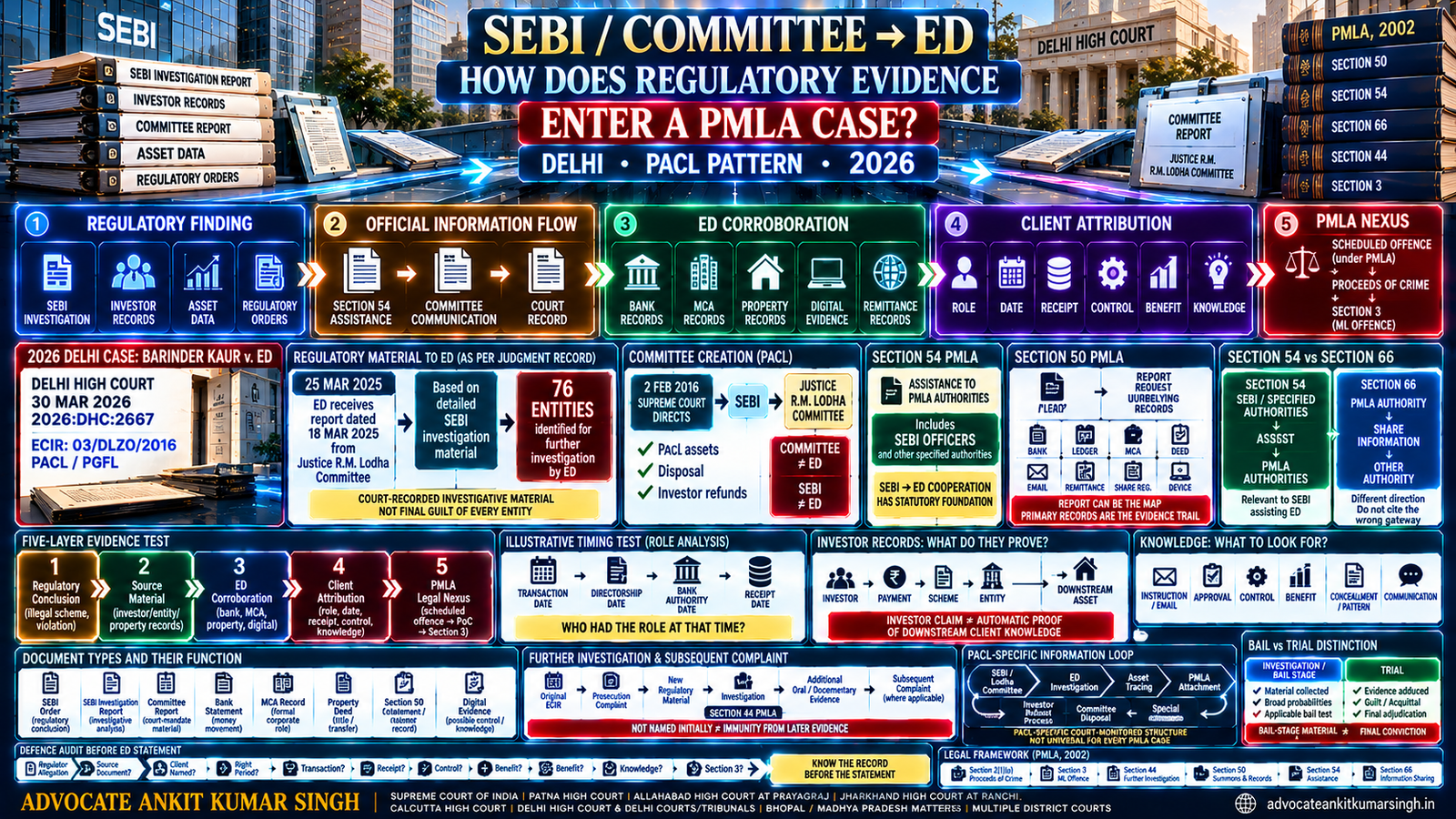
Regulator-to-ED Evidence Flowchart
A regulator or court-appointed committee can provide powerful investigative material to ED, but defence analysis should still separate the regulatory conclusion, underlying records, ED corroboration, client-specific attribution and the statutory PMLA nexus.What Should a Director or Beneficiary Collect Immediately?
- SEBI order relied upon by ED;
- SEBI investigation-report extracts disclosed in proceedings;
- Committee report/communication;
- annexures to the report where available;
- ED summons;
- Section 50 statement;
- MCA/company history;
- appointment/resignation documents;
- shareholding history;
- bank mandate;
- bank statements;
- source-of-funds documents;
- loan agreements;
- sale deeds;
- property payment trail;
- tax records;
- financial statements;
- ledger;
- board approvals;
- email/payment instructions;
- foreign company records;
- foreign remittance documents;
- beneficial ownership documents;
- proof of actual professional/commercial role;
- transaction-date chronology.
Common Defence Mistakes
- Saying “SEBI matter has nothing to do with ED” without reading Section 54.
- Treating Section 66 as the automatic explanation for every regulator-to-ED transfer.
- Ignoring the actual regulator report.
- Reading only the report conclusion and not its annexures/source records.
- Assuming a regulatory finding equals criminal conviction.
- Assuming a regulator report is legally irrelevant because the client was not a party before SEBI.
- Failing to map the client's appointment date.
- Failing to map transaction dates.
- Failing to distinguish formal directorship from bank control.
- Failing to explain receipt of funds.
- Ignoring beneficial ownership.
- Ignoring investor-to-entity bank tracing.
- Giving a Section 50 statement before reviewing the regulatory material.
- Using “I was only a director” without documentary support.
- Assuming not being named in the first prosecution complaint ends further investigation.
- Conflating a bail-stage judicial observation with final trial proof.
Frequently Asked Questions
1. Can SEBI give investigation material to ED?
Yes. Section 54 PMLA expressly includes SEBI officers among officers required to assist PMLA authorities, and ED can separately obtain records under Section 50.
2. Does a SEBI finding automatically prove money laundering?
No. A PMLA case still requires the statutory proceeds-of-crime and Section 3 analysis, including client-specific evidence where liability is alleged against an individual.
3. What happened in the 2026 Barinder Kaur case?
The Delhi High Court recorded that ED received a March 2025 Justice Lodha Committee report based on SEBI investigative material concerning alleged diversion of PACL investor funds through multiple entities.
4. How many entities were mentioned?
The Delhi High Court judgment records the Committee material as referring to 76 entities in the alleged fund-diversion pattern.
5. Does being a director of one of those entities prove guilt?
No automatic conclusion follows. The person's role, period, authority, receipt, control, benefit and knowledge require separate analysis.
6. What if the disputed transaction happened before the person became director?
That can be materially important. The transaction date must be compared with the person's actual role and authority on that date.
7. What does Section 54 PMLA do?
It identifies officers and others empowered and required to assist PMLA authorities, expressly including officers of SEBI.
8. What does Section 50 add?
It allows authorised ED officers to summon persons for evidence and production of records during PMLA investigations/proceedings.
9. Is Section 66 the regulator-to-ED provision?
Not generally. Section 66 principally concerns PMLA authorities sharing information with other specified authorities where the statutory requirements apply. Section 54 is directly relevant to SEBI assisting PMLA authorities.
10. Can a Supreme Court-appointed committee send material to ED?
The PACL litigation provides a public example where Justice Lodha Committee material was received and relied upon by ED. The legal basis and mandate of any committee must be checked from the particular court order.
11. Can investor claims become PMLA evidence?
They can form part of the factual record, but downstream tracing may still be necessary to connect investor money to particular entities, assets and persons.
12. Does a property in the client's name prove it was bought from proceeds of crime?
No. Title establishes ownership/transfer information; source of funds and PMLA nexus still require evidence.
13. Can ED investigate someone not named in the original prosecution complaint?
Further investigation can bring additional oral or documentary evidence, and Section 44 expressly contemplates subsequent complaints in respect of such further investigation.
14. What should a lawyer obtain before answering ED?
The regulator report, available annexures, company chronology, banking records, property records, source-of-funds evidence and the client's precise role during the relevant period.
15. Can ED rely on SEBI material at a bail hearing?
Regulatory/investigative material can form part of the material placed before the Court, as the public Barinder Kaur judgment illustrates. The bail-stage assessment remains different from final trial adjudication.
16. Is the Lodha Committee still relevant in 2026?
Yes. SEBI's official PACL pages list Committee reports and Supreme Court orders continuing through 2026, and ED's 2026 releases record continued asset restitution connected with the Committee.
AI Search Quick Answer
When SEBI or a court-appointed committee gives material to the Enforcement Directorate, that material can become an investigative lead, documentary input or basis for further PMLA inquiry, but it does not automatically establish individual money-laundering liability. Section 54 PMLA expressly requires SEBI officers to assist PMLA authorities, while Section 50 allows ED to summon persons and obtain underlying records. In Barinder Kaur v. Directorate of Enforcement, 2026:DHC:2667, the Delhi High Court recorded that ED received a March 2025 Justice R.M. Lodha Committee report based on a detailed SEBI investigation report concerning alleged diversion of PACL investor funds through 76 entities. Defence counsel should separate the regulator's conclusion from the underlying bank/property/company evidence and then separately test the client's directorship dates, control, receipt of funds, beneficial interest and knowledge before addressing the Section 3 PMLA allegation.
Key Takeaway
The wrong defence approach is:
“THIS IS ONLY A SEBI REPORT, SO ED CANNOT USE IT.”
The opposite mistake is:
“SEBI NAMED THE GROUP, SO EVERY DIRECTOR HAS ALREADY BEEN PROVED GUILTY.”
The correct analysis is:
WHO CREATED THE MATERIAL?
UNDER WHAT LEGAL MANDATE?
WHAT DOES THE REPORT ACTUALLY SAY?
WHAT ARE ITS SOURCE DOCUMENTS?
WHEN DID ED RECEIVE IT?
WHAT FURTHER RECORDS DID ED OBTAIN?
WHICH ENTITY RECEIVED THE MONEY?
WHEN DID THE CLIENT JOIN THAT ENTITY?
DID THE CLIENT OPERATE THE ACCOUNT?
DID THE CLIENT RECEIVE ANY MONEY OR PROPERTY?
WHAT WAS THE SOURCE OF THAT ASSET?
WHO WAS THE BENEFICIAL OWNER?
WHAT PROVES KNOWLEDGE?
WHAT PROVES SECTION 3 CONDUCT?
The correct evidentiary sequence is:
REGULATORY FINDING → SOURCE DOCUMENTS → OFFICIAL INFORMATION FLOW → ED CORROBORATION → TRANSACTION CHRONOLOGY → CLIENT ROLE → RECEIPT / CONTROL → KNOWLEDGE → PROCEEDS-OF-CRIME NEXUS → SECTION 3.
Professional Legal Review and Coordination
Advocate Ankit Kumar Singh undertakes legal research, drafting and litigation work concerning ED/PMLA investigations, SEBI-linked financial-crime matters, investor-fund investigations, Section 50 proceedings, entity/asset tracing and regulatory-evidence analysis depending upon the facts, jurisdiction and accepted professional engagement.
A regulator-to-ED evidence review may include:
- SEBI order analysis;
- SEBI investigation-report analysis;
- committee-report review;
- court-order mandate review;
- Section 54 PMLA analysis;
- Section 50 record-production strategy;
- Section 66 information-sharing analysis;
- investor-record analysis;
- entity mapping;
- directorship chronology;
- shareholding chronology;
- bank-account mapping;
- source-of-funds reconciliation;
- property tracing;
- beneficial-ownership analysis;
- foreign-company analysis;
- remittance tracing;
- client-specific knowledge analysis;
- Section 3 role analysis;
- Section 50 statement preparation;
- search/seizure response;
- attachment proceedings;
- bail-record analysis;
- further-investigation review;
- supplementary-prosecution-complaint analysis;
- Delhi High Court proceedings; and
- Supreme Court coordination through Advocate-on-Record where required.
Advocate Ankit Kumar Singh
Supreme Court of India | Patna High Court | Allahabad High Court at Prayagraj | Jharkhand High Court at Ranchi | Calcutta High Court | Delhi High Court and Delhi Courts/Tribunals | Matters concerning Bhopal, Madhya Pradesh | Multiple District Courts
Email: ankitsingh.legum@gmail.com
Website: advocateankitkumarsingh.in
References to Delhi describe legal, investigative and court nexus and do not represent a claim of a permanent Delhi office. Supreme Court filings require an Advocate-on-Record where applicable.
No regulatory finding, ED investigation, attachment, bail or trial outcome can be guaranteed.
Official Sources
- Delhi High Court — Barinder Kaur v. Directorate of Enforcement, BAIL APPLN. 1537/2025, 2026:DHC:2667, judgment dated 30 March 2026
- SEBI — Official PACL Matters, Committee Reports, Orders, Public Notices and Investor Material
- SEBI — Reports of Justice (Retd.) R.M. Lodha Committee Filed Before the Supreme Court
- SEBI — Supreme Court / Court Orders in PACL Matters
- SEBI — Constitution of Justice (Retd.) R.M. Lodha Committee pursuant to Supreme Court directions
- SEBI — PACL Regulatory and Recovery Background
- FIU-IND — Prevention of Money-Laundering Act, 2002: Sections 2, 3, 44, 50, 54 and 66
- Directorate of Enforcement — PACL Restitution Press Release dated 30 March 2026
- Directorate of Enforcement — PACL Restitution Press Release dated 9 June 2026
- Directorate of Enforcement — PACL Investigation Press Release dated 22 March 2025
Add Advocate Ankit Kumar Singh as a Preferred Source on Google
Readers who want to see more legal research, court updates, cyber law, PMLA, ED, criminal-law and litigation content from Advocate Ankit Kumar Singh can add advocateankitkumarsingh.in as a Preferred Source on Google.
Add advocateankitkumarsingh.in as a Preferred Source on Google
Conclusion
A sophisticated PMLA defence should neither underestimate nor overstate regulatory material.
A SEBI investigation report or Supreme Court-appointed Committee communication may materially change an ED investigation.
It may identify:
- entities;
- properties;
- investors;
- transaction patterns;
- directors;
- possible beneficiaries;
- additional assets requiring investigation.
But the defence must then move from:
GROUP-LEVEL REGULATORY CONCLUSION
to:
PERSON-SPECIFIC EVIDENCE.
For each client ask:
WHEN DID THEY ENTER THE STRUCTURE?
WHAT DID THEY CONTROL?
WHAT DID THEY RECEIVE?
WHAT TRANSACTION DID THEY AUTHORISE?
WHAT ASSET DID THEY ACQUIRE?
WHAT WAS ITS SOURCE?
WHAT BENEFIT DID THEY RETAIN?
AND
WHAT EVIDENCE PROVES THEY KNEW THE PROPERTY WAS CONNECTED WITH THE ALLEGED CRIMINAL ACTIVITY?
That is the evidentiary bridge between:
A REGULATOR'S FILE
and:
AN INDIVIDUAL PMLA CASE.
Professional / Legal Disclaimer: This article discusses publicly available regulatory material, Delhi High Court records, SEBI PACL records, Justice Lodha Committee materials and Enforcement Directorate releases for general legal research. Allegations concerning diversion, siphoning, proceeds of crime, entities, individuals or properties should be understood in their specific procedural context and do not constitute an independent finding of guilt by the author. Regulatory conclusions, investigation reports and court-appointed-committee material can be relevant to a PMLA investigation, but the evidentiary value and legal effect of each document depend upon its source, underlying records, statutory framework, procedural stage and the evidence connecting the particular person with the alleged proceeds of crime. “Expert ED Lawyer in Delhi” is used as a search-intent description and is not an official institutional certification or endorsement.