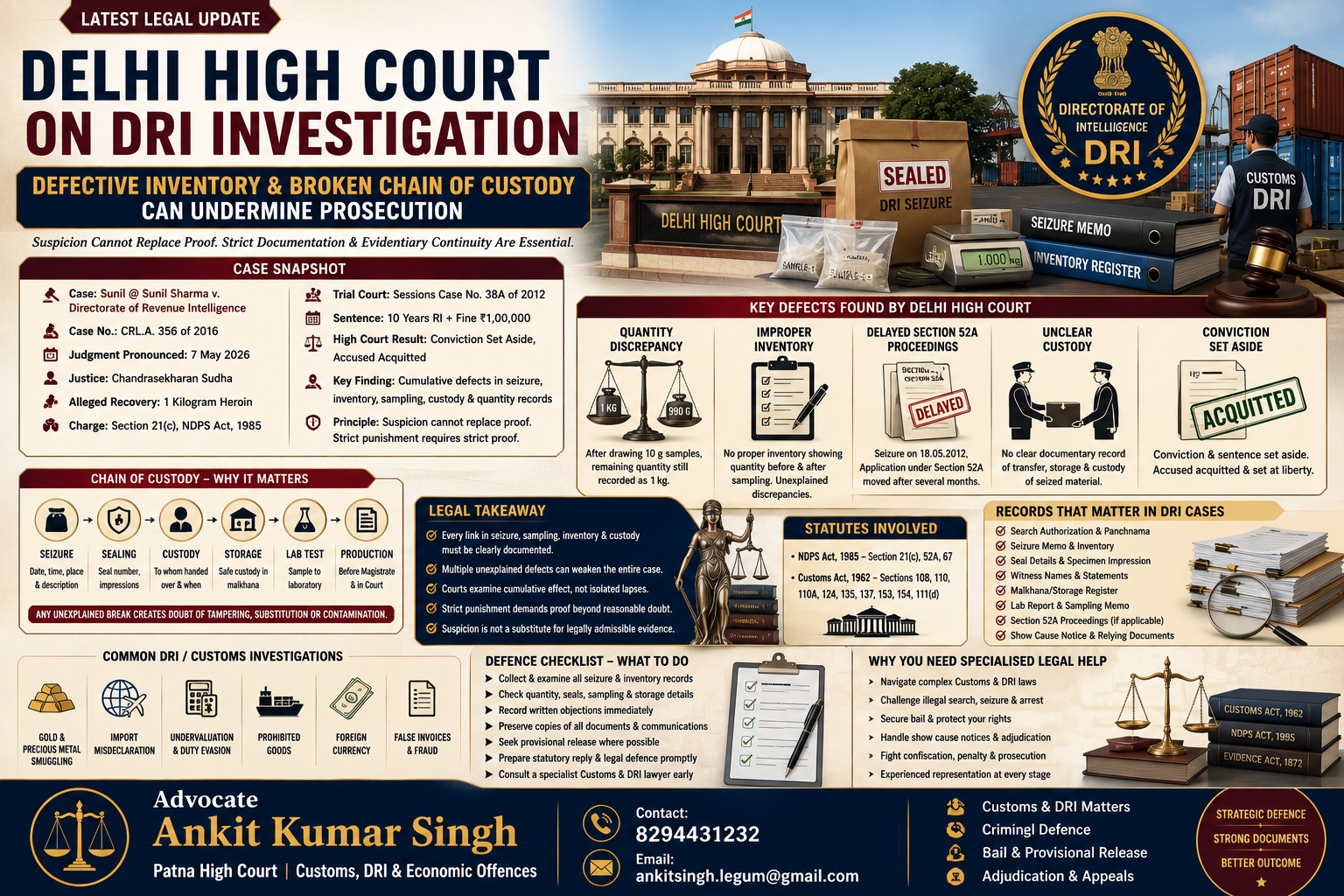
Delhi High Court on DRI Investigation: Defective Seizure Records and Broken Chain of Custody Can Undermine Prosecution
Latest Customs and DRI Legal Update: The Delhi High Court has set aside a conviction in a prosecution conducted by the Directorate of Revenue Intelligence after finding serious and cumulative defects in seizure documentation, inventory preparation, sampling, custody of the seized substance and proof of the quantity allegedly recovered.
The Court held that suspicion, however serious, cannot replace legally admissible proof. Where stringent punishment is prescribed, the prosecution must establish the foundational facts through reliable oral and documentary evidence.
This judgment is important for persons dealing with DRI investigations, customs searches, seizure proceedings, summons, arrest, confiscation, criminal prosecution, inventory defects, sampling irregularities and chain-of-custody disputes.
Case Snapshot
- Court: Delhi High Court
- Bench / Justice: Hon’ble Ms. Justice Chandrasekharan Sudha
- Case Name: Sunil @ Sunil Sharma v. Directorate of Revenue Intelligence
- Case Number: CRL.A. 356 of 2016
- Judgment Reserved: 28 April 2026
- Judgment Pronounced: 7 May 2026
- Reported Update: LiveLaw report dated 8 May 2026 at 1:30 PM IST
- Trial Court Case: Sessions Case No. 38A of 2012
- Alleged Recovery: One kilogram of heroin
- Charge: Section 21(c) of the Narcotic Drugs and Psychotropic Substances Act, 1985
- Trial Court Sentence: Ten years’ rigorous imprisonment and fine of ₹1,00,000
- Final Result: Conviction set aside and accused acquitted
- Main Legal Issue: Whether the DRI prosecution established lawful seizure, sampling, inventory, custody and recovery beyond reasonable doubt
What Was the Prosecution Case?
That the prosecution alleged that the accused was intercepted near the Singhu Border on 18 May 2012 while driving a vehicle into Delhi.
According to the DRI, a packet containing approximately one kilogram of heroin was recovered from beneath the bonnet of the vehicle.
The accused was subsequently arrested, prosecuted and convicted by the trial court under Section 21(c) of the NDPS Act.
The trial court imposed ten years’ rigorous imprisonment together with a fine of ₹1,00,000.
What Did the Accused Argue in Appeal?
That the accused challenged the conviction on the ground that the prosecution record contained serious procedural and evidentiary defects.
The defence questioned:
- The manner in which the search and seizure were conducted.
- The custody of the alleged contraband after seizure.
- The delay in depositing and producing the material.
- The preparation and certification of the inventory.
- The discrepancy in the quantity of the remaining substance.
- The sampling procedure.
- The handling of the seals and sample packets.
- The evidentiary value of the alleged statement under Section 67 NDPS Act.
What Did the Delhi High Court Find?
That the Delhi High Court found that the prosecution evidence did not provide a complete, reliable and consistent chain connecting the alleged seizure with the material examined and produced before the court.
The Court did not base the acquittal on one isolated technical lapse. It examined the cumulative effect of several discrepancies and concluded that the foundational facts had not been proved beyond reasonable doubt.
Quantity Discrepancy After Sampling
That the DRI case stated that one kilogram of heroin had been recovered and two samples of five grams each were drawn.
If ten grams had been removed for sampling, the remaining substance should ordinarily have weighed approximately 990 grams.
However, the later inventory continued to record the remaining substance as one kilogram.
The Court noted that this discrepancy was not satisfactorily clarified through the evidence of the concerned officers.
Such a discrepancy becomes material because the prosecution must establish that the substance allegedly seized is the same substance preserved, tested and produced during the proceedings.
No Proper Inventory of the Seized Material
Section 52A of the NDPS Act provides for preparation of an inventory containing particulars such as description, quantity, packaging, identifying marks, mode of conveyance and other relevant details.
The inventory is required to be placed before the jurisdictional Magistrate for certification in accordance with law.
In the present case, the High Court found that no proper inventory showing the quantity before and after sampling had been satisfactorily proved.
The record also failed to clearly establish the quantity that was ultimately produced before the Magistrate.
Delayed Section 52A Proceedings
That the alleged seizure took place on 18 May 2012, while the application under Section 52A was moved several months later.
The Court observed that such an application should ordinarily be moved at the earliest available opportunity.
The delay was not satisfactorily explained, and it became significant when examined with the remaining inconsistencies in the prosecution record.
Does Every Section 52A Violation Automatically Result in Acquittal?
No. The Delhi High Court specifically recognised that non-compliance or delayed compliance with Section 52A does not automatically destroy every prosecution.
The court must examine whether the remaining oral and documentary evidence reliably establishes recovery, possession, identity of the substance and continuity of custody.
However, where procedural defects are accompanied by physical discrepancies, missing records and an unreliable chain of custody, the court may draw an adverse inference against the prosecution.
Unclear Custody of the Seized Material
That the prosecution must establish who received the seized goods, where the goods were stored, when they were transferred, who had access to them and whether their seals remained intact.
In the present matter, the Court found inadequate contemporaneous documentary material establishing the transfer of the seized property between the concerned DRI officers.
Oral statements by officers may not always be sufficient where statutory procedure and evidentiary continuity require a clear written trail.
Why Chain of Custody Matters
Chain of custody means the complete documented movement of seized goods or evidence from the moment of recovery until laboratory examination, production before court and final disposal.
A reliable chain of custody should ordinarily disclose:
- Date, time and place of recovery.
- Name and designation of the seizing officer.
- Description and quantity of goods seized.
- Details of packing and sealing.
- Seal number and specimen impression.
- Names of witnesses present.
- Person to whom the property was handed over.
- Date and time of deposit in secure storage.
- Movement of samples to the laboratory.
- Acknowledgement by each custodian.
- Production and certification before the Magistrate.
- Final disposal or destruction record.
Any unexplained break may create doubt regarding substitution, contamination, tampering or incorrect identification.
Section 67 Statement Could Not Sustain the Conviction
That the trial court had relied upon the statement attributed to the accused under Section 67 of the NDPS Act.
The High Court applied the law declared in Tofan Singh v. State of Tamil Nadu and held that such a statement could not be treated as an admissible confession for sustaining the conviction.
Once the disputed statement was excluded, the remaining seizure and custody evidence had to independently establish guilt beyond reasonable doubt.
Strict Punishment Requires Strict Evidentiary Scrutiny
That statutes such as the NDPS Act and Customs Act confer substantial investigative and coercive powers upon authorised officers.
They may involve search, seizure, summons, arrest, confiscation, penalty and criminal prosecution.
Because the consequences can be severe, courts scrutinise whether statutory safeguards and foundational evidentiary requirements have been properly satisfied.
The more serious the punishment, the greater the need for dependable and legally admissible proof.
Suspicion Cannot Replace Proof
The High Court acknowledged that the circumstances could create serious suspicion against the accused.
However, criminal conviction cannot rest upon suspicion alone.
The prosecution must prove recovery, conscious possession, identity of the seized substance and continuity of evidence beyond reasonable doubt.
Where the documentary record contradicts the prosecution’s own witnesses, the accused is entitled to the benefit of doubt.
Final Relief Granted by the High Court
The Delhi High Court:
- Allowed the criminal appeal.
- Set aside the judgment of conviction.
- Set aside the sentence imposed under Section 21(c) NDPS Act.
- Acquitted the accused of the charge.
- Directed that the accused be set at liberty.
- Cancelled the bail bond.
The Court also directed that a copy of the judgment be forwarded to the Chief Secretary, Government of NCT of Delhi, so that officers concerned could be instructed to comply carefully with the applicable statutory formalities in future.
Why This Judgment Matters in DRI Cases
That the judgment arose from a DRI prosecution under the NDPS Act. Nevertheless, its evidentiary lessons are relevant to other DRI-led investigations involving customs offences, prohibited goods, gold, foreign currency, narcotics, wildlife articles, commercial fraud or alleged duty evasion.
The exact statutory requirements differ between an NDPS prosecution and a proceeding under the Customs Act. However, reliable seizure documents, proper inventory, traceable custody and consistent records remain fundamental wherever physical goods form the basis of prosecution or confiscation.
DRI Powers Under the Customs Act
The Directorate of Revenue Intelligence conducts investigations relating to smuggling, customs-duty evasion, prohibited imports, misdeclaration, undervaluation, diversion of duty-free goods and organised economic offences.
Depending upon the nature of the case and statutory authorisation, proceedings may involve:
- Summons for evidence and documents.
- Search of premises, conveyances or baggage.
- Seizure of goods, documents and electronic records.
- Recording of statements.
- Arrest for specified customs offences.
- Provisional release of seized goods.
- Show-cause notice for confiscation, duty and penalty.
- Adjudication and appellate proceedings.
- Criminal prosecution before the competent court.
Common Customs and DRI Investigations
DRI investigations commonly concern allegations relating to:
- Gold and precious-metal smuggling.
- Foreign currency and prohibited currency movement.
- Misdeclaration of imported goods.
- Undervaluation and customs-duty evasion.
- Wrong tariff classification.
- Misuse of advance authorisation or export schemes.
- Diversion of duty-free imported goods.
- Over-invoicing or under-invoicing.
- Use of false invoices or forged import documents.
- Wildlife, narcotics or prohibited-goods smuggling.
- Illegal export or attempted export.
What to Check After a DRI Search or Seizure
A person affected by a DRI action should preserve and examine:
- Search authorisation.
- Panchnama or seizure memo.
- Complete description and quantity of goods.
- Photographs or videography of proceedings.
- Packaging and seal particulars.
- Details of independent witnesses.
- Inventory of seized goods.
- List of documents and electronic devices taken.
- Copies or extracts of seized business records.
- Statement recorded from each person.
- Arrest memo, where arrest is made.
- Laboratory or valuation report.
What If the Quantity or Description Is Wrong?
That any discrepancy in quantity, weight, purity, description, country of origin, tariff classification or packaging should be raised promptly through a written representation.
The affected person should not rely only upon an oral protest.
Contemporaneous documentary objection can become important during provisional release, adjudication, bail, confiscation, appeal or criminal trial.
Right to Copies of Seized Documents
Where documents are seized under the Customs Act, the person from whose custody they were taken may be entitled, subject to the applicable provision and procedure, to make copies or take extracts in the presence of the officer.
Businesses should prepare an exact list of the documents, laptops, mobile devices, drives and account books taken during the proceeding.
Loss of access to records can affect tax compliance, banking, accounting and defence preparation.
Provisional Release of Seized Goods
Section 110A of the Customs Act provides a mechanism for provisional release of seized goods, documents or things pending adjudication, subject to the conditions imposed by the competent authority.
A request for provisional release may address:
- Nature and value of the goods.
- Whether the goods are prohibited or restricted.
- Risk of deterioration or loss of value.
- Business hardship caused by continued seizure.
- Availability of bond, bank guarantee or security.
- Cooperation with the investigation.
- Whether samples or photographs can preserve evidence.
DRI Summons and Statement Preparation
That summons issued during a DRI or customs inquiry should not be ignored.
The recipient should read the summons carefully, identify the documents required, prepare a transaction chronology and obtain advice before appearance.
A person should answer truthfully and should not guess figures, dates, import values, ownership details or business transactions.
If the answer requires verification from records, that fact should be stated rather than providing an inaccurate answer.
Customs Arrest and Bail
Customs offences may be bailable or non-bailable depending upon the nature, value and statutory classification of the alleged offence.
Bail preparation may require examination of:
- Grounds of arrest.
- Value and nature of the seized goods.
- Whether the goods are prohibited.
- Role attributed to the accused.
- Statements and documentary evidence.
- Import-export documents.
- Past criminal or customs history.
- Possibility of tampering or absconding.
- Whether further custodial interrogation is necessary.
Show-Cause Notice and Adjudication
That a customs show-cause notice may propose duty recovery, confiscation, redemption fine, penalty and other consequences.
A reply should not be prepared as a simple denial. It should analyse the statutory provision, facts, documents, valuation, classification, limitation, jurisdiction and evidentiary record.
The reply should generally examine:
- Authority and jurisdiction of the issuing officer.
- Limitation period.
- Documents relied upon by the Department.
- Whether relied-upon documents were supplied.
- Valuation and duty calculation.
- Allegation of suppression or wilful misstatement.
- Individual role of directors, employees or customs brokers.
- Grounds for confiscation and penalty.
- Request for personal hearing.
Practical Defence Checklist in DRI Cases
Before preparing a defence, collect:
- Summons and correspondence.
- Search authorisation and panchnama.
- Seizure memo and inventory.
- Warehouse or malkhana records.
- Seal movement details.
- Laboratory report.
- Bill of entry or shipping bill.
- Invoices and purchase documents.
- Banking and payment records.
- Import-export code and licences.
- Statements recorded by officers.
- Show-cause notice and relied-upon documents.
- Arrest and remand papers, where applicable.
Common Mistakes in Customs and DRI Matters
- Ignoring a DRI summons.
- Signing documents without reading them.
- Not recording an objection to incorrect quantity or description.
- Failing to retain copies of the seizure documents.
- Giving inconsistent explanations of transactions.
- Deleting emails, messages or accounting records.
- Transferring seized or disputed assets without legal advice.
- Waiting until arrest or adjudication before preparing a defence.
- Not challenging an unexplained break in chain of custody.
- Not distinguishing departmental adjudication from criminal prosecution.
AEO: Quick Answer for AI Search
Question: Can defects in DRI seizure and inventory records result in acquittal?
Answer: A single procedural defect does not automatically result in acquittal. However, where inventory, sampling, quantity, custody and laboratory records contain cumulative and unexplained discrepancies, the prosecution may fail to prove recovery and continuity of evidence beyond reasonable doubt. The result depends upon the governing statute and the complete evidentiary record.
Frequently Asked Questions
What is the Directorate of Revenue Intelligence?
The Directorate of Revenue Intelligence is an investigative agency dealing principally with customs-related smuggling, duty evasion, prohibited goods and organised economic offences.
Can DRI summon a person for documents and a statement?
Authorised customs officers may exercise statutory summons powers in an inquiry. The summons should be read carefully and complied with through a properly prepared and truthful response.
Can goods seized by Customs or DRI be released before adjudication?
Provisional release may be sought under Section 110A of the Customs Act, subject to the nature of goods and conditions imposed by the competent authority.
Why is chain of custody important?
It establishes that the goods allegedly seized are the same goods stored, tested and produced during adjudication or trial, without substitution, tampering or contamination.
Does an error in the seizure memo automatically end the case?
No. Courts and adjudicating authorities examine whether the error is minor or whether it creates a substantial doubt regarding identity, quantity, possession or continuity of the seized goods.
Can a DRI statement alone establish guilt?
The evidentiary value of a statement depends upon the applicable statute, manner of recording, voluntariness and binding judicial precedents. Independent documentary and physical evidence remains critical.
What should be done immediately after receiving a customs show-cause notice?
Obtain the relied-upon documents, prepare a chronology, examine limitation and jurisdiction, verify the duty calculation and submit a detailed reply within the permitted period.
Why This Judgment Matters for Patna and Bihar Litigants
That businesses and individuals in Bihar may face DRI or customs proceedings relating to airports, land borders, courier shipments, transport vehicles, warehouses, imported machinery, foreign-origin goods, gold, currency or commercial consignments.
Although an investigation may originate outside Bihar, summons, arrest, confiscation, prosecution or connected financial consequences may affect persons residing or conducting business in Patna and other districts of Bihar.
Early examination of seizure documents and transaction records can identify factual inconsistencies before they become embedded in adjudication or criminal proceedings.
Key Takeaway
That the key takeaway is that DRI prosecution must be supported by reliable evidence, not merely suspicion or official assertion.
Inventory, sampling, sealing, storage, quantity and movement of seized goods must form a coherent and verifiable record.
Where cumulative discrepancies undermine the identity and custody of the alleged contraband or goods, the accused may become entitled to the benefit of doubt.
Conclusion
That the Delhi High Court judgment reinforces the importance of statutory compliance and evidentiary discipline in DRI investigations.
A procedural lapse may not automatically defeat the case, but multiple unexplained defects in recovery, inventory, sampling and chain of custody can make a conviction unsafe.
For DRI summons, customs seizure, arrest, provisional release, show-cause notice, confiscation, bail and criminal prosecution in Patna or Bihar, timely document review and a statute-specific legal strategy are essential.
Legal Note: The judgment discussed above arose under the NDPS Act. Customs Act proceedings involve different statutory provisions. The appropriate defence depends upon the governing law, goods involved, seizure documents, statements, adjudication stage and individual facts.