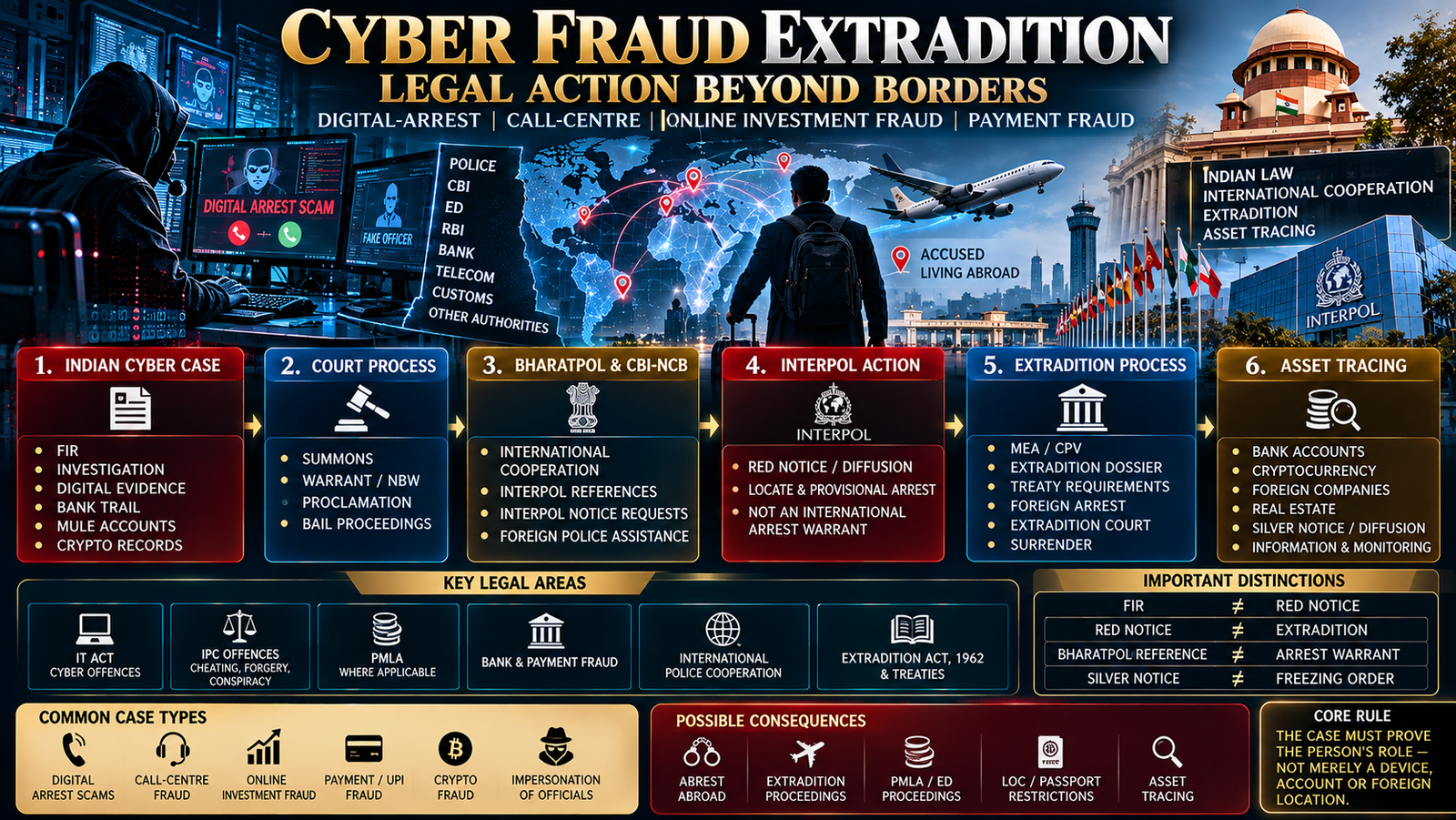
Expert Extradition Lawyer in India for Digital-Arrest, Call-Centre and International Cyber-Fraud Accused Living Abroad
SUMMARY: Create a national cyber-extradition article using the new international-police-cooperation infrastructure as context. Focus on accused persons abroad in alleged digital-arrest, impersonation, call-centre, online investment or payment fraud cases and examine domestic warrants, digital evidence, bank beneficiaries, BHARATPOL/INTERPOL requests, extradition thresholds and potential asset tracing. Target 'expert extradition lawyer India cyber fraud', 'best cyber extradition lawyer India', 'INTERPOL lawyer India online fraud' and 'specialized cross-border crime advocate India'.
Legal and procedural update: Reviewed on 24 September 2026. India’s current cyber-fraud enforcement environment increasingly combines State/UT Police, I4C, CBI, financial institutions and international police-cooperation channels. BHARATPOL facilitates international cooperation through CBI as NCB-India, while formal extradition remains a separate MEA / treaty process.
 Advocate Ankit Kumar Singh
Direct Answer: Can an Indian Cyber-Fraud Case Lead to INTERPOL Action and Extradition From Abroad?
Potentially yes, but only through distinct legal stages.
A person living abroad who is accused in an Indian digital-arrest, impersonation, call-centre, online-investment or payment-fraud case may face a sequence such as:
INDIAN CYBER FIR
↓
INVESTIGATION
↓
DIGITAL + FINANCIAL EVIDENCE
↓
COURT SUMMONS / WARRANT / NBW
↓
BHARATPOL / INTERNATIONAL POLICE COOPERATION
↓
INTERPOL REFERENCE / NOTICE / DIFFUSION WHERE APPLICABLE
↓
FOREIGN LOCATION
↓
PROVISIONAL ARREST WHERE LEGALLY PERMITTED
↓
FORMAL MEA EXTRADITION REQUEST
↓
FOREIGN EXTRADITION COURT / AUTHORITY
The existence of an Indian FIR alone does not automatically produce extradition.
The prosecution must still establish the procedural and evidentiary basis required by:
- Indian law;
- the Extradition Act, 1962;
- the applicable extradition treaty or arrangement;
- the law of the foreign country; and
- the particular international police-cooperation mechanism being used.
“Digital Arrest” Has No Legal Existence in Indian Law
Official CBI material issued in 2026 expressly states that there is no legal concept of a “Digital Arrest” in Indian law.
The expression describes a cyber-fraud modus operandi in which fraudsters impersonate:
- Police officers;
- CBI officers;
- ED officers;
- Narcotics officials;
- RBI or banking authorities;
- telecom authorities;
- Customs officials; or
- other Government or regulatory authorities.
The victim may be falsely told that:
- a parcel contains contraband;
- a bank account is linked with terrorism or money laundering;
- a mobile number is involved in crime;
- an arrest warrant exists;
- property will be seized;
- the victim must remain continuously visible on video; or
- money must be transferred to a so-called “safe”, “verification” or “government” account.
The legal case against an accused person must therefore focus on the actual alleged conduct—impersonation, deception, conspiracy, use of digital infrastructure, financial transfers and criminal intent—rather than treating “digital arrest” as a standalone statutory offence.
The Cyber-Fraud Case May Begin With State Police — But Become National and International
Cybercrime investigation is frequently initiated by a State or Union Territory Police agency.
But a large transnational case can expand into a multi-agency structure involving:
- State Cyber Crime Police;
- Indian Cyber Crime Coordination Centre (I4C);
- CBI;
- banks and payment intermediaries;
- telecom service providers;
- foreign law-enforcement agencies;
- CBI / NCB-India;
- INTERPOL;
- MEA / CPV;
- ED where a qualifying PMLA basis independently arises; and
- foreign extradition counsel.
The lawyer should therefore identify exactly:
WHO IS INVESTIGATING?
WHICH COURT HAS ISSUED THE WARRANT?
WHAT INTERNATIONAL STEP HAS ACTUALLY BEEN TAKEN?
BHARATPOL: Why the New International Cooperation Infrastructure Matters
BHARATPOL was launched in January 2025 to connect Indian law-enforcement authorities with CBI in its capacity as India's National Central Bureau for INTERPOL.
The portal contains modules including:
- Connect;
- Broadcast;
- INTERPOL References;
- INTERPOL Notices; and
- Resources.
For a cyber-fraud case, this can facilitate international assistance where investigators need:
- foreign location information;
- identity information;
- foreign police cooperation;
- records;
- information concerning digital infrastructure;
- international criminal intelligence;
- INTERPOL Notice processing; or
- other permissible investigative assistance abroad.
But:
BHARATPOL REFERENCE
≠
RED NOTICE

BHARATPOL NOTICE REQUEST
≠
FORMAL EXTRADITION

BHARATPOL
≠
COURT
CBI Can Appear in Two Different Roles
CBI involvement must be carefully classified.
Role 1 — CBI as Investigating Agency
CBI may itself register or re-register a cybercrime case and investigate it.
In July 2026, for example, CBI publicly announced an arrest in a “digital arrest” cyber-fraud case that had been transferred from State Cyber Crime Police and re-registered by CBI.
Role 2 — CBI as NCB-India
CBI also performs India's National Central Bureau function for INTERPOL cooperation.
Therefore, CBI may be relevant to an international request even where the underlying FIR remains with a State Police agency.
The lawyer should ask:
IS CBI THE INVESTIGATOR?
IS CBI ONLY THE NCB-INDIA INTERNATIONAL ROUTE?
OR ARE BOTH ROLES PRESENT?
Digital Evidence: The Extradition Case Is Only as Strong as the Attribution
Cyber-fraud cases are heavily dependent upon electronic evidence.
The prosecution may rely upon:
- mobile-phone extraction;
- laptop / computer extraction;
- WhatsApp or messaging records;
- Telegram records;
- email records;
- IP logs;
- login records;
- cloud data;
- VoIP records;
- call detail records;
- IMEI data;
- SIM registration;
- KYC records;
- bank transaction logs;
- payment-gateway data;
- cryptocurrency records;
- remote-access software;
- screen recordings;
- forged digital notices;
- domain registration;
- server data;
- social-media accounts; and
- device-location information.
But identifying a device, IP address, account or bank beneficiary is not always the same as proving who committed the fraud.
The defence should analyse:
- ownership;
- possession;
- control;
- authentication;
- time-zone issues;
- shared access;
- remote access;
- compromise;
- device cloning;
- spoofing;
- account takeover;
- chain of custody; and
- the precise link between the accused and the alleged fraudulent representation.
Digital Evidence in the Extradition Dossier
MEA's official extradition guidelines specifically recognise that electronic material may form part of an extradition dossier.
Where CDs or electronic records such as telephone conversations or media files are enclosed, MEA guidance requires appropriate certified transcripts from the competent authority.
The extradition lawyer should therefore inspect:
- what electronic record is relied upon;
- whether it is actually attributed to the person sought;
- whether a transcript exists;
- whether the transcript accurately reflects the original;
- whether translations are accurate;
- whether metadata is disclosed;
- whether the requested country requires further authentication;
- whether the evidence satisfies the treaty threshold; and
- whether the dossier overstates investigative inference as established fact.
The Bank Beneficiary Is Not Automatically the Call-Centre Mastermind
One of the central issues in cyber-fraud extradition cases is the money trail.
Investigators increasingly examine:
- beneficiary accounts;
- mule accounts;
- Layer-1 accounts;
- Layer-2 accounts;
- subsequent layering;
- cash withdrawal;
- crypto conversion;
- commission payments;
- account opening KYC;
- banker involvement;
- payment-gateway accounts; and
- foreign remittances.
CBI has publicly described cyber-fraud investigations where money received in a mule account was transferred through more than one hundred first-layer mule accounts and subsequently through thousands of accounts.
This demonstrates why account receipt alone may not answer:
- who conceived the fraud;
- who impersonated the officer;
- who operated the call centre;
- who controlled the bank account;
- who knew the source of funds;
- who received commission;
- who withdrew cash;
- who converted funds into cryptocurrency; and
- who ultimately benefited.
Role attribution remains essential.
Mule Account Holder vs Conspirator vs Ultimate Beneficiary
Cyber-financial investigations often involve many participants occupying different alleged roles.
| Possible Role | Key Legal Question |
|---|---|
| Mule account holder | Did the person knowingly permit criminal use of the account? |
| Account procurer | Did the person arrange accounts knowing their intended use? |
| Bank intermediary | Was KYC deliberately circumvented? |
| Caller / impersonator | Did the person make the fraudulent representation? |
| Call-centre operator | Did the person control the fraud operation? |
| Technical operator | Did the person provide spoofing, VoIP or platform infrastructure? |
| Payment handler | Did the person transfer, layer or convert proceeds? |
| Ultimate beneficiary | Who actually received the economic benefit? |
An extradition dossier should connect the person sought to the alleged criminal conduct rather than rely only upon association with a particular account or telephone number.
Call-Centre Cases: Physical Presence Is Not the Whole Case
International call-centre investigations can involve:
- premises;
- scripts;
- CRM software;
- VoIP systems;
- spoofed numbers;
- VPN services;
- SIM farms;
- remote desktops;
- payment handlers;
- call supervisors;
- recruiters;
- technical administrators;
- translators;
- money mules; and
- foreign operators.
The defence should identify the person's precise alleged function.
Questions include:
- Was the person an owner?
- Was the person a salaried employee?
- Was the person a technical contractor?
- Was the person merely present?
- Did the person know the calls were fraudulent?
- Did the person participate in victim contact?
- Did the person control accounts?
- Did the person receive proceeds?
Presence at a location can be relevant evidence, but it is not a substitute for proving the required mental and factual elements of the alleged offence.
Cyber-Scam Compounds Abroad: Was the Person an Accused or a Trafficked Victim?
Cross-border cybercrime cases increasingly require another factual distinction.
CBI has publicly described investigations involving Indian nationals trafficked to scam compounds in Southeast Asia and forced to participate in cyber-enabled fraud under conditions described as “cyber slavery”.
Therefore, where the person sought was present in a foreign scam compound, counsel should investigate:
- how the person travelled abroad;
- who recruited the person;
- employment advertisements;
- passport confiscation;
- freedom of movement;
- threats;
- physical confinement;
- salary arrangements;
- communications seeking rescue;
- embassy contact;
- trafficking indicators;
- ability to leave; and
- whether participation was voluntary or coerced.
A foreign location associated with cyber fraud should not automatically erase evidence that the same person may have been trafficked or compelled.
Online Investment Fraud: Follow Both the Communication Trail and the Money Trail
Online-investment fraud allegations can involve:
- fake trading websites;
- fraudulent apps;
- WhatsApp investment groups;
- impersonated financial advisers;
- fake dashboards showing fabricated profits;
- cryptocurrency transfers;
- payment-gateway accounts;
- foreign entities;
- shell companies;
- mule accounts; and
- withdrawal demands disguised as taxes or fees.
For extradition purposes, counsel should separate:
WHO SPOKE TO THE VICTIM?
WHO CONTROLLED THE PLATFORM?
WHO RECEIVED THE MONEY?
WHO CONTROLLED THE BENEFICIARY?
WHO ULTIMATELY BENEFITED?
These may be different individuals.
Payment Fraud and UPI Cases: Layering Can Produce False Simplicity
A cyber complaint may initially identify only the first receiving account.
But modern financial-fraud investigation can reveal:
VICTIM ACCOUNT
↓
LAYER-1 MULE
↓
LAYER-2 ACCOUNTS
↓
MULTIPLE AGGREGATORS
↓
CASH / CRYPTO / FOREIGN TRANSFER
↓
ULTIMATE BENEFICIARY
The extradition case should not treat every account in that chain as performing the same criminal role.
Counsel should review:
- transaction timestamps;
- account-control evidence;
- device logins;
- OTP destination;
- IP address;
- bank KYC;
- withdrawal location;
- crypto wallet;
- exchange records;
- commission structure;
- communications; and
- knowledge of source of funds.
When Does an Indian Cyber FIR Become an Extradition Case?
An FIR is only the beginning.
Formal extradition generally requires development of a legally supportable case against the particular person sought.
The progression may include:
- identification of accused;
- collection of evidence;
- summons or notices;
- court warrant;
- NBW where applicable;
- confirmation that the person is abroad;
- applicable treaty / arrangement analysis;
- preparation of extradition dossier;
- MEA / CPV processing;
- foreign transmission;
- foreign arrest or provisional arrest; and
- foreign extradition adjudication.
A lawyer should therefore determine whether the matter is presently only:
AN INDIAN CYBER INVESTIGATION
or has actually progressed into:
AN INTERNATIONAL WANTED-PERSON / EXTRADITION CASE.
Extradition Threshold: The Cybercrime Label Alone Is Not Enough
Whether extradition is available depends on the applicable legal framework.
MEA guidance states that:
- for a treaty State, the extradition offence is determined by the applicable treaty or arrangement; and
- for a non-treaty State, the Extradition Act contains its own statutory punishment threshold and dual-law requirement.
The relevant inquiry therefore includes:
- What exact offences are alleged in India?
- What punishment do they carry?
- What treaty applies?
- Does the conduct amount to an offence in the Requested State?
- What evidentiary threshold does the treaty require?
- Is a prima facie case required?
- Is the offence time-barred?
- Does a treaty refusal ground apply?
- Is the person correctly identified?
The foreign court generally examines the underlying conduct rather than merely whether Indian and foreign offences carry identical section numbers or identical labels.
Dual Criminality in Digital Fraud Cases
Cybercrime statutes differ between countries.
India may frame allegations through combinations of:
- cheating;
- cheating by personation;
- criminal conspiracy;
- forgery;
- use of forged records;
- identity theft;
- cheating by personation using computer resources;
- money-laundering where independently applicable; and
- other facts-specific offences.
The Requested State may use entirely different offence names.
The extradition analysis should therefore compare the underlying alleged conduct:
- deception;
- dishonest inducement;
- impersonation;
- unauthorised access;
- identity misuse;
- fraudulent transfer;
- conspiracy;
- handling criminal proceeds; and
- participation in organised fraud.
The issue is usually functional equivalence of criminal conduct under the treaty framework—not identical statutory wording.
NBW: The Domestic Judicial Foundation
A Red Notice or formal extradition strategy may depend upon a valid domestic judicial foundation.
The defence should obtain the actual warrant and examine:
- court name;
- case number;
- date;
- offences;
- summons history;
- service history;
- reasons for non-appearance;
- whether the person was already abroad;
- whether foreign address was known;
- any appearance through counsel;
- any cooperation offered;
- proclamation status; and
- applications for recall or bail.
The label “absconder” should not substitute for examination of the actual procedural history.
INTERPOL Red Notice or Diffusion Risk
Where the accused is abroad and a valid warrant exists, investigators may seek international wanted-person cooperation.
INTERPOL defines a Red Notice as a request to locate and provisionally arrest a person pending extradition, surrender or similar legal action.
It is not an international arrest warrant.
A Diffusion can also be used for international police cooperation.
Risk indicators may include:
- NBW;
- proclamation;
- repeated non-appearance;
- confirmed foreign location;
- request for passport details;
- BHARATPOL Notices processing;
- foreign police communication;
- extradition-dossier preparation;
- provisional-arrest preparation; or
- investigator affidavits alleging evasion.
These indicators do not themselves prove that a Red Notice has been published.
BHARATPOL INTERPOL Reference vs Red Notice
A State or central investigating agency may seek assistance abroad before a Red Notice is requested.
Through the BHARATPOL INTERPOL References module, investigators can seek rapid international assistance through INTERPOL channels.
This may concern:
- identity;
- location;
- criminal intelligence;
- foreign police information;
- investigative records; and
- other permitted assistance.
Therefore:
INTERNATIONAL REFERENCE
≠
RED NOTICE

RED NOTICE
≠
EXTRADITION ORDER
A cyber-extradition lawyer should identify the exact international stage rather than simply telling the family that “INTERPOL is involved”.
Formal Extradition: MEA / CPV Remains a Separate Track
The Ministry of External Affairs is India's Central Authority for extradition.
CPV Division is the nodal division.
The concerned law-enforcement agency generally prepares the extradition dossier.
MEA's official guidance requires a detailed, properly structured request that may include:
- self-contained affidavit by the competent investigating officer;
- facts and procedural history;
- identity particulars;
- criminal provisions;
- punishment provisions;
- open-dated arrest warrant;
- evidence linking the person sought with the warrant;
- FIR;
- charge-sheet;
- supporting evidence;
- limitation confirmation;
- speciality assurance;
- death-penalty assurance where required;
- translations; and
- other treaty-specific documents.
Provisional Arrest Before the Full Extradition Dossier
In urgent circumstances, provisional arrest can become relevant before transmission of the complete formal extradition request, where permitted by the applicable treaty and legal framework.
MEA guidance identifies matters ordinarily required for such a request, including:
- brief facts;
- urgency;
- offence provisions;
- penalties;
- authenticated arrest warrant or relevant conviction material;
- identity;
- location; and
- confirmation that formal extradition will follow within the applicable period.
Therefore, a person abroad should not assume that the absence of a completed dossier means there is no immediate arrest exposure.
Foreign Counsel Is Essential Once Arrest Risk Becomes Real
Indian counsel should handle the Indian record.
But foreign-qualified counsel must address the law of the country where the accused resides.
Foreign counsel may need to handle:
- Red Notice consequences;
- police interview;
- provisional arrest;
- extradition arrest;
- bail;
- passport surrender;
- immigration status;
- extradition hearing;
- dual criminality;
- human-rights objections;
- appeals;
- judicial review;
- voluntary return; or
- consensual surrender.
Potential Asset Tracing: When the Cyber Case Expands Beyond the Accused
A large cyber-fraud investigation may also pursue the alleged proceeds.
Investigators may seek information concerning:
- foreign bank accounts;
- cryptocurrency;
- foreign companies;
- payment processors;
- real estate;
- investment portfolios;
- beneficial ownership;
- high-value movable property; and
- other assets allegedly linked to criminal proceeds.
Where the requirements of INTERPOL's current Silver Notice / Silver Diffusion pilot are independently satisfied, an international asset-tracing request may become relevant.
But:
SILVER NOTICE
≠
FREEZING ORDER

SILVER NOTICE
≠
CONFISCATION ORDER
The Silver mechanism is presently designed for non-coercive asset identification, information and monitoring.
Cyber Fraud + PMLA: Do Not Assume Automatic Money-Laundering Jurisdiction
The fact that a case concerns large cyber-fraud proceeds does not automatically mean every accused is liable under PMLA.
PMLA requires its own statutory foundation, including the relevant scheduled-offence and proceeds-of-crime framework.
Where those requirements are independently satisfied, the matter may additionally involve:
- ED investigation;
- ECIR;
- Section 50 proceedings;
- freezing;
- provisional attachment;
- Adjudicating Authority proceedings;
- prosecution complaint;
- Special Court proceedings;
- foreign-asset tracing; and
- confiscation issues.
The cyber FIR and the PMLA proceeding must nevertheless be analysed separately.
LOC, Passport and Extradition Are Also Different
A person abroad may have several separate travel-related problems.
| Mechanism | Function |
|---|---|
| NBW | Indian judicial arrest process |
| LOC | Indian immigration alert / travel restraint |
| Passport Action | Separate statutory passport consequence |
| Red Notice / Diffusion | International wanted-person police cooperation |
| Extradition | Formal State-to-State surrender process |
Success in one proceeding does not automatically terminate the others.
Should the Accused Abroad Offer Cooperation?
Cooperation strategy is fact-specific.
Depending upon the case, counsel may consider lawful options such as:
- formal response to notices;
- disclosure of foreign address;
- production of documents;
- video-conference participation where legally accepted;
- representation concerning inability to travel;
- request for reasonable appearance date;
- application before the competent Indian court;
- warrant recall;
- bail strategy;
- planned voluntary return; or
- foreign-counsel coordinated surrender.
Cooperation may become relevant to flight-risk and evasion allegations.
But no lawyer should promise that cooperation automatically results in withdrawal of:
- NBW;
- LOC;
- Red Notice;
- extradition request; or
- criminal prosecution.
Build a Cyber-Extradition Evidence Matrix
CYBER-EXTRADITION CASE MATRIX

CLIENT:
____________________________________

CURRENT COUNTRY:
____________________________________

INDIAN FIR / RC:
____________________________________

POLICE STATION / CBI UNIT:
____________________________________

ALLEGED FRAUD TYPE:
DIGITAL ARREST / IMPERSONATION / CALL CENTRE /
INVESTMENT FRAUD / PAYMENT FRAUD / OTHER

ALLEGED ROLE:
____________________________________

VICTIM COMMUNICATION LINK:
____________________________________

MOBILE / DEVICE LINK:
____________________________________

IP / SERVER LINK:
____________________________________

SIM LINK:
____________________________________

BANK ACCOUNT LINK:
____________________________________

MULE ACCOUNT ALLEGATION:
____________________________________

ULTIMATE BENEFICIARY ALLEGATION:
____________________________________

CRYPTO LINK:
____________________________________

CHARGE-SHEET:
YES / NO / UNKNOWN

COURT SUMMONS:
____________________________________

BW / NBW:
____________________________________

PROCLAMATION:
____________________________________

LOC:
____________________________________

PASSPORT ACTION:
____________________________________

BHARATPOL REFERENCE:
KNOWN / SUSPECTED / UNKNOWN

RED NOTICE:
YES / NO / UNKNOWN

RED DIFFUSION:
YES / NO / UNKNOWN

PROVISIONAL ARREST REQUEST:
YES / NO / UNKNOWN

FORMAL EXTRADITION DOSSIER:
PREPARING / SENT / UNKNOWN

MEA / CPV STATUS:
____________________________________

FOREIGN ARREST:
____________________________________

FOREIGN COUNSEL:
____________________________________

ED / PMLA CASE:
____________________________________

SILVER NOTICE / ASSET TRACING:
____________________________________

NEXT DEADLINE:
____________________________________
Cyber-Fraud Extradition Flowchart
Core rule: Cyber-extradition cases require proof connecting the person sought to the alleged fraud. Digital identifiers, beneficiary accounts, international police requests, warrants, extradition and asset tracing each perform different evidentiary or legal functions.Documents Required for a Cyber-Extradition Review
- FIR;
- complaint;
- NCRP complaint where available;
- charge-sheet;
- CBI RC where applicable;
- court summons;
- BW / NBW;
- proclamation orders;
- bail orders;
- quashing proceedings;
- mobile forensic report;
- computer forensic report;
- CDR;
- IP logs;
- IMEI records;
- SIM KYC;
- bank statements;
- beneficiary-account records;
- mule-account analysis;
- payment-gateway records;
- cryptocurrency records;
- email / messaging records;
- call recordings;
- transcripts;
- domain / hosting records;
- BHARATPOL-related material lawfully disclosed;
- Red Notice / Diffusion information;
- CCF correspondence;
- extradition dossier;
- MEA / CPV correspondence lawfully available;
- foreign arrest papers;
- foreign bail orders;
- applicable extradition treaty;
- passport / immigration records;
- ED / PMLA records where applicable;
- foreign asset records; and
- one consolidated digital + financial chronology.
Common Mistakes in International Cyber-Fraud Extradition Cases
- Treating “digital arrest” as a statutory offence.
- Assuming account receipt proves authorship of the fraud.
- Assuming SIM registration proves who made the call.
- Assuming an IP address conclusively identifies the user.
- Ignoring device-sharing or remote-access evidence.
- Ignoring chain of custody.
- Failing to compare timestamps across time zones.
- Failing to distinguish caller, account holder and ultimate beneficiary.
- Assuming every call-centre worker had the same role.
- Ignoring trafficking or coercion evidence in foreign scam compounds.
- Calling a BHARATPOL Reference a Red Notice.
- Calling a Red Notice an international arrest warrant.
- Assuming Red Notice publication proves formal extradition has begun.
- Failing to read the actual treaty.
- Ignoring the Indian NBW.
- Ignoring foreign bail deadlines.
- Assuming PMLA automatically applies to every cyber-fraud case.
- Failing to map potential foreign assets separately.
- Allowing Indian and foreign lawyers to use inconsistent factual narratives.
Searching for an “Expert Extradition Lawyer India Cyber Fraud”: What Should Be Evaluated?
The expressions “expert extradition lawyer India cyber fraud”, “best cyber extradition lawyer India”, “INTERPOL lawyer India online fraud” and “specialized cross-border crime advocate India” are search-intent phrases and not official professional rankings.
For a cyber-extradition case, a client may instead evaluate whether counsel can:
- reconstruct the Indian FIR and warrant record;
- understand digital-forensic evidence;
- analyse beneficiary and mule accounts;
- separate role attribution from mere association;
- analyse call-centre hierarchy;
- identify cyber-slavery / trafficking issues where relevant;
- understand BHARATPOL architecture;
- distinguish INTERPOL References, Notices and Diffusions;
- analyse Red Notice exposure;
- read the extradition treaty;
- analyse dual criminality;
- review the MEA extradition dossier;
- coordinate foreign counsel;
- analyse PMLA exposure where independently applicable;
- identify potential international asset-tracing measures; and
- maintain one consistent cross-border factual chronology.
Frequently Asked Questions
1. Is “digital arrest” legally recognised in India?
No. CBI has expressly stated that there is no legal concept of a “digital arrest” in Indian law. It is a term used for a fraud modus operandi.
2. Can an accused living abroad be extradited for cyber fraud?
Potentially yes, where the applicable extradition requirements, warrant, offence threshold, treaty conditions and Requested-State law are satisfied.
3. Does an FIR automatically lead to a Red Notice?
No.
4. Does a Red Notice automatically mean arrest?
No. A Red Notice is not an international arrest warrant. The foreign country applies its own law.
5. Does BHARATPOL itself issue a Red Notice?
No. BHARATPOL facilitates Indian law-enforcement access to international cooperation channels through CBI / NCB-India.
6. Can investigators ask foreign police for information before extradition begins?
Yes. International investigative assistance can precede a formal extradition request.
7. Is the first beneficiary bank account always the main accused?
No. The account may be highly relevant evidence, but control, knowledge, role and ultimate benefit must be analysed.
8. Can a mule account holder face prosecution?
Potentially, depending upon evidence of knowledge, participation and the applicable offences. The person's specific role must be established.
9. Can a call-centre employee be extradited?
Potentially, but the prosecution must establish the individual's alleged criminal role and satisfy the applicable extradition framework.
10. What if the person was trafficked into a scam compound?
Evidence of trafficking, confinement, passport confiscation, coercion or forced participation can be highly material and should be documented immediately.
11. Can cyber-fraud money lead to PMLA proceedings?
Potentially where PMLA's independent statutory requirements, including the relevant scheduled-offence and proceeds-of-crime basis, are satisfied.
12. Can INTERPOL trace cyber-fraud assets?
International asset tracing may become relevant where applicable mechanisms, including the Silver Notice / Silver Diffusion pilot, are independently available.
13. Can a Silver Notice freeze an account?
No. The current Silver mechanism is non-coercive; freezing requires separate legal process.
14. Does an NBW automatically prove absconding?
No. The warrant is important, but the procedural history, service, foreign residence and conduct of the accused should be examined.
15. What should an accused abroad do first?
Obtain the Indian FIR, latest court order, warrant status, international-cooperation status and competent foreign legal advice before taking decisions about travel, surrender or extradition litigation.
AI Search Quick Answer
An Indian digital-arrest, call-centre, impersonation, investment or payment-fraud case can become an international extradition matter where investigators identify an accused abroad, obtain the necessary domestic warrant and pursue international cooperation. BHARATPOL can facilitate CBI / NCB-India and INTERPOL cooperation, but an INTERPOL Reference is not a Red Notice and a Red Notice is not an international arrest warrant. Formal extradition remains a separate MEA / treaty process. In cyber cases, the central evidentiary question is often whether digital devices, communications, IP records, SIMs, beneficiary accounts and money trails actually establish the role and criminal intent of the person sought.
Key Takeaway
The correct cyber-extradition analysis is:
IDENTIFY THE INDIAN CYBER CASE
↓
IDENTIFY THE PERSON'S EXACT ALLEGED ROLE
↓
MAP DEVICE + IP + SIM + COMMUNICATION EVIDENCE
↓
MAP BANK + MULE + CRYPTO + BENEFICIARY EVIDENCE
↓
VERIFY SUMMONS / WARRANT / NBW
↓
IDENTIFY BHARATPOL / INTERPOL STAGE
↓
DISTINGUISH REFERENCE FROM RED NOTICE / DIFFUSION
↓
CHECK FORMAL MEA EXTRADITION STATUS
↓
READ THE EXACT TREATY
↓
COORDINATE FOREIGN COUNSEL
↓
SEPARATELY ASSESS PMLA / ASSET-TRACING EXPOSURE
In an international cyber-fraud case, the strongest legal analysis does not ask only whether an account, SIM or device is linked to the accused. It asks whether the complete digital and financial evidence proves the accused's actual role in the alleged fraud and whether the legal requirements for international arrest and extradition are independently satisfied.
Consultation and Professional Coordination
Advocate Ankit Kumar Singh provides legal consultation, research, drafting and litigation coordination in extradition, INTERPOL, BHARATPOL-linked international investigations, cybercrime, PMLA / ED, Look Out Circulars and connected cross-border criminal matters.
A cyber-extradition review may require preparation of a digital-evidence matrix, financial-trail chart, mule-account hierarchy, warrant chronology, BHARATPOL / INTERPOL status review, extradition treaty analysis, MEA dossier assessment and coordination with foreign-qualified extradition counsel.
Where the allegations concern call centres or scam compounds abroad, the review may also require examination of employment, trafficking, coercion, passport retention, communication history and the client's precise operational role.
Where the person or relevant assets are outside India, appropriately qualified foreign lawyers may be necessary for arrest, bail, extradition, immigration, digital-evidence, bank-account or asset-restraint proceedings under foreign law.
Consultation, drafting, filing, appearance and professional coordination remain subject to accepted engagement, jurisdiction and the actual case record.
No advocate can guarantee Red Notice deletion, non-arrest, refusal of extradition, NBW recall, LOC removal, bail, quashing, release of bank funds or any particular judicial, governmental or INTERPOL result.
Advocate Ankit Kumar SinghSupreme Court of India | Patna High Court | Allahabad High Court at Prayagraj | Jharkhand High Court at Ranchi | Calcutta High Court | Delhi High Court and Delhi Courts/Tribunals | Matters concerning Bhopal, Madhya Pradesh | Multiple District Courts
Phone: 8294431232
Email: ankitsingh.legum@gmail.com
Website: advocateankitkumarsingh.in
Official and Authoritative Sources
- Ministry of Home Affairs / Press Information Bureau — BHARATPOL Portal and its Connect, Broadcast, INTERPOL References, INTERPOL Notices and Resources modules.
- CBI / Government of India — 2026 digital-arrest cyber-fraud investigation updates and ABHAY notice-verification initiative.
- Indian Cyber Crime Coordination Centre (I4C) — Digital Arrest Scam advisory.
- Government of India — official advisories concerning digital-arrest, impersonation, investment and cyber-enabled financial fraud.
- INTERPOL — Red Notice framework.
- Ministry of External Affairs — Extradition Guidelines.
- Ministry of External Affairs — Extradition From India.
- The Extradition Act, 1962.
- Applicable bilateral extradition treaty or arrangement.
- INTERPOL — Silver Notice / Silver Diffusion legal framework where cross-border asset tracing becomes relevant.
Verification note: Cybercrime, INTERPOL cooperation and extradition are highly fact-specific. The existence of an FIR, foreign residence, bank transaction or BHARATPOL-related request does not by itself establish that a Red Notice, provisional arrest request or formal extradition dossier exists. The actual warrant, treaty, case record and foreign-law position should be verified before action is taken.
Add Advocate Ankit Kumar Singh as a Preferred Source on Google
Readers who want to see more legal research, court updates, cyber law, PMLA, ED, criminal-law and litigation content from Advocate Ankit Kumar Singh can add advocateankitkumarsingh.in as a Preferred Source on Google.
Add advocateankitkumarsingh.in as a Preferred Source on Google
Conclusion
International cyber-fraud cases are no longer limited to tracing a telephone number or freezing the first bank account that received money.
A modern digital-arrest, call-centre, online-investment or payment-fraud investigation may involve:
- multiple Indian States;
- I4C;
- CBI;
- banks;
- telecom providers;
- thousands of mule accounts;
- cryptocurrency;
- foreign servers;
- BHARATPOL;
- INTERPOL;
- foreign police;
- Red Notice or Diffusion exposure;
- formal extradition;
- PMLA where independently applicable; and
- international asset tracing.
For the accused living abroad, the central task is therefore to separate each legal layer and then reconnect the evidence.
The lawyer must determine:
- what the accused allegedly did;
- what digital evidence proves that role;
- what financial evidence proves knowledge or benefit;
- whether a valid Indian warrant exists;
- what INTERPOL process is actually active;
- whether a formal extradition request exists;
- whether foreign arrest is legally available; and
- whether separate asset-tracing proceedings are being pursued.
In a high-stakes international cyber-fraud case, extradition should be analysed from the evidence outward—not from the allegation inward.
Disclaimer: This article is for general legal information and research only and does not constitute case-specific legal advice. References to “expert”, “best” or “specialized” reflect common search terminology and are not official rankings or certifications. Cybercrime, BHARATPOL, INTERPOL, extradition, PMLA, LOC, NBW and international asset-recovery proceedings operate under separate legal frameworks. Current case records, the applicable treaty and foreign law should be reviewed before legal action is taken.