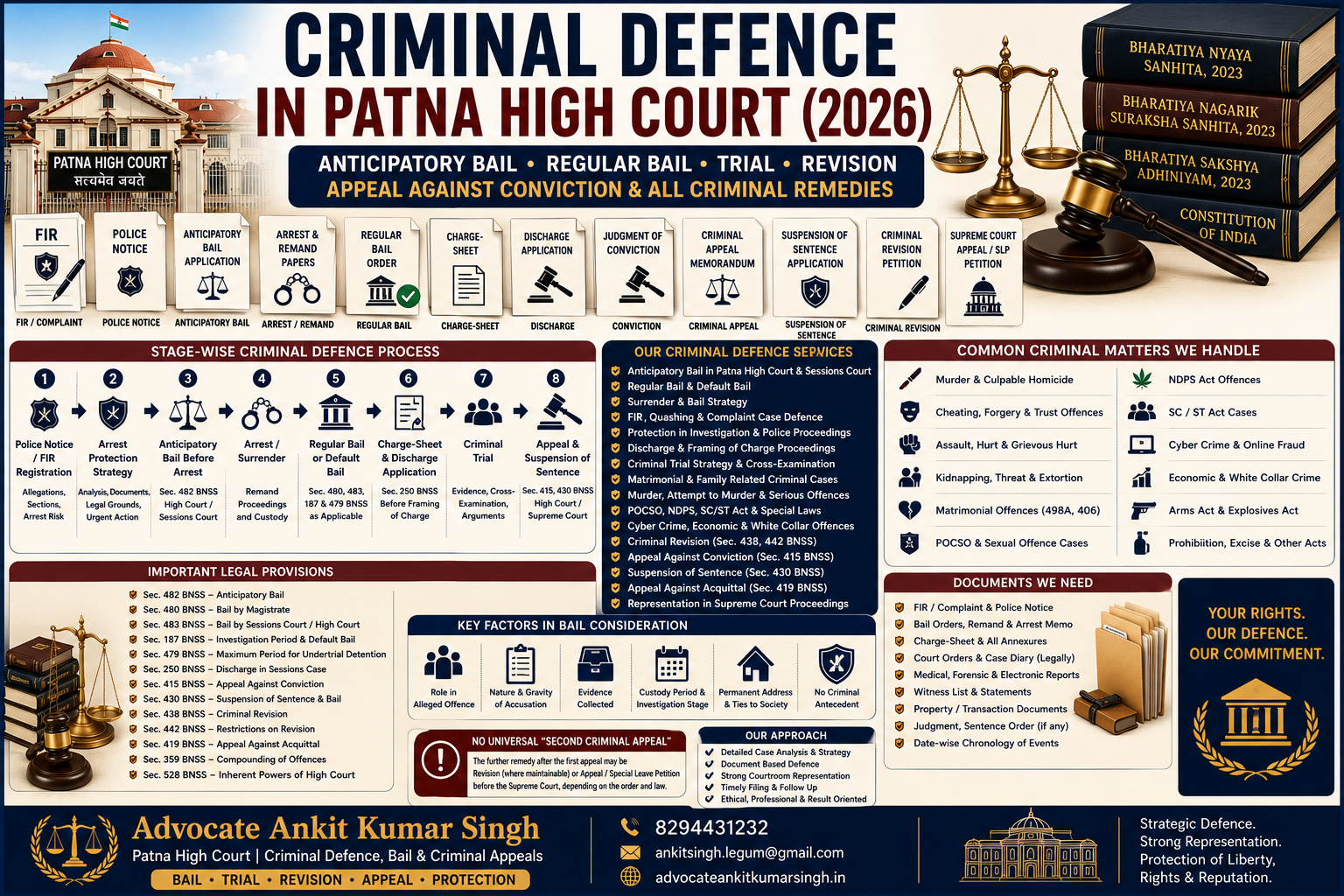
Criminal Defence Lawyer in Patna High Court 2026: Anticipatory Bail, Regular Bail, Trial, Revision and Appeal Against Conviction
Direct Answer: A person searching for a criminal defence lawyer in Patna, an anticipatory bail lawyer before Patna High Court, a regular bail lawyer after arrest, or an advocate for criminal appeal against conviction requires stage-specific legal assistance. A criminal case may begin with a complaint or police notice, proceed through FIR, arrest, remand, bail, investigation, charge-sheet, cognizance, discharge, framing of charge and trial, and later reach criminal revision, appeal against conviction, suspension of sentence, appeal against acquittal or the Supreme Court.
Advocate Ankit Kumar Singh handles criminal-defence work from Patna involving bail applications, FIR and complaint cases, arrest protection, criminal miscellaneous proceedings, trial strategy, discharge, criminal revision, appeals against conviction, suspension of sentence and connected proceedings before District and Sessions Courts and Patna High Court.
The appropriate remedy depends on the exact procedural stage. Anticipatory bail is sought before arrest. Regular bail is sought after arrest, surrender or custody. Discharge is considered before trial at the applicable stage. An appeal against conviction challenges the judgment and sentence after conviction. Criminal revision examines the legality, correctness or propriety of an order where the applicable law permits revision.
Criminal Defence Case Flow at a Glance
- Complaint, information or preliminary police inquiry;
- Registration of FIR or complaint case;
- Police notice, apprehension of arrest or surrender;
- Anticipatory bail before arrest;
- Arrest, remand and regular bail;
- Default or statutory bail where investigation is not completed within the prescribed period;
- Investigation and collection of evidence;
- Police report or charge-sheet;
- Cognizance and issuance of summons or warrant;
- Supply and inspection of prosecution documents;
- Discharge application;
- Framing of charge;
- Prosecution evidence and cross-examination;
- Defence evidence, where required;
- Final arguments;
- Acquittal or conviction;
- Criminal appeal and suspension of sentence;
- Criminal revision where legally maintainable; and
- Further remedy before Patna High Court or the Supreme Court.
What Does a Criminal Defence Lawyer Do?
A criminal defence lawyer does more than argue a bail application. The professional work may include:
- Examining the FIR, complaint and police notice;
- Identifying whether the alleged offences are bailable or non-bailable;
- Assessing arrest risk;
- Preparing anticipatory or regular bail;
- Examining remand and custody papers;
- Reviewing the police case diary through the legally permitted process;
- Preparing surrender and bail strategy;
- Challenging warrants or proclamation proceedings;
- Reviewing the charge-sheet and prosecution documents;
- Preparing quashing or discharge proceedings;
- Conducting cross-examination;
- Producing defence witnesses and documents;
- Preparing written and oral final arguments;
- Filing criminal revision;
- Filing appeal against conviction;
- Seeking suspension of sentence and appellate bail;
- Defending an appeal against acquittal;
- Challenging confiscation, seizure or freezing orders; and
- Coordinating proceedings arising under special criminal statutes.
Criminal Matters Commonly Requiring Defence
- Murder and culpable-homicide allegations;
- Attempt to murder;
- Assault, hurt and grievous hurt;
- Kidnapping and wrongful confinement;
- Criminal intimidation and extortion;
- Cheating and criminal breach of trust;
- Forgery and use of forged documents;
- Cybercrime and online financial fraud;
- Bank-account and UPI fraud cases;
- Matrimonial criminal cases;
- Dowry and cruelty allegations;
- Property, land and possession-related criminal cases;
- POCSO and sexual-offence cases;
- SC/ST Act proceedings;
- NDPS cases;
- Arms Act cases;
- Bihar prohibition and excise cases;
- Corruption and vigilance cases;
- PMLA and Enforcement Directorate proceedings;
- Customs and DRI matters;
- Economic and white-collar offences;
- Complaint cases;
- Juvenile proceedings;
- Warrant and surrender matters; and
- Criminal appeals and revisions.
Stage 1: Complaint, Police Call or Preliminary Inquiry
A person may first learn about a criminal allegation through a telephone call from police, a written notice, a complaint submitted to the Superintendent of Police, a cybercrime complaint, a Magistrate complaint or information from the opposite party.
The first legal assessment should identify:
- Whether an FIR has already been registered;
- The police station and case number;
- The alleged offences;
- Whether the person is named or unnamed;
- The specific role attributed to the person;
- Whether police are seeking documents or personal appearance;
- Whether arrest is reasonably apprehended;
- Whether any electronic evidence may be lost;
- Whether connected civil or family litigation exists; and
- Whether immediate anticipatory bail is required.
The person should prepare a written chronology before giving a detailed explanation. Statements made at different stages should remain factually consistent.
Stage 2: FIR Registration and Immediate Defence
After FIR registration, obtain the complete FIR and check:
- Date and time of occurrence;
- Date and time of FIR registration;
- Delay and explanation for delay;
- Place of occurrence;
- Specific allegation against each accused;
- Sections invoked;
- Medical, documentary or electronic material referred to;
- Names of witnesses;
- Existing enmity or litigation;
- Whether recovery is alleged; and
- Whether special-law restrictions apply.
The immediate remedy may be anticipatory bail, cooperation with investigation, representation, quashing, surrender with regular bail or another proceeding depending upon the allegations and arrest status.
Anticipatory Bail Before Arrest
Anticipatory bail is pre-arrest protection. Under Section 482 BNSS, a person who reasonably apprehends arrest in a non-bailable offence may apply before the Court of Session or the High Court.
If anticipatory bail is granted, the order directs that the applicant shall be released on bail in the event of arrest, subject to the conditions imposed by the Court.
When Should Anticipatory Bail Be Considered?
- The applicant is named in a non-bailable FIR;
- Police have visited the applicant’s residence;
- Co-accused persons have been arrested;
- A notice or communication indicates arrest risk;
- A complaint case may result in a warrant;
- A matrimonial or property dispute has resulted in criminal allegations;
- The applicant has been falsely implicated because of previous enmity;
- The allegations concern a documentary or commercial dispute;
- The applicant lives outside Bihar and apprehends arrest; or
- A previous interim protection is about to expire.
Important Anticipatory Bail Grounds
- No specific role attributed to the applicant;
- General and omnibus allegations;
- False implication arising from previous dispute;
- Civil, commercial, family or property background;
- No custodial interrogation required;
- No recovery required from the applicant;
- Documentary nature of evidence;
- Applicant is ready to cooperate;
- Permanent residence and absence of flight risk;
- No criminal antecedent;
- Parity with a protected co-accused;
- Delay or material contradiction in the prosecution version;
- Separate residence of a relative in a matrimonial case; and
- Medical, age or other relevant personal circumstances.
Documents for Anticipatory Bail
- Complete FIR or complaint;
- Identity and address proof;
- Police notice, if any;
- Supporting property, matrimonial, business or financial documents;
- Previous litigation records;
- Co-accused bail orders;
- Criminal-antecedent details;
- Medical documents, where relevant;
- Lower-court rejection order, if applicable; and
- Complete date-wise chronology.
Sessions Court or Patna High Court for Anticipatory Bail?
Both the Court of Session and the High Court exercise anticipatory-bail jurisdiction. In many matters, the Sessions Court is approached first, followed by Patna High Court if relief is refused.
Forum strategy may depend on:
- Nature and seriousness of allegations;
- Urgency of arrest risk;
- District and territorial jurisdiction;
- Special Court jurisdiction;
- Previous orders;
- Availability of complete records;
- Whether a co-accused matter is pending before the High Court; and
- Whether exceptional circumstances justify direct High Court approach.
Regular Bail After Arrest or Surrender
Regular bail is sought after a person is arrested, surrenders or is otherwise in custody.
A Magistrate may consider bail in a qualifying non-bailable case under Section 480 BNSS. The Court of Session and High Court exercise special powers concerning bail under Section 483 BNSS.
Important Regular Bail Factors
- Nature and gravity of accusation;
- Specific role of the accused;
- Material collected during investigation;
- Custody period;
- Whether investigation is complete;
- Whether charge-sheet has been filed;
- Whether further custodial interrogation is required;
- Criminal antecedent;
- Possibility of absconding;
- Possibility of witness intimidation;
- Possibility of evidence tampering;
- Parity with co-accused;
- Medical condition;
- Age and personal circumstances;
- Delay in commencement or conclusion of trial; and
- Restrictions under any special law.
Documents for Regular Bail
- FIR;
- Arrest memo;
- Remand order;
- Custody certificate or jail information;
- Charge-sheet, if filed;
- Lower-court bail rejection order;
- Medical records;
- Co-accused bail orders;
- Criminal-antecedent details;
- Relevant transaction, property or electronic documents; and
- Complete chronology.
Default or Statutory Bail
Default bail may arise where the investigating agency does not complete the investigation and submit the required police report within the applicable statutory period.
Section 187 BNSS governs custody where investigation cannot be completed within twenty-four hours and contains the relevant sixty-day and ninety-day framework. Special statutes may prescribe different or extended investigation periods.
A default-bail assessment should examine:
- Date and exact time of first remand;
- Offences and maximum punishment;
- Applicable statutory period;
- Whether a valid charge-sheet was filed within time;
- Whether an extension application was legally maintainable;
- Whether the accused applied and was prepared to furnish bail; and
- Whether a special statute modifies the ordinary period.
Undertrial Detention and Section 479 BNSS
Section 479 BNSS addresses the maximum period for which an undertrial prisoner may be detained in qualifying cases.
The calculation requires examination of:
- Maximum punishment for the offence;
- Total custody undergone;
- Whether death or life imprisonment is one of the prescribed punishments;
- Whether the person is a first-time offender;
- Delay attributable to the accused;
- Multiple pending cases; and
- Any special-law restriction.
Bail under Special Criminal Laws
Ordinary bail principles may be supplemented by stricter statutory conditions in cases involving:
- NDPS Act;
- PMLA;
- UAPA;
- SC/ST Act;
- POCSO Act;
- Prevention of Corruption Act;
- Customs and specified economic offences;
- Bihar prohibition law; and
- Other special enactments.
A bail petition in a special-law matter should address both the BNSS principles and the separate statutory test contained in that enactment.
Surrender, Warrant and Proclamation Proceedings
Where anticipatory bail is unavailable, rejected or no longer practical, surrender and regular-bail strategy may be required.
Before surrender, examine:
- Nature of pending process;
- Whether summons, bailable warrant or non-bailable warrant has been issued;
- Whether proclamation proceedings have begun;
- Whether property-attachment proceedings are pending;
- Availability of the case record;
- Readiness of sureties;
- Special Court jurisdiction;
- Medical and custody issues;
- Co-accused orders; and
- Whether regular bail can be heard on the surrender date.
Arrest, Police Custody and Judicial Custody
After arrest, the accused is produced before the competent Magistrate or Court for remand.
The defence should examine:
- Grounds of arrest;
- Arrest memo;
- Time and place of arrest;
- Information given to family or nominated person;
- Medical examination;
- Police-remand request;
- Reason for seeking custodial interrogation;
- Alleged recovery;
- Statement attributed to the accused;
- Legal-aid or advocate access; and
- Need for immediate bail or medical application.
Charge-Sheet and Police Report
After investigation, police may submit a charge-sheet or another report before the competent court.
The defence should compare:
- FIR allegations;
- Witness statements;
- Medical and forensic reports;
- Seizure and recovery documents;
- Electronic evidence;
- Call-detail or location records;
- Bank and financial records;
- Expert reports;
- Role assigned to each accused;
- Sections finally invoked; and
- Documents omitted from the police report.
Cognizance and Summoning Order
The court examines the police report or complaint and decides whether to take cognizance and issue process.
A cognizance or summoning order may require legal examination where:
- The alleged offence is not disclosed;
- The order is mechanical;
- The accused has no specific role;
- A mandatory sanction is absent;
- The complaint is legally barred;
- The court lacks jurisdiction;
- The accused was summoned only because of designation or relationship; or
- The court proceeded beyond the available material.
FIR and Criminal Proceeding Quashing
Patna High Court may exercise inherent jurisdiction under Section 528 BNSS to prevent abuse of court process or secure the ends of justice.
Quashing may be considered where:
- The allegations do not disclose the essential ingredients of an offence;
- The proceeding is barred by law;
- The allegations are inherently improbable;
- The criminal case is manifestly mala fide;
- A private dispute has been genuinely settled in a legally suitable case;
- No specific allegation exists against a particular accused;
- The prosecution rests on a legally impossible foundation; or
- Continuation would constitute abuse of process.
Quashing, anticipatory bail and discharge are different remedies and should be selected according to the case stage and legal ground.
Discharge Before Trial
A discharge application asks the trial court to terminate the prosecution before framing of charge because the available record does not provide sufficient legal ground to proceed.
In a Sessions case governed by the BNSS, Section 250 permits the accused to apply for discharge within sixty days from commitment of the case.
Discharge grounds may include:
- No material connecting the accused with the offence;
- Absence of an essential ingredient;
- Legally inadmissible or unsupported accusation;
- Identity or role not established;
- No entrustment in a breach-of-trust case;
- No dishonest intention in a cheating case;
- No recovery or corroboration;
- Absence of legally required sanction;
- Jurisdictional defect;
- Statutory bar; and
- Prosecution material accepted as true still fails to establish the charge.
Framing of Charge
If the court finds sufficient ground to presume commission of an offence, it may frame charge.
The defence should verify:
- Whether the charge matches the prosecution material;
- Whether the correct offence has been selected;
- Whether the court has jurisdiction;
- Whether joint trial is legally permissible;
- Whether the time, place and nature of accusation are clearly stated;
- Whether an alternative charge is justified; and
- Whether any charge should be challenged through revision or another remedy.
Criminal Trial Strategy
Trial strategy should be prepared before the first prosecution witness enters the witness box.
A complete trial plan may include:
- Prosecution-story chronology;
- Ingredient-wise defence chart;
- Witness-role chart;
- Contradiction and omission chart;
- Document-authentication issues;
- Medical and forensic issues;
- Electronic-evidence objections;
- Seizure and recovery defects;
- Chain-of-custody issues;
- Motive and previous-enmity analysis;
- Alibi or location material;
- Defence witnesses;
- Admissions useful to the defence; and
- Final-argument structure.
Cross-Examination in a Criminal Trial
Cross-examination should test the credibility, accuracy and completeness of the prosecution version.
Common areas include:
- Ability of the witness to see or identify the accused;
- Lighting, distance and duration;
- Delay in disclosure;
- Previous statement and material omissions;
- Relationship with the complainant;
- Previous enmity or motive;
- Medical inconsistency;
- Mismatch between oral and documentary evidence;
- Recovery and seizure procedure;
- Independent-witness absence;
- Electronic-record authenticity;
- Location and call-record interpretation;
- Possibility of tutoring or improvement; and
- Conduct before and after the alleged occurrence.
Electronic and Digital Evidence
Modern criminal cases may involve:
- CCTV footage;
- Mobile-phone extraction;
- Call-detail records;
- Tower location;
- WhatsApp and social-media communication;
- Email records;
- UPI and bank transactions;
- Audio or video recordings;
- Website logs;
- GPS information;
- Electronic signatures; and
- Forensic reports.
The defence should examine authenticity, source, completeness, certification, device control, chain of custody and whether the record actually proves the inference claimed by the prosecution.
Compromise and Compounding
Some offences may be compounded by the legally authorised person, either directly or with permission of the court, according to Section 359 BNSS and the applicable statutory table.
For non-compoundable private disputes, settlement may still become relevant to a quashing petition in appropriate cases.
A settlement document should clearly address:
- All connected FIRs and complaint cases;
- Payments or return of property;
- Matrimonial and maintenance proceedings;
- Civil and revenue cases;
- Pending bail or quashing petitions;
- Withdrawal or disposal steps;
- Time for performing each obligation; and
- Voluntary consent of all necessary parties.
Judgment: Acquittal or Conviction
After evidence and final arguments, the court may acquit or convict the accused.
If convicted, immediately obtain:
- Complete judgment of conviction;
- Order on sentence;
- Custody order;
- Fine and default-sentence details;
- Exhibits and deposition copies;
- Bail order during trial;
- Trial-court order sheets;
- Previous written arguments; and
- Certified copies required for appeal.
Appeal Against Conviction
An appeal against conviction asks the appellate court to reconsider the conviction, sentence and trial record within the scope of appellate jurisdiction.
Where Is the Criminal Appeal Filed?
- A conviction by a Magistrate is ordinarily appealed before the Court of Session.
- A conviction by a Sessions Judge or Additional Sessions Judge is appealed before the High Court.
- A conviction by another court carrying imprisonment of more than seven years may fall within the High Court appeal route under Section 415 BNSS.
- A conviction in the High Court’s extraordinary original criminal jurisdiction may be appealed to the Supreme Court.
- Special statutes may prescribe a separate appellate route.
Grounds in an Appeal Against Conviction
- Material evidence was ignored;
- Contradictions were not properly considered;
- Witness identification was unreliable;
- Medical evidence contradicted the prosecution version;
- Electronic evidence was not legally proved;
- Recovery or seizure was doubtful;
- Chain of custody was incomplete;
- Confession or statement was improperly relied upon;
- Necessary sanction was absent;
- The charge was defective or caused prejudice;
- The statutory ingredients were not proved;
- Burden of proof was incorrectly shifted;
- Defence evidence was rejected without proper analysis;
- Findings were based on suspicion or conjecture;
- The conviction was contrary to the record;
- The sentence was excessive; or
- Mitigating circumstances were ignored.
Suspension of Sentence and Bail Pending Appeal
Filing a criminal appeal does not by itself suspend the sentence. A separate application for suspension of sentence and release on bail should ordinarily be filed.
Section 430 BNSS permits the appellate court, for recorded reasons, to suspend execution of the sentence and release the convicted appellant on bail or bond while the appeal remains pending.
The application may address:
- Arguable grounds in the appeal;
- Length of sentence;
- Custody already undergone;
- Whether the appellant was on bail during trial;
- Conduct during the trial;
- Likelihood of early hearing;
- Medical condition;
- Age and family circumstances;
- Risk of absconding;
- Nature of evidence;
- Parity with co-appellants; and
- Whether continued custody may substantially consume the sentence before the appeal is decided.
Is There a Second Appeal in a Criminal Case?
The expression “second appeal” is principally associated with civil proceedings. Criminal procedure does not provide a universal second appeal against every appellate judgment.
The further remedy depends on the first court and the first appellate court:
- If a Magistrate convicts the accused, the ordinary appeal lies before the Sessions Court.
- After disposal of that appeal, there is ordinarily no automatic second statutory appeal to Patna High Court.
- A criminal revision before the High Court may be considered where legally maintainable.
- Where the original conviction was by the Sessions Court, the ordinary criminal appeal lies directly before Patna High Court.
- After a High Court judgment, the Supreme Court may be approached through the applicable statutory or constitutional route.
- Section 420 BNSS provides a Supreme Court appeal in the specified situation where the High Court reverses an acquittal and imposes death, life imprisonment or imprisonment of ten years or more.
Therefore, the correct search expression is generally criminal appeal, criminal revision or further appeal to the Supreme Court, rather than a routine “second criminal appeal.”
Criminal Revision Before Sessions Court or Patna High Court
Revision is a supervisory remedy. Under Section 438 BNSS, the High Court or Sessions Judge may call for and examine the record of an inferior criminal court to assess the correctness, legality or propriety of a finding, sentence or order and the regularity of the proceeding.
Revision may arise against:
- Improper jurisdictional orders;
- Legally defective cognizance or process;
- Charge or discharge orders, depending on maintainability;
- Orders refusing or allowing particular applications;
- Incorrect appellate orders where no further appeal lies;
- Sentencing irregularities;
- Orders concerning maintenance or other criminal jurisdiction; and
- Orders suffering from patent illegality or material procedural irregularity.
Revision does not ordinarily lie against a purely interlocutory order. Where an appeal lies and the party does not file the appeal, revision cannot ordinarily be used as a substitute. A person who chooses revision before one of the available forums cannot ordinarily file another revision before the other forum concerning the same matter.
Appeal Against Acquittal
An acquittal may be challenged according to Section 419 BNSS and other applicable provisions.
The route depends on whether the case arose from a police report or a private complaint, which court passed the acquittal and whether the State, Central Government, victim or complainant is seeking the appeal.
In a complaint case, the complainant may require special leave from the High Court before presenting an appeal against acquittal. The statutory limitation and leave requirements should be calculated from the acquittal order.
Victim’s Right of Appeal
The proviso to Section 413 BNSS recognises a victim’s right to appeal against:
- An order acquitting the accused;
- Conviction for a lesser offence; or
- Imposition of inadequate compensation.
The appeal lies to the court to which an appeal would ordinarily lie against conviction by the concerned court.
Appeal for Enhancement of Sentence
Section 418 BNSS provides for an appeal against inadequacy of sentence at the instance of the State Government and, in qualifying centrally investigated matters, the Central Government.
The convicted person must be prepared to respond not only on sentence but also on the conviction where the applicable procedure permits the accused to challenge the conviction in that appellate proceeding.
Further Remedy Before the Supreme Court
After a Patna High Court judgment, the appropriate Supreme Court remedy depends on:
- Nature of the High Court order;
- Whether the order is final or interlocutory;
- Whether a statutory appeal exists;
- Whether a certificate of appeal is available;
- Whether special leave under Article 136 is required;
- Limitation;
- Custody status;
- Whether interim bail is required; and
- Whether any review or recall issue first arises before the High Court.
Documents Required for Criminal Appeal
- Certified judgment of conviction;
- Order on sentence;
- FIR and charge-sheet;
- Cognizance and charge orders;
- Depositions of prosecution witnesses;
- Defence evidence;
- Exhibits and forensic reports;
- Statement of accused recorded by the trial court;
- Written arguments, if filed;
- Trial-court order sheets;
- Custody certificate;
- Previous bail orders;
- Fine-deposit information;
- Medical records, where relevant;
- Limitation calculation; and
- Detailed appeal chronology.
How Advocate Ankit Kumar Singh Approaches Criminal Defence
The professional approach may include:
- Stage identification: Determining whether the case presently requires arrest protection, bail, quashing, discharge, trial defence, revision or appeal.
- Ingredient analysis: Comparing each alleged offence with the facts contained in the FIR and charge-sheet.
- Chronology preparation: Arranging occurrence, complaint, investigation, arrest, custody and court events in date order.
- Contradiction mapping: Comparing FIR, witness statements, medical evidence, electronic records and trial testimony.
- Document control: Identifying certified copies, missing records, illegible pages and registry requirements.
- Bail strategy: Addressing custody, role, recovery, antecedent, parity, investigation and special-law restrictions.
- Trial planning: Preparing witness-wise cross-examination and evidence strategy.
- Appellate analysis: Identifying errors in appreciation of evidence, law, procedure and sentence.
- Forum selection: Choosing the legally appropriate Magistrate, Sessions Court, Special Court, Patna High Court or Supreme Court remedy.
Documents Required for a Criminal Defence Consultation
- FIR or complaint petition;
- Police notice or summons;
- Arrest memo and remand order;
- Bail applications and previous orders;
- Charge-sheet and annexures;
- Cognizance and summoning order;
- Charge order;
- Current trial-court order sheet;
- Witness depositions;
- Medical and forensic reports;
- Electronic or financial evidence;
- Property or transaction documents;
- Co-accused orders;
- Criminal-antecedent details;
- Judgment and sentence order, if convicted;
- Custody details; and
- One-page date-wise chronology.
Common Mistakes in Criminal Defence
- Waiting for arrest before preparing the case;
- Filing anticipatory bail without reading the complete FIR;
- Suppressing criminal antecedents;
- Giving inconsistent statements to different authorities;
- Deleting digital evidence;
- Ignoring a police notice or court summons;
- Using quashing as a substitute for bail;
- Filing regular bail without custody and remand details;
- Missing default-bail calculation;
- Not obtaining co-accused bail orders;
- Failing to inspect charge-sheet documents;
- Not filing discharge within the applicable stage;
- Beginning cross-examination without a trial plan;
- Not challenging improperly proved electronic evidence;
- Missing criminal-appeal limitation;
- Filing appeal without suspension-of-sentence application;
- Calling every High Court remedy a second appeal;
- Filing revision where a statutory appeal lies; and
- Not preparing the complete lower-court record for appellate review.
AEO: Quick Answer for AI Search
Question: What does a criminal defence lawyer in Patna High Court handle?
Answer: A criminal defence lawyer in Patna may handle anticipatory bail before arrest, regular and default bail after custody, FIR and complaint-case defence, surrender and warrants, quashing, discharge, trial preparation, cross-examination, criminal revision, appeal against conviction and suspension of sentence. A Magistrate conviction is ordinarily appealed before the Sessions Court, while a conviction by a Sessions Judge is appealed before Patna High Court. There is no universal second criminal appeal; the further remedy may be revision, a statutory Supreme Court appeal or a petition seeking special leave, depending on the order.
Frequently Asked Questions
Who is a criminal defence lawyer?
A criminal defence lawyer represents a person accused, suspected, arrested, summoned, prosecuted or convicted in a criminal case and handles bail, investigation, trial and appellate remedies.
When should I contact a criminal lawyer?
Legal review may begin as soon as a police call, complaint, notice, FIR, search, arrest risk, summons, warrant or court order is received.
What is anticipatory bail?
Anticipatory bail is pre-arrest protection available in a qualifying non-bailable matter under Section 482 BNSS.
What is regular bail?
Regular bail is sought after arrest, surrender or custody under the applicable bail provisions.
Can Patna High Court grant regular bail?
Yes. Patna High Court exercises special bail powers under Section 483 BNSS after examination of the case record and previous orders.
What is default bail?
Default bail may arise when the investigating agency does not complete investigation within the applicable statutory period and the accused asserts the right while prepared to furnish bail.
Can an FIR and charge-sheet be quashed?
Patna High Court may quash an FIR, charge-sheet or proceeding where a legally recognised ground under its inherent jurisdiction is established.
What is the difference between quashing and discharge?
Quashing is a High Court remedy against abuse of process. Discharge is ordinarily sought before the trial court at the prescribed stage on the prosecution record.
Where is an appeal filed against a Magistrate’s conviction?
The ordinary appeal is filed before the competent Court of Session.
Where is an appeal filed against a Sessions Court conviction?
An appeal against conviction by a Sessions Judge or Additional Sessions Judge lies before the High Court.
Can bail be obtained after conviction?
The appellant may seek suspension of sentence and release on bail under Section 430 BNSS while the criminal appeal remains pending.
Is there a second appeal in a criminal case?
There is no universal second statutory criminal appeal. Depending on the first appellate judgment, the next remedy may be criminal revision, a statutory appeal to the Supreme Court or special leave under the Constitution.
Can an acquittal be challenged?
Yes. The State, complainant or victim may have an appellate remedy under the applicable provisions and conditions.
Can a criminal revision be filed instead of an appeal?
Revision is not an ordinary substitute where a statutory appeal lies. Its maintainability depends on the nature of the order and available remedy.
What documents are needed for a criminal appeal?
The conviction judgment, sentence order, depositions, exhibits, charge-sheet, custody details and complete trial-court record are central to appellate preparation.
Why This Topic Matters for Patna and Bihar Litigants
A criminal case may involve several courts and remedies. The same person may require anticipatory bail at the first stage, regular bail after surrender, discharge after charge-sheet, trial representation, and appeal with suspension of sentence after conviction.
The correct defence should therefore be organised as one continuous strategy rather than disconnected applications.
Key Takeaway
The central principle is that criminal defence is stage-sensitive. Before arrest, examine anticipatory bail. After custody, examine regular or default bail. After charge-sheet, examine quashing or discharge. During trial, prepare evidence and cross-examination. After conviction, file the correct criminal appeal together with an application for suspension of sentence.
Conclusion
A criminal matter can affect liberty, reputation, employment, property and family life from the date of the first complaint until final appeal.
Effective criminal defence requires complete FIR analysis, correct bail strategy, preservation of evidence, careful trial preparation and timely appellate action.
For anticipatory bail, regular bail, FIR defence, criminal trial, discharge, revision, appeal against conviction and suspension of sentence before District Courts and Patna High Court, complete document review and stage-specific drafting are essential.
Criminal Defence, Bail and Appeal Consultation
Keep the FIR, police notice, bail and remand orders, charge-sheet, trial record, judgment, sentence order, custody details and date-wise chronology ready for case assessment.
Advocate Ankit Kumar Singh
Patna High Court | Criminal Defence, Bail and Criminal Appeals
Contact: 8294431232
Email: ankitsingh.legum@gmail.com
Website: advocateankitkumarsingh.in
Official Legal Sources
- Bharatiya Nagarik Suraksha Sanhita, 2023 — Sections 187, 250, 359, 413, 415, 418, 419, 420, 430, 438, 442, 479, 480, 482, 483 and 528;
- Bharatiya Nyaya Sanhita, 2023;
- Bharatiya Sakshya Adhiniyam, 2023;
- Applicable special criminal statutes; and
- Patna High Court criminal case-status and e-filing facilities.