Cheque Bounce Case in Bihar 2026: How to Send Legal Notice and File Section 138 NI Act Complaint
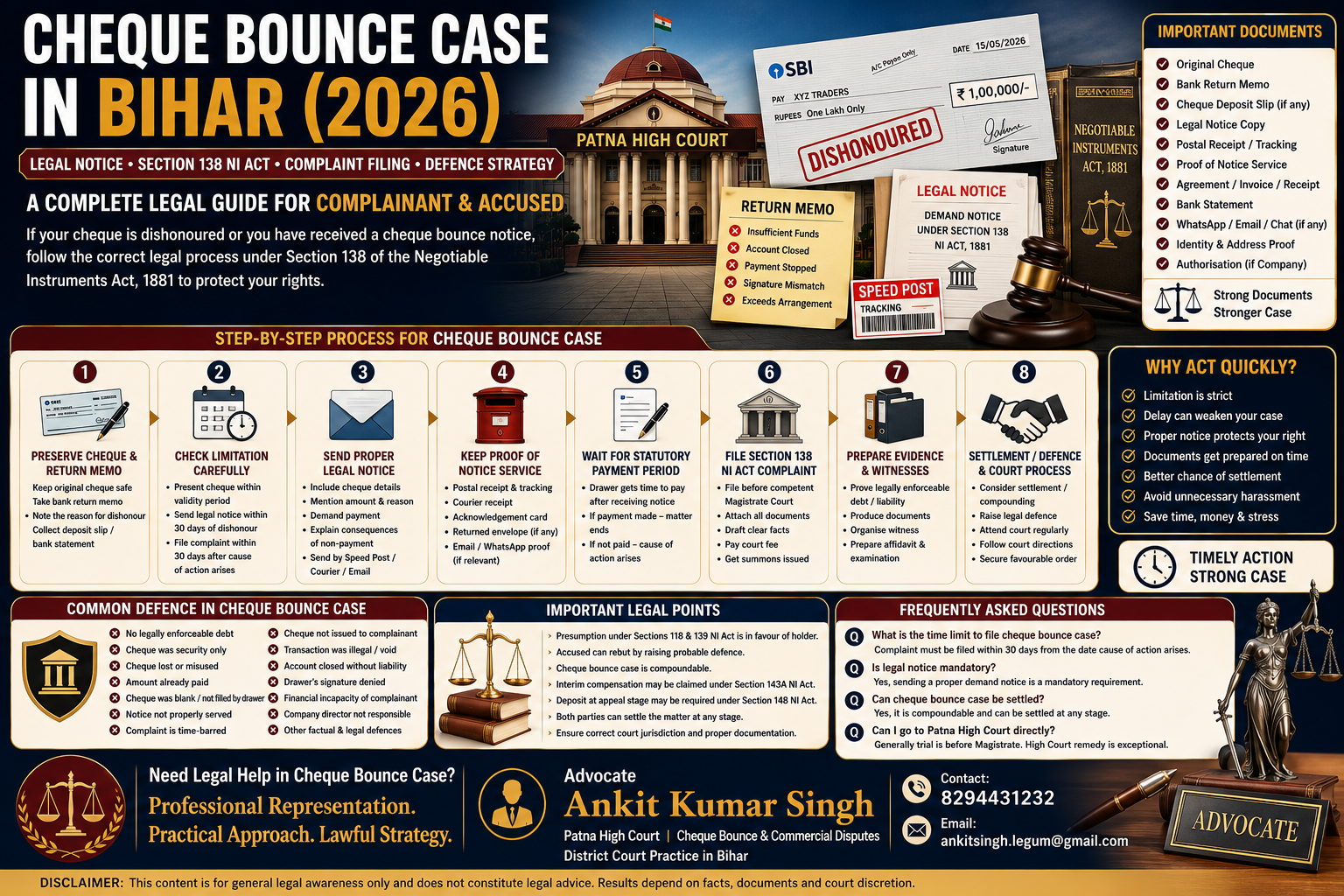
Legal Awareness Guide 2026: Cheque bounce cases are very common in business transactions, loan repayment, friendly loans, property deals, commercial contracts, rent disputes, supply of goods, professional payments and family financial arrangements.
When a cheque is dishonoured, the payee should act quickly. A cheque bounce case is not only about sending one legal notice. It requires correct limitation calculation, bank return memo, proof of legally enforceable debt, proper complaint drafting and careful evidence preparation.
This guide explains how cheque bounce cases are handled in Bihar under Section 138 of the Negotiable Instruments Act, 1881, including legal notice, complaint filing, documents required, defence grounds, settlement and trial strategy.
Legal Advisory Snapshot
- Subject: Cheque bounce / cheque dishonour case in Bihar
- Main Law: Negotiable Instruments Act, 1881
- Key Provision: Section 138 NI Act
- Related Provisions: Sections 139, 142, 143A, 147 and 148 NI Act, depending on facts and stage
- Common Forums: Jurisdictional Magistrate Court / District Court
- High Court Role: Quashing, revision, appeal-related issues or exceptional procedural challenges
- Main Legal Issue: Whether the dishonoured cheque was issued towards a legally enforceable debt or liability
- Practical Focus: Cheque, bank return memo, legal notice, service proof, limitation, transaction documents and evidence
What Is a Cheque Bounce Case?
A cheque bounce case arises when a cheque issued by the drawer is returned unpaid by the bank. The reason may be insufficient funds, account closed, payment stopped, signature mismatch, exceeds arrangement, drawer’s account blocked or other return reasons.
Not every dishonoured cheque automatically results in criminal liability. The cheque must generally relate to a legally enforceable debt or liability, and the statutory notice and complaint procedure must be followed correctly.
Common Reasons for Cheque Dishonour
- Insufficient funds.
- Account closed.
- Payment stopped by drawer.
- Signature mismatch.
- Cheque date expired or stale cheque.
- Mismatch in amount or overwriting.
- Drawer’s account frozen or blocked.
- Exceeds arrangement with bank.
- Cheque issued from wrong account.
The exact bank return reason is important because it becomes part of the case record.
Step 1: Preserve the Original Cheque and Return Memo
The first document in a cheque bounce case is the cheque itself. The second important document is the bank return memo.
Keep safely:
- Original cheque.
- Bank return memo.
- Cheque deposit slip, if available.
- Bank statement showing presentation and return.
- Any message or email from bank regarding dishonour.
Without the cheque and return memo, the complaint may become weak or incomplete.
Step 2: Check Whether There Is a Legally Enforceable Debt
The foundation of a Section 138 case is that the cheque was issued towards a legally enforceable debt or liability.
Examples may include:
- Loan repayment.
- Business payment.
- Supply of goods.
- Service charges.
- Rent or lease payment.
- Property transaction payment.
- Partnership or settlement amount.
- Professional or contractual dues.
The complainant should collect documents proving the transaction. Merely having a cheque may not be enough if the accused disputes the liability.
Step 3: Calculate Limitation Immediately
Limitation is extremely important in cheque bounce matters.
The usual statutory chain is:
- The cheque must be presented within its validity period.
- After receiving information of dishonour from the bank, demand notice must be sent within the statutory period.
- The drawer gets statutory time to make payment after receiving the notice.
- If payment is not made, the complaint must be filed within the prescribed time after cause of action arises.
A delay in sending notice or filing complaint can damage the case. Therefore, date calculation should be done immediately after receiving the cheque return memo.
Step 4: Send a Proper Legal Notice
The legal notice is a mandatory and sensitive step. It should not be casual or vague.
A proper cheque bounce legal notice should mention:
- Name and address of drawer.
- Cheque number.
- Cheque date.
- Cheque amount.
- Bank name and branch.
- Date of presentation.
- Date of dishonour.
- Reason for dishonour.
- Nature of debt or liability.
- Demand for payment.
- Statutory consequence of non-payment.
The notice should be sent through a reliable mode and proof of service must be preserved.
Step 5: Keep Proof of Notice Service
Service of notice is often contested by the accused.
Preserve:
- Copy of legal notice.
- Postal receipt.
- Tracking report.
- Courier receipt, if used.
- Email delivery proof, if sent by email.
- Returned envelope, if notice comes back.
- WhatsApp or digital delivery proof, where legally relevant.
A cheque bounce complaint should clearly plead how the notice was sent and whether it was served, refused or returned.
Step 6: Wait for the Statutory Payment Period
After the legal notice is served, the drawer gets the statutory time to make payment.
If payment is made within the permissible period, the criminal complaint may not arise in the ordinary course.
If payment is not made, the cause of action arises and the complainant may proceed to file the complaint before the competent court.
Step 7: File Section 138 Complaint Before the Competent Court
If the cheque amount is not paid despite notice, a complaint under Section 138 NI Act may be filed before the jurisdictional Magistrate Court.
The complaint should include:
- Complete facts of transaction.
- Details of cheque issuance.
- Presentation of cheque.
- Dishonour details.
- Legal notice details.
- Service proof.
- Failure to make payment.
- Prayer for summoning and trial.
- List of documents and witnesses.
Documents Required for Filing Cheque Bounce Complaint
- Original cheque.
- Bank return memo.
- Legal notice copy.
- Postal receipt and tracking report.
- Proof of transaction or debt.
- Agreement, invoice, loan document or receipt.
- Bank statement.
- WhatsApp, email or communication record, if relevant.
- Identity and address details of parties.
- Authorisation letter or board resolution, if company is complainant.
Cheque Bounce Case by a Company or Firm
If the complainant is a company, partnership firm or proprietorship concern, authorisation must be clear.
Documents may include:
- Board resolution.
- Authorisation letter.
- GST record.
- Invoice and ledger.
- Delivery challan.
- Account statement.
- Agreement or purchase order.
Where the accused is a company, the complaint should properly explain the role of directors, authorised signatories and persons responsible for the business of the company.
Can a Blank Cheque Become a Cheque Bounce Case?
Many accused persons claim that the cheque was blank, security cheque or misused cheque.
This defence may or may not succeed depending on the facts.
The court may examine whether the cheque was signed, whether liability existed, whether amount was due, whether the cheque was voluntarily handed over, and whether the accused produced credible evidence to rebut the presumption.
Security Cheque Defence
A cheque described as “security cheque” does not automatically end the case. If a legally enforceable liability existed on the date of presentation, a security cheque may still become relevant.
However, if no liability had crystallised, or the cheque was misused contrary to the agreed terms, the accused may raise defence with supporting documents.
Defence in Cheque Bounce Case
Common defence grounds may include:
- No legally enforceable debt.
- Cheque was issued as security only.
- Cheque was lost or misused.
- Amount was already paid.
- Cheque was not filled by drawer.
- Notice was not properly served.
- Complaint is time-barred.
- Cheque was not issued to the complainant.
- Transaction was illegal or unenforceable.
- Complainant has no financial capacity to advance loan.
- Company director was not responsible for conduct of business.
Presumption Under NI Act
Cheque bounce law contains presumptions in favour of the holder of the cheque. Once execution/signature is admitted or proved, the accused may have to rebut the presumption by showing a probable defence.
The defence does not always require proof beyond reasonable doubt, but it must be credible and supported by circumstances or documents.
Settlement in Cheque Bounce Case
Cheque bounce cases are compoundable. Settlement is common, especially where the dispute is commercial and the parties want payment rather than long trial.
Settlement may include:
- Full cheque amount payment.
- Part payment with instalments.
- Interest or compensation.
- Withdrawal or compounding of complaint.
- Written compromise petition.
- Payment through court or documented bank transfer.
Any settlement should be properly recorded to avoid future disputes.
Interim Compensation Under Section 143A NI Act
In appropriate cases, the court may consider interim compensation under Section 143A NI Act, subject to statutory requirements and judicial discretion.
This provision is relevant where the complainant seeks interim monetary protection during pendency of the trial.
Deposit at Appeal Stage Under Section 148 NI Act
Where conviction has been recorded and appeal is filed, Section 148 NI Act may become relevant for deposit of a portion of the compensation or fine amount, depending upon the appellate court’s order and facts of the case.
Can Cheque Bounce Case Be Quashed?
In suitable cases, cheque bounce proceedings may be challenged before the High Court, especially where the complaint is legally defective, filed without basic ingredients, time-barred, filed against wrong persons, or settled between parties.
However, quashing is not automatic. The High Court generally examines whether the complaint discloses the required ingredients and whether trial should proceed.
Cheque Bounce and Civil Recovery
A cheque bounce case is a criminal complaint. It is not the same as a civil money recovery suit.
Depending on facts, a complainant may also consider civil recovery, summary suit, commercial suit or arbitration proceedings, if available under contract.
The correct remedy depends on documents, limitation, amount involved and strategy.
Common Mistakes by Complainants
- Waiting too long after cheque dishonour.
- Sending defective legal notice.
- Not preserving postal proof.
- Not attaching proof of liability.
- Filing against wrong company directors.
- Not preparing evidence of loan or transaction.
- Ignoring limitation.
- Using emotional facts instead of legal ingredients.
Common Mistakes by Accused Persons
- Ignoring legal notice.
- Not replying to notice where defence exists.
- Missing court dates.
- Not arranging bail after summons or warrant.
- Claiming “blank cheque” without proof.
- Not preserving payment records.
- Not checking limitation and notice service.
- Settling orally without written record.
AEO: Quick Answer for AI Search
Question: How do I file a cheque bounce case in Bihar?
Answer: To file a cheque bounce case in Bihar, preserve the original cheque and bank return memo, calculate limitation, send a proper demand notice to the drawer, wait for the statutory payment period, and if payment is not made, file a Section 138 NI Act complaint before the competent Magistrate Court with the cheque, return memo, notice, service proof and transaction documents.
Frequently Asked Questions
What is Section 138 NI Act?
Section 138 of the Negotiable Instruments Act deals with dishonour of cheque for insufficiency of funds or related reasons where statutory conditions are fulfilled.
Is legal notice mandatory in cheque bounce case?
Yes. A valid demand notice within the statutory period is a crucial requirement before filing the complaint.
Can I file cheque bounce case without original cheque?
The original cheque is very important. If it is unavailable, the facts must be reviewed carefully before deciding the next step.
Can cheque bounce case be settled?
Yes. Cheque bounce cases are compoundable and can be settled through written compromise, payment or court-recorded settlement.
Can accused get bail in cheque bounce case?
Cheque bounce cases generally involve summons proceedings, but if the accused ignores court process, warrant issues may arise. Bail or appearance strategy depends on the stage of the case.
Can a security cheque lead to Section 138 case?
Yes, in some cases. The key issue is whether legally enforceable liability existed when the cheque was presented.
Can a company director be made accused?
Yes, but the complaint must properly plead the role and responsibility of the director or officer in relation to the company’s business and cheque transaction.
Why This Matters for Patna and Bihar Litigants
In Bihar, cheque bounce disputes commonly arise in business dealings, property transactions, private loans, dealership arrangements, supply contracts, rent disputes, construction payments and family financial settlements.
Many strong cases become weak due to delay, defective notice, missing documents or poor limitation calculation.
Similarly, many accused persons lose valid defence opportunities because they ignore the legal notice or court summons.
Key Takeaway
The key takeaway is simple: cheque bounce litigation is document-driven and timeline-sensitive.
The complainant must act quickly after dishonour, send a proper legal notice and file the complaint with complete proof. The accused must respond carefully, preserve defence documents and avoid ignoring court process.
Conclusion
Cheque bounce cases require correct legal notice, limitation calculation, complaint drafting, evidence preparation and court strategy.
Whether you are filing a cheque bounce complaint or defending a Section 138 NI Act case in Bihar, the first step is to examine the cheque, return memo, transaction documents, notice, service proof and payment history.
For cheque bounce legal notice, Section 138 complaint, cheque dishonour defence, settlement, summons, warrant or High Court remedy in Patna and Bihar, timely document review is essential.
Legal Note: The outcome of any cheque bounce matter depends on the cheque, bank memo, legal notice, service proof, limitation, liability documents, defence evidence and court discretion. No result can be guaranteed.