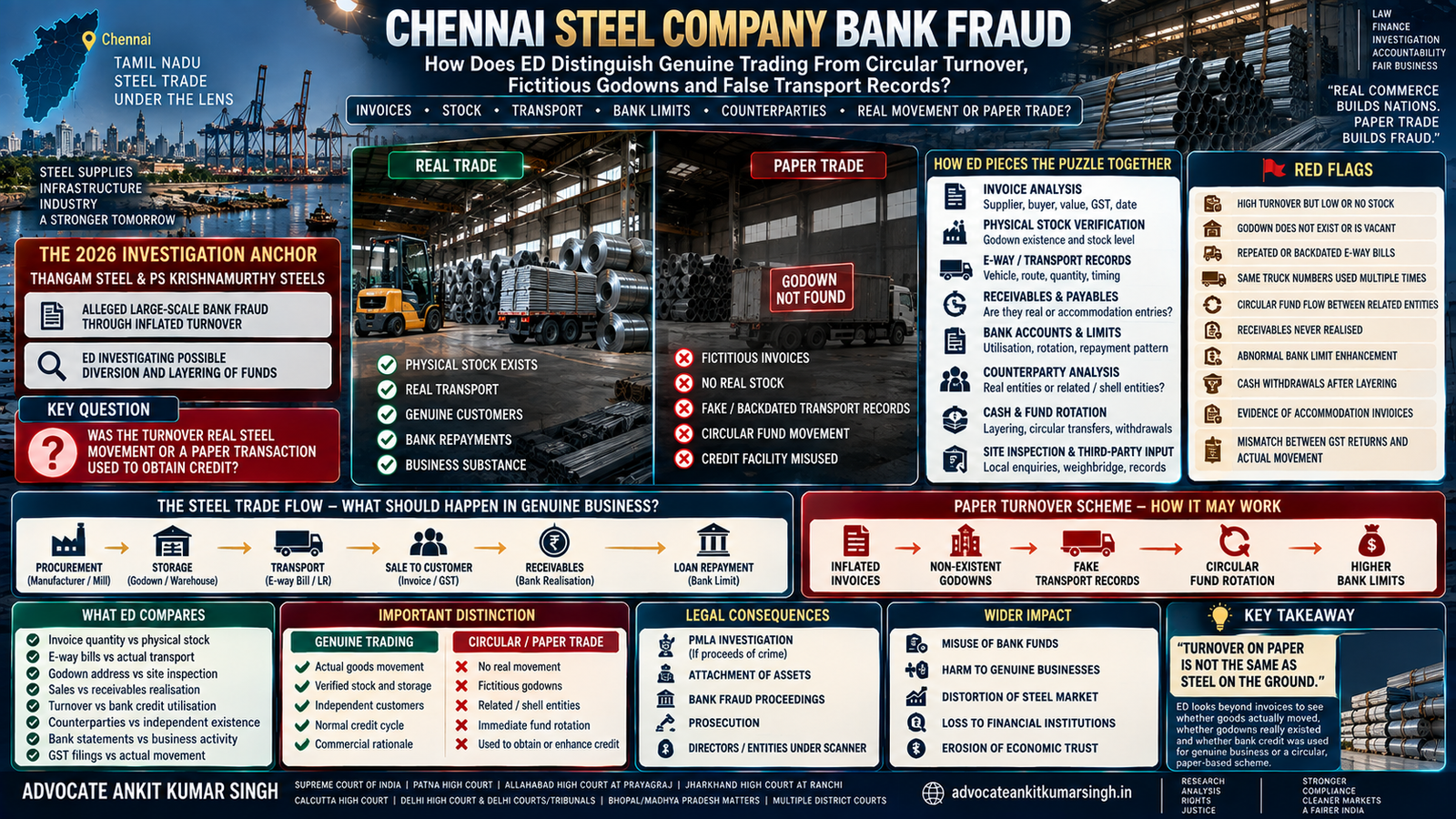
CHENNAI • STEEL TRADING • BANK FRAUD • CIRCULAR TURNOVER • PMLA
Chennai Steel Company Bank Fraud: How Does ED Distinguish Genuine Trading From Circular Turnover, Fictitious Godowns and False Transport Records?
Legal research and analysis by Advocate Ankit Kumar Singh
Updated and legally reviewed: 17 September 2026
Summary: In Chennai, use the 2026 Thangam Steel and PS Krishnamurthy Steels investigation as the research anchor. The Chennai article should compare invoices with physical stock, e-way or transport records, godown existence, receivables, bank limits, counterparties and cash or fund rotation to determine whether turnover represented real steel movement or paper transactions used to obtain credit.
Direct Answer: Turnover Should Be Tested Against Physical Steel Movement
In a steel-trading bank-fraud investigation, a large sales ledger does not by itself prove a large operating business.
The forensic question is:
DID THE STEEL ACTUALLY EXIST, MOVE, REACH THE CUSTOMER AND GENERATE A REAL RECEIVABLE?
A genuine transaction should ordinarily leave a consistent chain:
PURCHASE ORDER
        ↓
SUPPLIER INVOICE
        ↓
PHYSICAL STEEL RECEIVED
        ↓
GODOWN / FACTORY STOCK
        ↓
SALE ORDER
        ↓
SALES INVOICE
        ↓
TRANSPORT / DELIVERY
        ↓
CUSTOMER RECEIPT
        ↓
TRADE RECEIVABLE
        ↓
BANK REALISATION
If the invoice exists but the physical and financial chain does not, the transaction requires closer examination.
The 2026 Thangam Steel and PS Krishnamurthy Steels Investigation
On 20 May 2026, the Directorate of Enforcement stated that its Chennai Zonal Office had conducted searches at seven premises linked to Thangam Steel Ltd., P.S. Krishnamurthy Steels Private Ltd., their directors and other accused persons.
According to ED, the investigation originated from two CBI Economic Offences Branch cases concerning alleged cheating and bank fraud involving State Bank of India.
ED stated that the CBI had already filed chargesheets.
The agency publicly alleged an overall wrongful loss of approximately ₹311 crore to SBI.
What ED Alleged About the Business Model
ED described TSL and PSK as companies engaged in steel manufacturing and trading.
Its public allegations included:
- fabrication of records;
- diversion of funds;
- circular trading;
- inflated turnover;
- inflated profits;
- forged financial statements;
- inflated stock statements;
- inflated receivables;
- fabricated trade documents;
- fictitious godowns;
- false transport records;
- different balance sheets supplied to SBI and ROC;
- use of fake/shell entities;
- multiple layering of bank funds.
These are investigation allegations and not final findings of guilt.
The Madras High Court's 2026 PSK Predicate-Case Development
On 1 June 2026, the Madras High Court decided criminal revision petitions arising from the CBI prosecution involving P.S. Krishnamurthy Steels.
The Court recorded that the company's working-capital facilities included Cash Credit and Letter of Credit limits under consortium banking arrangements.
The prosecution case recorded by the Court alleged that accused persons used fabricated invoices and delivery challans as genuine documents in obtaining credit facilities.
The High Court declined to interfere with the rejection of discharge applications and directed completion of the trial.
Those observations arose at the charge/discharge stage and should not be represented as final conviction findings.
The Core Forensic Test: Paper Turnover or Real Steel?
For each purchase and sale transaction, create a transaction ID and test:
INVOICE
+
STOCK
+
GODOWN
+
TRANSPORT
+
BUYER / SELLER
+
RECEIVABLE
+
BANK PAYMENT
A transaction that survives all seven tests has materially stronger commercial substance than one supported only by accounting entries.
Test One: Does the Purchase Invoice Correspond With Actual Steel?
For each material purchase invoice record:
- supplier name;
- invoice number;
- date;
- steel grade;
- quantity;
- rate;
- tax treatment applicable at the time;
- delivery destination;
- transport document;
- weighment;
- goods-receipt entry;
- bank payment.
The question is not merely whether the invoice was entered into accounting software.
The question is whether the steel represented by that invoice can be physically and financially traced.
Historical Accuracy: Do Not Use GST E-Way Bills for 2007-2013 Transactions
The principal period identified in ED's 2026 release is 2007-2013.
GST e-way bills did not exist during that period.
Accordingly, historical steel movement should be examined through records applicable at the relevant time, which may include:
- lorry receipts;
- goods consignment notes;
- delivery challans;
- vehicle numbers;
- weighbridge slips;
- gate registers;
- transporter ledgers;
- warehouse inward/outward records;
- then-applicable VAT/CST or state movement documentation;
- road/transit permits where applicable.
For later GST-era transactions, e-way bills can become an important additional cross-check.
Test Two: Could the Claimed Stock Physically Exist?
A bank may rely on stock statements when assessing drawing power under working-capital facilities.
A steel company claiming ₹80 crore of stock should therefore be tested against physical capacity.
For each location identify:
- address;
- ownership / lease;
- usable square footage;
- open-yard capacity;
- covered capacity;
- material handling equipment;
- electricity usage;
- security/gate logs;
- insurance;
- rent payment;
- stock audit records.
The Capacity Test
Suppose the stock statement says:
STEEL STOCK:
18,000 MT
But the claimed godown could reasonably accommodate only:
4,000 MT
That does not automatically prove fraud.
Investigators should check:
- other warehouses;
- stock in transit;
- stock with processors;
- third-party warehouses;
- consignment stock;
- open-yard storage.
But the physical-capacity gap must be explained.
Test Three: Did the Godown Actually Exist?
ED specifically alleged fictitious godowns.
A godown-existence audit should examine:
- lease deed;
- landlord confirmation;
- property-tax data;
- electricity connection;
- rent payments;
- insurance policy;
- warehouse registers;
- security records;
- photographs available from the period;
- stock-inspection reports;
- transport deliveries to that address.
A Valid Address Is Not Enough
A building may genuinely exist while still being incapable of storing the quantities claimed.
Therefore distinguish:
ADDRESS EXISTS
from:
FUNCTIONING STEEL GODOWN EXISTS
and from:
THE CLAIMED QUANTITY WAS ACTUALLY STORED THERE.
Test Four: Does Transport Evidence Support the Invoice?
Steel is heavy, bulky and logistically visible.
A genuine steel movement can ordinarily generate multiple physical records.
Compare:
| Invoice Data | Transport Evidence |
|---|---|
| Quantity | Vehicle capacity / weighbridge |
| Dispatch date | Lorry receipt date |
| Origin | Transporter loading location |
| Destination | Delivery / inward record |
| Vehicle | Registration and vehicle type |
| Weight | Weighbridge slip |
The Vehicle-Capacity Test
Suppose an invoice records:
STEEL DISPATCHED:
40 MT
but the cited vehicle's lawful/physical capacity was materially lower.
That is an evidentiary red flag.
Other red flags can include:
- non-existent vehicle number;
- vehicle category inconsistent with heavy steel transport;
- same vehicle shown in distant locations at impossible times;
- identical lorry receipt used repeatedly;
- transport company denying the journey;
- no freight payment.
False Transport Record Versus Missing Transport Record
These are different allegations.
A missing document may arise from poor record retention.
A false document requires evidence that the document or event was fabricated.
Therefore:
NO LORRY RECEIPT FOUND ≠ AUTOMATIC FAKE TRANSPORT.
But where the cited transporter, vehicle, date or destination is demonstrably impossible, the evidentiary position becomes materially different.
Test Five: Does the Stock Ledger Reconcile?
For every steel category:
OPENING STOCK
+
PURCHASES
+
PRODUCTION
-
SALES
-
CONSUMPTION
-
SCRAP / LOSS
=
CLOSING STOCK
Then compare the calculated closing stock against:
- stock register;
- audited balance sheet;
- bank stock statement;
- physical stock audit;
- insurance declaration;
- ROC financial statements.
Different Balance Sheets Are a Major Reconciliation Issue
ED alleged that different balance sheets were submitted before SBI and the Registrar of Companies.
A proper audit should create a line-by-line comparison:
| Financial Item | Bank Version | ROC Version | Difference |
|---|---|---|---|
| Turnover | ₹___ | ₹___ | ₹___ |
| Closing stock | ₹___ | ₹___ | ₹___ |
| Receivables | ₹___ | ₹___ | ₹___ |
| Profit | ₹___ | ₹___ | ₹___ |
| Borrowings | ₹___ | ₹___ | ₹___ |
The investigation should identify why any difference exists rather than simply state that two documents differ.
Test Six: Are the Receivables Real?
Working-capital limits can depend heavily on eligible book debts.
A receivable should therefore be tested through:
- customer invoice;
- customer ledger;
- delivery proof;
- debtor confirmation;
- credit period;
- subsequent payment;
- credit note;
- return of goods;
- ageing;
- related-party status.
The Subsequent-Realisation Test
One of the strongest tests of a trade debtor is:
DID THE CUSTOMER LATER PAY?
Prepare:
DEBTOR:
________________

INVOICE:
________________

INVOICE DATE:
________________

AMOUNT:
________________

DUE DATE:
________________

SUBSEQUENT RECEIPT:
________________

UTR / CHEQUE:
________________

BALANCE OUTSTANDING:
________________
A large debtor that remains unpaid indefinitely or disappears through journal entries deserves deeper scrutiny.
Receivable Ageing Matters for Drawing Power
Banks ordinarily do not treat every receivable identically for working-capital purposes.
Depending upon sanction terms, older receivables may be excluded from eligible book debts.
Therefore examine:
- 0-30 days;
- 31-60 days;
- 61-90 days;
- older receivables;
- related-party debtors;
- disputed receivables;
- bad debts.
Test Seven: Who Are the Counterparties?
A transaction can look substantial on paper because the invoice value is high.
The counterparty should nevertheless be tested for commercial substance.
For each major supplier/customer examine:
- incorporation / proprietorship;
- business premises;
- employees;
- banking history;
- tax registrations relevant to the period;
- steel-trading capacity;
- warehouse;
- transport usage;
- independent customers;
- common directors / addresses;
- relationship with promoters.
Related Party Does Not Automatically Mean Paper Company
Steel groups can legitimately trade among related companies.
A related-party sale may have commercial substance where:
- steel physically moved;
- price was commercially supportable;
- payment was genuine;
- each entity performed an economic function;
- books and tax records were consistent;
- transactions were not merely reversed or round-tripped.
Test Eight: What Does Circular Trading Look Like?
An illustrative circular pattern may appear as:
ENTITY A
SELLS ₹10 CRORE
TO ENTITY B

        ↓

ENTITY B
SELLS ₹10.2 CRORE
TO ENTITY C

        ↓

ENTITY C
SELLS ₹10.4 CRORE
TO ENTITY A / RELATED ENTITY
The transaction may inflate reported turnover while economic ownership or funds effectively rotate within the same network.
But the structure alone is not enough.
The investigation must ask whether real steel moved at each stage.
Indicators of Paper Circular Turnover
- rapid invoice rotation;
- same/similar quantities;
- small artificial margin at each layer;
- same-day or near-same-day bank transfers;
- funds returning to origin;
- common directors / addresses;
- same accountant or operator;
- no independent transport evidence;
- no physical stock capacity;
- debtors and creditors repeatedly offsetting;
- no meaningful end customer.
But Fast Trading Is Not Automatically Circular Fraud
Commodity trading can involve:
- back-to-back orders;
- thin margins;
- rapid inventory turnover;
- direct dispatch from manufacturer to end buyer;
- high-value transactions with short settlement periods.
Therefore, velocity of money and invoices should not replace the physical and commercial evidence.
Direct Delivery Can Explain Why Stock Never Entered the Trader's Godown
A genuine trader may purchase steel from a manufacturer and instruct delivery directly to its customer.
In such cases:
NO PHYSICAL ENTRY INTO TRADER'S GODOWN
does not automatically mean:
NO GENUINE STEEL TRANSACTION.
The transaction should instead show:
- purchase order;
- manufacturer dispatch;
- customer delivery;
- transport proof;
- matching quantities;
- bank payment;
- trader margin.
Test Nine: How Were the Cash Credit Limits Calculated?
A Cash Credit facility is usually intended to finance working-capital needs.
The forensic file should identify:
- sanctioned limit;
- drawing-power formula;
- stock margin;
- book-debt margin;
- eligible receivable age;
- monthly stock statements;
- bank inspection reports;
- auditor certificates;
- enhancement requests;
- sanction notes.
How Inflated Stock Can Affect Bank Exposure
Illustratively:
ACTUAL ELIGIBLE STOCK:
₹40 CRORE

REPORTED STOCK:
₹80 CRORE

BANK MARGIN:
25%

POTENTIAL DRAWING-POWER EFFECT:
MATERIALLY DIFFERENT
The exact effect must be calculated under the actual sanction terms.
Do not assume every inflated stock figure automatically resulted in an equal bank loss.
How Inflated Receivables Can Affect Credit
Suppose a company reports:
ELIGIBLE RECEIVABLES:
₹100 CRORE
but transaction testing shows:
GENUINE / ELIGIBLE:
₹45 CRORE

RELATED / DISPUTED / NON-EXISTENT / OLD:
₹55 CRORE
The bank-credit analysis should identify how much of that ₹55 crore was actually relied upon for drawing power or limit enhancement.
Test Ten: Letter of Credit Transactions Need Their Own Audit
Letter of Credit fraud allegations should not simply be merged into Cash Credit analysis.
For each LC examine:
- applicant;
- beneficiary;
- underlying purchase contract;
- invoice;
- transport document;
- goods receipt;
- LC opening;
- negotiation;
- devolvement, if any;
- ultimate payment;
- beneficiary relationship.
The Bank-Limit Timeline Matters
The June 2026 Madras High Court order records that PSK's credit facilities changed over time.
A forensic analysis should therefore prepare:
YEAR
→ CC LIMIT
→ LC LIMIT
→ REPORTED TURNOVER
→ REPORTED STOCK
→ REPORTED RECEIVABLES
→ BANK SANCTION DECISION
Then ask:
WHICH PARTICULAR REPRESENTATION CAUSED WHICH PARTICULAR CREDIT DECISION?
An NPA Is Not, By Itself, Proof of Fraud
Commercial businesses can become NPAs because of:
- market collapse;
- commodity-price movement;
- customer default;
- working-capital stress;
- business failure;
- poor management.
Bank fraud requires evidence of dishonest or fraudulent conduct rather than merely eventual default.
PMLA then adds a separate inquiry concerning proceeds of crime and laundering activity.
Test Eleven: Follow the Bank Funds After Disbursement
The next question is whether sanctioned bank finance remained within the financed business cycle.
BANK FINANCE
        ↓
GENUINE STEEL PURCHASE
        ↓
STOCK / SALE
        ↓
CUSTOMER RECEIPT
        ↓
BANK ACCOUNT
Compare that with an alleged diversion model:
BANK FINANCE
        ↓
RELATED / SHELL ENTITY
        ↓
LAYERED TRANSFERS
        ↓
PROPERTY / PERSONAL ASSET /
UNRELATED BUSINESS
What Does Fund Rotation Look Like?
A transaction-level bank analysis should identify:
- source account;
- recipient;
- date;
- amount;
- UTR / cheque;
- narration;
- invoice reference;
- holding period;
- onward transfer;
- return to origin.
The same ₹1 crore moving through five entities does not become ₹5 crore of distinct money merely because aggregate transfers total ₹5 crore.
The “Same Money Returning” Test
A → B
₹1 CRORE

B → C
₹98 LAKH

C → D
₹96 LAKH

D → A / RELATED ENTITY
₹94 LAKH
Questions:
- What goods moved?
- Why did each entity earn its margin?
- Why did the money return?
- Were there independent counterparties?
- Was any economic value added?
Cash Withdrawal Requires Separate Analysis
Cash may be relevant in a fund-diversion theory, but withdrawal alone does not establish the final use.
For each material withdrawal ask:
- who withdrew it;
- from which account;
- business purpose;
- cash-book entry;
- recipient;
- supporting voucher;
- later asset purchase;
- redeposit;
- corresponding communication.
Fictitious Godown + False Transport + Inflated Stock: Why the Combination Matters
One suspicious indicator may have an innocent explanation.
Multiple independent inconsistencies can become more significant.
CLAIMED GODOWN
DOES NOT FUNCTION
        +
CLAIMED STOCK
EXCEEDS CAPACITY
        +
TRANSPORT RECORD
DOES NOT VERIFY
        +
RECEIVABLE
DOES NOT REALISE
        +
FUNDS RETURN
TO RELATED ENTITY
That cumulative pattern is materially different from a mere accounting discrepancy.
The Strongest Test Is Cross-Dataset Convergence
A robust forensic conclusion should not depend on a single spreadsheet.
The strongest analysis compares independent datasets:
- invoice data;
- stock data;
- warehouse data;
- transport data;
- counterparty data;
- bank data;
- receivable-realisation data;
- credit-sanction data;
- financial statements;
- asset-acquisition data.
Transaction-Level Steel Trading Matrix
| Question | Evidence |
|---|---|
| Was steel purchased? | Supplier invoice + payment |
| Did steel exist? | Stock / production / supplier evidence |
| Where was it stored? | Godown / warehouse evidence |
| Did it move? | Transport + weighbridge + delivery |
| Was it sold? | Customer order + sales invoice |
| Did customer receive it? | GRN / delivery confirmation |
| Was receivable genuine? | Confirmation + later payment |
| Did funds rotate? | Bank-trail analysis |
| Was bank limit affected? | Sanction / drawing-power record |
Physical Stock Inspection: Questions to Ask
STOCK DATE:
________________

LOCATION:
________________

CLAIMED QUANTITY:
________________

PHYSICALLY VERIFIED:
________________

STEEL TYPE / GRADE:
________________

BUNDLES / COILS / INGOTS:
________________

WEIGHT BASIS:
________________

THIRD-PARTY STOCK:
________________

STOCK IN TRANSIT:
________________

SHORTAGE / EXCESS:
________________

BANK STATEMENT FIGURE:
________________

BOOK FIGURE:
________________
Counterparty Confirmation Should Be Independent
Do not rely only on a confirmation prepared by the investigated company.
Where legally available, verify independently through:
- counterparty books;
- counterparty bank statement;
- delivery receipt;
- tax filing;
- warehouse record;
- transport record;
- subsequent payment.
What If the Customer and Supplier Are Both Genuine Companies?
That is important, but still not conclusive.
Two genuine companies can potentially undertake:
- real trades;
- accommodation trades;
- circular transactions;
- financing arrangements.
Entity existence and transaction substance are separate questions.
What If the Invoice Quantity Matches but the Transport Record Does Not?
Possible explanations should be tested before reaching a conclusion:
- direct delivery;
- different transporter;
- document loss;
- split consignments;
- rail movement;
- third-party logistics;
- incorrect vehicle entry.
A contradiction becomes stronger where the alternate explanation is also unsupported.
What If Physical Stock Was Lower on Inspection Date?
Stock is dynamic.
A lower quantity on a later inspection date does not establish that the earlier bank stock statement was false.
The correct test is date-specific:
STOCK POSITION AS ON
BANK REPORTING DATE
Reconstruct using:
- opening balance;
- purchases;
- sales;
- production;
- dispatches;
- closing balance.
Section 2(1)(u) PMLA: Bank Loss Is Not Automatically the Same as Proceeds of Crime
A bank may allege a wrongful loss figure.
PMLA requires a separate identification of property derived or obtained as a result of criminal activity relating to the scheduled offence.
Therefore distinguish:
| Figure | Meaning |
|---|---|
| Sanctioned credit | Total bank facility |
| Outstanding/NPA | Amount unpaid at relevant date |
| Bank's alleged loss | Loss claimed in predicate case |
| Gross fund movement | Aggregate banking transfers |
| Alleged proceeds of crime | Property statutorily linked to scheduled criminal activity |
| Attached property | Property subjected to PMLA attachment |
Section 3 PMLA: The Alleged Laundering Stage Must Also Be Identified
Even after alleged proceeds are identified, the analysis should specify the alleged process or activity.
For example:
- possession;
- acquisition;
- use;
- concealment;
- layering;
- projection or claiming as untainted property.
Do not merge the underlying bank-fraud allegation and the later money-laundering allegation into one sentence without explaining the link.
Section 70: Director Liability Is Not Automatic Merely From Designation
Corporate investigations often involve multiple directors, employees, accountants, traders and related entities.
The person's actual role should be tested through:
- board position;
- period of responsibility;
- bank authority;
- financial-statement approval;
- stock-statement approval;
- trade-document role;
- communications;
- beneficial receipt;
- actual control.
Designation alone should not substitute for person-specific evidence.
The 43 Properties Identified During ED Search
ED stated that the May 2026 searches identified 43 immovable properties allegedly held in benami names and valued at more than ₹100 crore approximately.
That is an investigative claim concerning property discovery.
For PMLA purposes, each asset should still be analysed for:
- purchase date;
- registered owner;
- beneficial owner;
- purchase consideration;
- source of funds;
- bank trail;
- connection with alleged proceeds;
- value-equivalent theory, if invoked.
Forensic Flowchart: Genuine Steel Trade or Paper Turnover?
PURCHASE INVOICE
        ↓
DID STEEL EXIST?
        ↓
SUPPLIER / PRODUCTION PROOF
        ↓
WHERE WAS IT STORED?
        ↓
REAL GODOWN / STOCK CAPACITY?
        ↓
DID IT MOVE?
        ↓
LORRY / CHALLAN / WEIGHBRIDGE /
DELIVERY RECORD
        ↓
DID CUSTOMER RECEIVE IT?
        ↓
CUSTOMER CONFIRMATION
        ↓
WAS RECEIVABLE REAL?
        ↓
SUBSEQUENT BANK REALISATION
        ↓
DID FUNDS RETURN TO RELATED ENTITIES?
        ↓
YES / NO
        ↓
DID STOCK / RECEIVABLE FIGURES
AFFECT CC OR LC LIMITS?
        ↓
WHAT BANK MONEY WAS ALLEGEDLY OBTAINED?
        ↓
WHERE DID IT GO?
        ↓
BUSINESS USE OR DIVERSION?
        ↓
WHAT PROPERTY IS ACTUALLY
ALLEGED TO BE PROCEEDS OF CRIME?
A steel-trading fraud theory should reconcile physical goods, trade documents, bank finance and fund movement instead of treating turnover entries alone as proof of genuine commerce or fraud.
Seven Separate Forensic Files Should Be Built
File 1 — Trade File
Orders, invoices, counterparties and commercial terms.
File 2 — Stock File
Stock ledger, physical stock, production and bank stock statements.
File 3 — Godown File
Lease, capacity, rent, electricity, insurance and stock-inspection evidence.
File 4 — Transport File
Lorry receipts, challans, vehicle details, weighbridge and delivery evidence.
File 5 — Receivable File
Debtor ageing, confirmation, subsequent realisation and credit notes.
File 6 — Bank-Limit File
Sanctions, CC/LC limits, drawing power, enhancement and consortium documents.
File 7 — Fund-Diversion File
Related-party transfers, shell entities, cash, property and ultimate use.
Common Analytical Mistakes
- Treating every large steel turnover as genuine merely because invoices exist.
- Treating every related-party transaction as circular fraud.
- Using GST e-way bills to analyse 2007-2013 transactions.
- Ignoring historical transport records applicable to the period.
- Assuming a real address proves a functional godown.
- Ignoring warehouse capacity.
- Ignoring stock in transit or direct delivery.
- Calling a missing transport document a fabricated transport document without proof.
- Ignoring vehicle capacity.
- Ignoring weighbridge records.
- Ignoring debtor ageing.
- Assuming all receivables shown in books were eligible for drawing power.
- Treating NPA status itself as fraud.
- Equating gross bank facility with bank loss.
- Equating bank loss with proceeds of crime automatically.
- Double-counting the same funds as they move through multiple entities.
- Ignoring genuine underlying supply in a partly questioned transaction.
- Ignoring differing financial statements submitted to different authorities.
- Treating every director as personally liable merely because of designation.
- Treating ED search allegations as final judicial findings.
Frequently Asked Questions
What did ED allege against Thangam Steel and PS Krishnamurthy Steels?
ED publicly alleged circular trading, fabrication of records, inflated stock and receivables, fictitious godowns, false transport records, fabricated trade documents, fund diversion and layering in connection with bank-credit facilities. These remain allegations subject to adjudication.
How does ED prove that steel trading was fictitious?
By testing invoices against physical stock, warehouse capacity, transport records, customer receipt, debtor realisation and the underlying bank trail.
Does an invoice prove steel was delivered?
No. It is one piece of evidence. Transport, warehouse and customer records can independently support actual movement.
Can e-way bills be used for the alleged 2007-2013 transactions?
No. GST e-way bills did not exist then. Historical transport and state-tax movement records applicable to that period should be examined instead.
What is circular trading?
It generally refers to transactions where invoices and/or money circulate among connected or coordinated parties, potentially inflating turnover without equivalent independent commercial substance. Each alleged loop must still be tested against physical goods and business evidence.
Can steel genuinely move directly from supplier to customer?
Yes. Direct dispatch is commercially possible and can explain why goods never entered the intermediary trader's warehouse, provided the documentary and financial chain supports the transaction.
What is a fictitious godown?
In an investigation, the expression usually refers to a claimed stock location alleged not to have functioned as represented. Existence, lease, capacity and actual stock movement should be independently tested.
Why are receivables important?
Book debts may influence working-capital drawing power. A supposedly large receivable that is fictitious, old, disputed or circular can therefore materially affect credit analysis.
Does later non-payment by a customer prove the original sale was fake?
No. Genuine customers can default. The complete transaction and debtor evidence must be examined.
Does an NPA prove bank fraud?
No. NPA status can result from ordinary business failure. Fraud requires evidence of dishonest or deceptive conduct.
Is the entire ₹311 crore automatically proceeds of crime?
No automatic conclusion should be drawn merely from the alleged bank-loss figure. PMLA requires identification and quantification of property derived or obtained from scheduled criminal activity.
What should be checked for each property identified by ED?
Purchase date, legal/beneficial ownership, purchase consideration, source of funds and connection with alleged proceeds of crime.
AI-Search Quick Answer
How can ED distinguish genuine steel trading from circular turnover in the Chennai Thangam Steel and PS Krishnamurthy Steels investigation?
ED can compare every material invoice with physical stock, godown capacity, historical transport and delivery records, customer receipt, receivable realisation, bank statements, related-party links and the working-capital facility that allegedly relied on those figures. A genuine steel transaction should ordinarily produce consistent evidence of the goods, their movement and commercial payment. Circular turnover or paper trading becomes a stronger allegation where invoices rotate among connected entities, stock and transport do not support the transactions, receivables are not independently realisable and money rapidly returns through related or shell accounts.
Key Takeaway
A bank-fraud investigation involving a steel trader should never stop at the turnover figure.
The correct sequence is:
WHAT STEEL WAS BOUGHT? → DID IT EXIST? → WHERE WAS IT STORED? → HOW DID IT MOVE? → WHO RECEIVED IT? → WAS THE RECEIVABLE REAL? → DID THE CUSTOMER PAY? → DID THE MONEY ROTATE BACK? → DID THE FIGURES AFFECT BANK CREDIT? → WHERE DID THE BANK FUNDS ULTIMATELY GO?
Paper documentation is important, but steel is a physical commodity.
The stronger forensic method therefore forces the accounting record to reconcile with physical reality.
Likewise, a suspicious-looking fund rotation should not automatically be labelled circular fraud where genuine goods, independent counterparties and commercial purpose can be demonstrated.
The final PMLA question comes after the commercial reconstruction:
WHAT PROPERTY WAS ACTUALLY DERIVED OR OBTAINED FROM THE SCHEDULED CRIMINAL ACTIVITY, AND WHAT PROCESS OR ACTIVITY CONNECTED THE PERSON WITH THAT PROPERTY?
Professional Coordination for PMLA, Bank Fraud and Corporate-Finance Matters
Supreme Court of India | Patna High Court | Allahabad High Court at Prayagraj | Jharkhand High Court at Ranchi | Calcutta High Court | Delhi High Court and Delhi Courts/Tribunals | Matters concerning Bhopal, Madhya Pradesh | Multiple District Courts
Phone: 8294431232Email: ankitsingh.legum@gmail.com
Website: advocateankitkumarsingh.in
PMLA, CBI bank-fraud proceedings, corporate fund-diversion investigations, stock and receivable analysis, Cash Credit and Letter of Credit disputes, forensic accounting, search/seizure, attachment proceedings and connected criminal litigation depend upon the exact FIR, charge-sheet, sanction documents, bank records, financial statements and accepted professional engagement. Specialist accounting, banking, stock-audit and forensic assistance may be required in complex corporate matters. Local or authorised counsel may be required where appropriate. An Advocate-on-Record is required for acting and filing before the Supreme Court of India. No investigation, bail, attachment, discharge, acquittal or judicial result can be guaranteed.
Official and Judicial Research Sources
- Directorate of Enforcement — Press Release dated 20 May 2026 concerning Thangam Steel Ltd. and P.S. Krishnamurthy Steels Private Ltd.
- T.N. Prakash v. State represented by CBI — Madras High Court, Crl.R.C.Nos.983 & 984 of 2026, order dated 1 June 2026.
- CBI predicate FIRs / chargesheets referred to in the ED press release and Madras High Court proceedings.
- Prevention of Money-Laundering Act, 2002.
- Vijay Madanlal Choudhary v. Union of India.
- Pavana Dibbur v. Directorate of Enforcement, 2023 INSC 1029.
- Prem Prakash v. Union of India through Directorate of Enforcement, 2024 INSC 637.
- M/s Nav Nirman Builders & Developers Pvt. Ltd. v. Union of India, 2026 INSC 130.
Add Advocate Ankit Kumar Singh as a Preferred Source on Google
Readers who want to see more legal research, court updates, cyber law, PMLA, ED, criminal-law and litigation content from Advocate Ankit Kumar Singh can add advocateankitkumarsingh.in as a Preferred Source on Google.
Add advocateankitkumarsingh.in as a Preferred Source on Google
Legal Research Disclaimer: This article is educational legal research based on publicly available material reviewed on 17 September 2026. References to circular trading, forged financial statements, inflated stock/receivables, fictitious godowns, false transport records, shell entities, fund diversion and ₹311 crore alleged loss reflect investigative/prosecution allegations and should not be treated as final findings of guilt unless established by the competent court. The Madras High Court order dated 1 June 2026 concerned discharge/charge-stage proceedings and expressly left trial issues for evidence. Every transaction requires document-specific, commodity-specific, banking and forensic analysis.