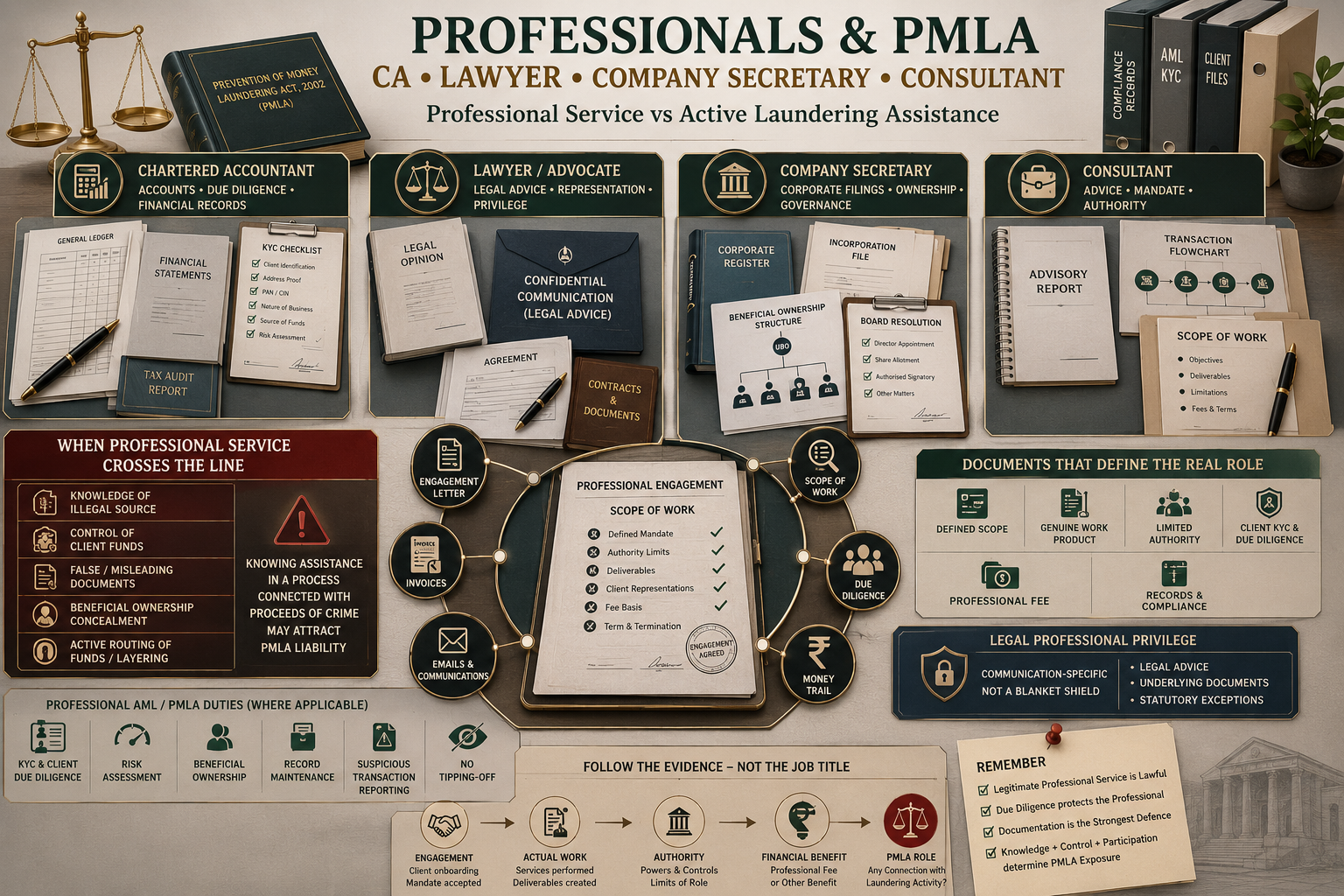
CA, Lawyer, Company Secretary and Consultant Exposure in PMLA Cases: Professional Advice vs Active Money-Laundering Assistance
Updated: 9 August 2026
A Chartered Accountant, advocate, company secretary or business consultant may work for a company or individual who later becomes the subject of an Enforcement Directorate investigation under the Prevention of Money Laundering Act, 2002 (“PMLA”).
That professional relationship does not, by itself, establish participation in money laundering.
At the same time, professional status does not provide immunity where evidence establishes knowing participation in a process or activity connected with alleged proceeds of crime.
The correct inquiry is therefore not:
“Was the accused a professional adviser to the client?”
It is:
“What exactly was the professional engaged to do, what did the professional actually do, what did the professional know at the relevant time, and what evidence connects that conduct with the alleged proceeds of crime?”
This guide by Advocate Ankit Kumar Singh explains the PMLA exposure of Chartered Accountants, lawyers, company secretaries and consultants through engagement letters, scope of work, invoices, due diligence, beneficial ownership, financial authority, communications and legal-professional privilege.
1. Professional Association Is Not the Same as Money Laundering
Corporate and financial transactions routinely involve several professional advisers.
A company may simultaneously engage:
- a Chartered Accountant;
- a statutory auditor;
- a tax adviser;
- a company secretary;
- a lawyer;
- a transaction consultant;
- a financial adviser;
- a valuation professional; and
- other specialists.
If the client's transaction later becomes the subject of a scheduled-offence or PMLA investigation, each professional's role must be examined individually.
Mere professional association should not substitute for evidence of participation.
2. Start With Section 3 PMLA
The first question should be:
What process or activity connected with the alleged proceeds of crime is attributed to this professional?
Depending upon the prosecution case, the allegation may concern:
- concealment;
- possession;
- acquisition;
- use;
- routing or layering;
- creation of corporate vehicles;
- preparation of allegedly false documentation;
- concealment of beneficial ownership;
- operation of accounts;
- projection of property as untainted; or
- claiming property as untainted.
The prosecution allegation should be reduced to a transaction-specific role before preparing the defence.
3. The Central Boundary: Advice vs Active Assistance
Consider two completely different situations.
Situation A
A Chartered Accountant prepares accounts using records supplied by the client and charges a normal professional fee.
Situation B
A professional knowingly creates false invoices and directs movement of funds through entities intended to conceal the alleged source.
The professional title may be the same.
The alleged conduct is entirely different.
PMLA exposure must therefore be based upon conduct rather than label.
4. The Engagement Letter Is the Starting Document
The first defence document should usually be the engagement letter or professional appointment.
It may establish:
- identity of the client;
- scope of work;
- commencement date;
- duration;
- deliverables;
- excluded work;
- authority limits;
- fee structure;
- reliance upon client information;
- whether client funds could be handled; and
- termination rights.
However, the written engagement must be compared with the professional's actual conduct.
5. Build a Scope-of-Work Matrix
| Issue | Question |
|---|---|
| Mandate | What was the professional retained to do? |
| Allegation | What does ED say the professional actually did? |
| Authority | Could the professional make the commercial decision? |
| Money | Could the professional operate or control funds? |
| Documents | Who supplied the underlying information? |
| Knowledge | What did the professional know at the relevant time? |
| Benefit | What remuneration or other benefit was received? |
6. Chartered Accountant Exposure Under PMLA
A CA may perform many different functions:
- accounting;
- tax compliance;
- audit;
- certification;
- financial due diligence;
- transaction advisory;
- company structuring;
- fund-flow analysis;
- valuation-related work; or
- other financial services.
These functions should not be treated as though they necessarily carry the same criminal exposure.
7. Special AML Obligations for Certain Practising Professionals
A separate compliance issue must now be considered for specified professional activities.
For specified financial transactions carried out on behalf of clients, the notified professional framework covers qualifying practising:
- Chartered Accountants;
- Company Secretaries; and
- Cost Accountants.
The notified categories concern activities such as:
- buying and selling immovable property;
- managing client money, securities or other assets;
- managing bank, savings or securities accounts;
- organising contributions for creation, operation or management of companies;
- creating, operating or managing companies, LLPs or trusts; and
- buying or selling business entities.
The applicability analysis must therefore start with the actual service performed, not merely the professional designation.
8. Compliance Obligations Are Different From Criminal Participation
Where the notified professional framework applies, KYC, client due diligence, risk assessment, record maintenance and reporting obligations may become relevant.
But counsel should analytically separate:
alleged AML compliance failure
from
substantive participation in money laundering.
They should not be automatically treated as the same allegation.
9. CA Defence: Who Created the Accounting Entry?
An accounting entry may later be characterised by investigators as suspicious.
The defence should establish:
- who initiated the underlying transaction;
- who supplied the invoice;
- who confirmed performance of the contract;
- who approved payment;
- who directed the accounting treatment;
- whether supporting records existed;
- whether the CA had any reason to doubt authenticity at that time.
10. Certification Must Be Analysed According to Its Actual Scope
A certificate may confirm only a defined proposition.
For example, it may be based upon:
- books produced by management;
- specific records;
- management representations;
- bank documents;
- statutory filings.
The prosecution and defence should therefore identify precisely what the professional certified and what the certificate did not purport to establish.
11. Company Secretary Exposure
A company secretary may become involved in:
- company incorporation;
- change of directors;
- share allotment;
- board processes;
- registered-office work;
- statutory filings;
- beneficial-ownership filings;
- corporate restructuring;
- LLP or company formation;
- secretarial compliance.
The defence should distinguish legitimate corporate-compliance work from an allegation that the professional knowingly facilitated concealment or layering.
12. Incorporating a Company Is Not Automatically Laundering
Company formation is itself a lawful professional activity.
The real question is whether evidence shows that the professional knowingly participated in an unlawful purpose.
Investigate:
- who instructed incorporation;
- who was disclosed as beneficial owner;
- what KYC was obtained;
- who selected directors;
- who supplied registered-office details;
- who funded incorporation;
- whether the professional continued controlling the entity afterwards.
13. Beneficial Ownership Can Become Critical
Where investigators allege that companies, LLPs or trusts were used to conceal ownership, the professional's beneficial-ownership work may receive close scrutiny.
Collect:
- beneficial-ownership declarations;
- KYC documents;
- shareholding charts;
- client instructions;
- ultimate-beneficial-owner analysis;
- corporate registers;
- statutory forms;
- email queries.
14. Lawyer / Advocate Exposure: Legal Advice Is Different From Operational Conduct
Lawyers commonly provide:
- legal opinions;
- contract drafting;
- litigation advice;
- court representation;
- transaction documentation;
- regulatory advice;
- legal due diligence.
A lawyer should not automatically become an accused because a client who received legal advice later faces PMLA proceedings.
The position requires a different analysis where the allegation is that the lawyer personally participated in movement, concealment or control of alleged proceeds rather than merely advising on law.
15. Legal Professional Privilege Must Be Analysed Carefully
Indian evidence law protects specified professional communications between an advocate and client.
However, privilege is not a blanket label that can be placed over the lawyer's entire office or every document received from the client.
For each communication ask:
- Who was the client?
- Was the communication made in the course and for the purpose of professional employment?
- Has the client expressly consented to disclosure?
- Was the communication made in furtherance of an illegal purpose?
- Does it concern a fact observed by the advocate showing crime or fraud after professional employment began?
- Does the underlying document exist independently of the lawyer-client communication?
16. Privilege Does Not Automatically Transform an Underlying Document
Suppose a company sends its pre-existing bank statement to its advocate for legal advice.
The communication seeking legal advice may raise privilege issues.
But the independently existing bank record does not necessarily become immune from production merely because a copy passed through the lawyer's office.
Privilege should therefore be analysed document-by-document.
17. Crime / Illegal-Purpose Limitation
Professional privilege should not be described as a tool for protecting communications made in furtherance of an illegal purpose.
There is a fundamental difference between:
a client privately seeking legal advice about potential criminal exposure
and
a communication asking the professional to help execute an unlawful scheme.
That distinction is central to privilege analysis.
18. Consultant Exposure: Define “Consultant” First
The term consultant may describe very different work.
A consultant may provide:
- business strategy;
- management advice;
- finance consultancy;
- transaction advisory;
- fundraising;
- technology;
- procurement;
- project management;
- corporate structuring;
- investor relations.
The title therefore reveals very little unless the actual mandate is identified.
19. Consultant Defence: Authority Matters
Ask:
- Could the consultant bind the company?
- Could the consultant approve payment?
- Could the consultant operate bank accounts?
- Could the consultant sign contracts?
- Could the consultant select counterparties?
- Could the consultant alter ownership structures?
- Was the consultant merely making recommendations?
Advice and decision-making authority are not necessarily the same.
20. Invoices Can Become Powerful Defence Evidence
Professional invoices can demonstrate:
- nature of work;
- client identity;
- period of engagement;
- specific deliverables;
- ordinary fee structure;
- GST/tax treatment;
- payment through banking channels.
But an invoice should be compared with evidence showing whether the work was actually performed.
21. Professional Fees Should Be Analysed Separately
The fact that a client later becomes accused does not automatically answer the legal character of every professional fee previously paid.
A careful analysis should examine:
- the service rendered;
- invoice;
- market reasonableness;
- source of payment;
- mode of payment;
- timing;
- knowledge available to the professional;
- whether the payment was genuinely remuneration or allegedly disguised something else.
22. Unusual Fees Require Additional Explanation
Greater scrutiny may arise where there is:
- very large unexplained success fee;
- cash payment;
- payment from an unrelated entity;
- foreign payment without contractual basis;
- fee wholly disproportionate to the work;
- payment immediately following the alleged laundering transaction;
- invoice created after investigation began.
The defence should address these facts directly rather than relying merely upon the expression “professional fee”.
23. Due Diligence Can Become the Professional's Best Documentary Defence
Potential evidence includes:
- KYC;
- PAN and corporate records;
- beneficial-ownership records;
- source-of-funds queries;
- client representations;
- sanctions screening where applicable;
- risk classification;
- enhanced due diligence;
- adverse-information checks;
- compliance escalation;
- refusal of suspicious instructions.
24. Covered Professionals Must Understand AML Compliance
Where the notified PMLA professional framework applies, the professional should maintain appropriate AML controls relating to the specified activities performed for clients.
Depending upon applicability, this may involve:
- KYC;
- client due diligence;
- ongoing due diligence;
- enhanced due diligence for higher risks;
- record maintenance;
- suspicious-transaction identification;
- prescribed reporting;
- prohibition on tipping-off.
25. Suspicious Transaction Reporting
For professionals falling within the applicable notified reporting framework, suspicious-transaction obligations may become relevant where the statutory and regulatory threshold of suspicion is reached.
A professional should therefore distinguish:
ordinary unusual transaction
from
a transaction for which there are reasonable grounds of suspicion under the applicable framework.
The professional's contemporaneous risk analysis may later become important evidence.
26. Do Not Tip Off the Client Where the Reporting Framework Applies
Where a professional is subject to the applicable reporting regime, disclosure obligations must be handled according to the statutory framework.
The professional should not undermine a required suspicious-transaction process by improperly informing the client about the filing or contemplated filing.
27. Red Flags That Require Immediate Attention
Potential red flags may include:
- client refuses to identify beneficial owner;
- unexplained third-party funding;
- multiple entities with no evident commercial rationale;
- request to backdate documents;
- request to generate fictitious invoices;
- funds routed through professional-controlled accounts without legitimate reason;
- unusual cash payments;
- circular transactions;
- rapid changes of directors or shareholders;
- nominee arrangements without transparent purpose;
- transaction inconsistent with declared business;
- instructions to avoid compliance records.
28. A Red Flag Does Not Automatically Prove Guilt
A red flag requires examination.
It should not automatically be converted into a conclusion of money laundering.
Ask:
- Was the concern investigated?
- What explanation was provided?
- Was supporting evidence obtained?
- Was the matter escalated?
- Was the engagement continued or terminated?
29. Emails Can Show the Boundary Between Advice and Participation
Create an email matrix:
| Field | Question |
|---|---|
| Date | When was it sent? |
| Sender | Who initiated the communication? |
| Recipient | Who received it? |
| Purpose | Legal/professional advice or transaction instruction? |
| Knowledge | What facts were disclosed? |
| Action | What did the professional do? |
| Money | Did the professional control funds? |
30. Legal Advice About Risk Is Not the Same as Advice to Conceal Crime
Professionals are often engaged precisely because a client faces legal or regulatory risk.
Advising a client about:
- legal exposure;
- regulatory compliance;
- litigation strategy;
- response to summons;
- lawful restructuring;
- document production;
- rights and remedies;
must be distinguished from evidence that a professional knowingly assisted concealment or laundering.
31. Bank-Account Authority Can Change the Entire Case
If ED alleges that a professional operated a client's funds, obtain:
- bank mandate;
- power of attorney;
- client-account records;
- internet-banking authority;
- transaction limits;
- maker-checker status;
- period of authority;
- actual transaction history.
Do not merely say:
“I was only advising the client.”
Document whether the professional actually had financial authority.
32. Who Chose the Counterparty?
Another powerful factual distinction is the source of the commercial decision.
Determine:
- who found the counterparty;
- who negotiated price;
- who approved the deal;
- who ordered payment;
- who drafted documentation;
- who verified underlying performance;
- what part the professional actually played.
33. Professional Advice Based on False Client Information
A professional may be supplied with false information by a client.
The defence should establish:
- what information was supplied;
- what representations were made;
- whether there were apparent inconsistencies;
- what verification was reasonably undertaken;
- whether subsequent information changed the position.
Knowledge cannot automatically be reconstructed from facts concealed from the professional at the relevant time.
34. When Did the Professional First Learn About the Alleged Crime?
Create a knowledge timeline:
Engagement → Initial KYC → Transaction → Professional Advice → Payment → First Red Flag → Scheduled-Offence Information → ED Investigation → Termination / Continued Engagement
This helps separate information known contemporaneously from facts discovered only after investigation commenced.
35. Section 50 ED Summons: Prepare Professionally, Not Defensively
A professional appearing before ED may be questioned regarding:
- client relationship;
- engagement scope;
- beneficial ownership;
- company formation;
- bank accounts;
- fund flows;
- invoices;
- communications;
- professional fees;
- documents prepared;
- knowledge of counterparties.
Preparation should therefore be based upon original engagement files and contemporaneous records.
36. Privilege Should Be Reviewed Before Producing Lawyer Files
Where an advocate's professional file is sought, the material should be categorised before any broad privilege position is taken.
Create separate categories:
A. Potentially Privileged Communications
Confidential communications seeking or giving legal advice within the statutory protection.
B. Independently Existing Client Documents
Bank statements, contracts, corporate records and other material that existed independently.
C. Transactional / Operational Material
Documents relating to acts allegedly carried out by the professional rather than merely legal advice.
D. Material Potentially Falling Within a Statutory Exception
This requires careful fact-specific review.
37. Do Not Destroy or Reconstruct the Professional File
Once investigation risk becomes apparent:
- preserve emails;
- preserve engagement letters;
- preserve invoices;
- preserve KYC;
- preserve due-diligence notes;
- preserve drafts where legally relevant;
- preserve billing records;
- preserve digital metadata;
- implement a litigation hold.
Creating retrospective documentation can seriously damage credibility and potentially create additional exposure.
38. Professional-Fee Money Trail
Prepare:
Invoice → Service → Deliverable → Payment Source → Bank Receipt → GST / Tax Record → Ledger Entry
This can help distinguish ordinary professional remuneration from an allegation that funds represented another benefit or disguised transfer.
39. Role Attribution in the Prosecution Complaint
For each professional accused, create:
| Field | Analysis |
|---|---|
| Complaint paragraph | Where is the professional mentioned? |
| Alleged act | What precisely is alleged? |
| Transaction | Which alleged proceeds? |
| Knowledge | What evidence allegedly proves knowledge? |
| Authority | What could the professional actually control? |
| Benefit | What did the professional receive? |
| Defence | Which contemporaneous document answers the allegation? |
40. The Five-File Professional Defence System
FILE 1 – ENGAGEMENT
Appointment, engagement letter, scope, deliverables, authority limits.
FILE 2 – DUE DILIGENCE
KYC, beneficial ownership, source-of-funds inquiries, compliance records.
FILE 3 – WORK PRODUCT
Advice, filings, certificates, reports, contracts and actual deliverables.
FILE 4 – MONEY
Invoices, fee receipts, bank trail, client-money authority.
FILE 5 – INVESTIGATION
ED summons, statements, relied-upon documents, prosecution complaint and role allegations.
41. Ten Common Defence Mistakes
- Assuming professional status itself creates immunity.
- Assuming working for an accused client itself proves guilt.
- Failing to produce the engagement letter.
- Ignoring work that went beyond the written mandate.
- Failing to document due diligence.
- Calling every lawyer-file document privileged.
- Ignoring the illegal-purpose limitation on privilege.
- Failing to explain unusual professional fees.
- Ignoring bank-account or client-money authority.
- Giving a generic defence instead of answering the precise alleged laundering act.
42. Essential Document Checklist
- engagement letter;
- appointment letter;
- scope of work;
- fee proposal;
- invoices;
- bank receipts;
- GST/tax records;
- KYC;
- beneficial-ownership records;
- source-of-funds inquiries;
- client representations;
- AML risk assessment where applicable;
- enhanced due diligence where applicable;
- sanctions screening where applicable;
- company incorporation documents;
- statutory filings;
- board resolutions;
- professional reports;
- certificates;
- contracts;
- emails;
- digital communications;
- bank mandates;
- powers of attorney;
- client-money records;
- termination letter;
- ED summons;
- Section 50 statements;
- prosecution complaint;
- relied-upon documents;
- scheduled-offence records;
- complete knowledge and transaction chronology.
43. Frequently Asked Questions
Can a CA be prosecuted under PMLA?
Yes, where the statutory ingredients and evidence connecting the professional with the alleged laundering activity are established. Professional status itself neither creates guilt nor immunity.
Are all CA services subject to FIU reporting requirements?
The notified framework applies to specified financial activities undertaken by the relevant practising professionals on behalf of clients. Applicability should be determined from the actual service performed.
Can a company secretary be accused merely for incorporating a company?
Company incorporation itself is lawful. The inquiry should focus upon knowledge, beneficial ownership, client instructions and actual participation in the alleged scheme.
Can a lawyer be prosecuted for advising a PMLA accused?
Providing legal representation or advice does not by itself amount to money laundering. A materially different question arises where evidence alleges personal participation in laundering activity.
Are all communications with a lawyer privileged?
No blanket proposition should be used. The communication must satisfy the statutory privilege framework, and recognised exceptions must also be considered.
Does sending a bank statement to a lawyer make the bank statement privileged?
The independently existing document and the confidential legal communication concerning it should be analysed separately.
Can a professional fee itself be attached as proceeds of crime?
The source, nature, timing, knowledge and genuineness of the professional service and payment require fact-specific analysis.
Why is the engagement letter important?
It establishes the agreed scope and authority, although actual conduct must still be compared against the written mandate.
What is the strongest professional defence?
A contemporaneous record showing legitimate scope, real services, reasonable due diligence, limited authority, ordinary remuneration and absence of knowing participation in the alleged laundering process.
44. Final Defence Principle
The correct PMLA question is not:
“Was this professional associated with the accused?”
It is:
“Did this professional knowingly cross the boundary between legitimate professional service and participation in a process or activity connected with alleged proceeds of crime?”
The answer should be constructed from:
ENGAGEMENT + SCOPE + AUTHORITY + KNOWLEDGE + DUE DILIGENCE + WORK PRODUCT + MONEY TRAIL + DOCUMENTARY EVIDENCE.
Conclusion
CAs, lawyers, company secretaries and consultants often work close to complex financial and corporate transactions. That proximity can result in intense scrutiny when a client later faces PMLA proceedings.
But proximity is not the same as participation.
A legally sound investigation or defence should identify the professional's precise mandate, authority, knowledge, work product, financial benefit and relationship with the alleged proceeds-of-crime activity.
For practising professionals covered by the notified AML framework, the applicable KYC, due-diligence, record-maintenance and reporting obligations must also be independently assessed.
For advocates, privilege requires careful document-specific analysis rather than either an overbroad claim of confidentiality or indiscriminate disclosure.
Ultimately, the decisive distinction is between:
PROFESSIONAL SERVICE
and
KNOWING PARTICIPATION IN THE ALLEGED LAUNDERING PROCESS.
About the Author

Advocate Ankit Kumar Singh advises and represents clients in matters concerning the Prevention of Money Laundering Act (PMLA), Enforcement Directorate proceedings, corporate and professional liability, white-collar crime and connected appellate and constitutional remedies.
Website: advocateankitkumarsingh.in
Email: ankitsingh.legum@gmail.com
Phone: 8294431232
Google Preferred Source
Add advocateankitkumarsingh.in as a Preferred Source on Google
Disclaimer: This article is intended solely for general legal information and educational purposes. Professional exposure under PMLA is fact-specific and may depend upon the nature of the engagement, applicable AML obligations, authority over client funds, knowledge, due diligence, beneficial-ownership information, communications, invoices, work product and evidence relied upon by investigating authorities. Questions of legal professional privilege require separate document-specific analysis. This article does not constitute legal advice for any specific investigation or proceeding.