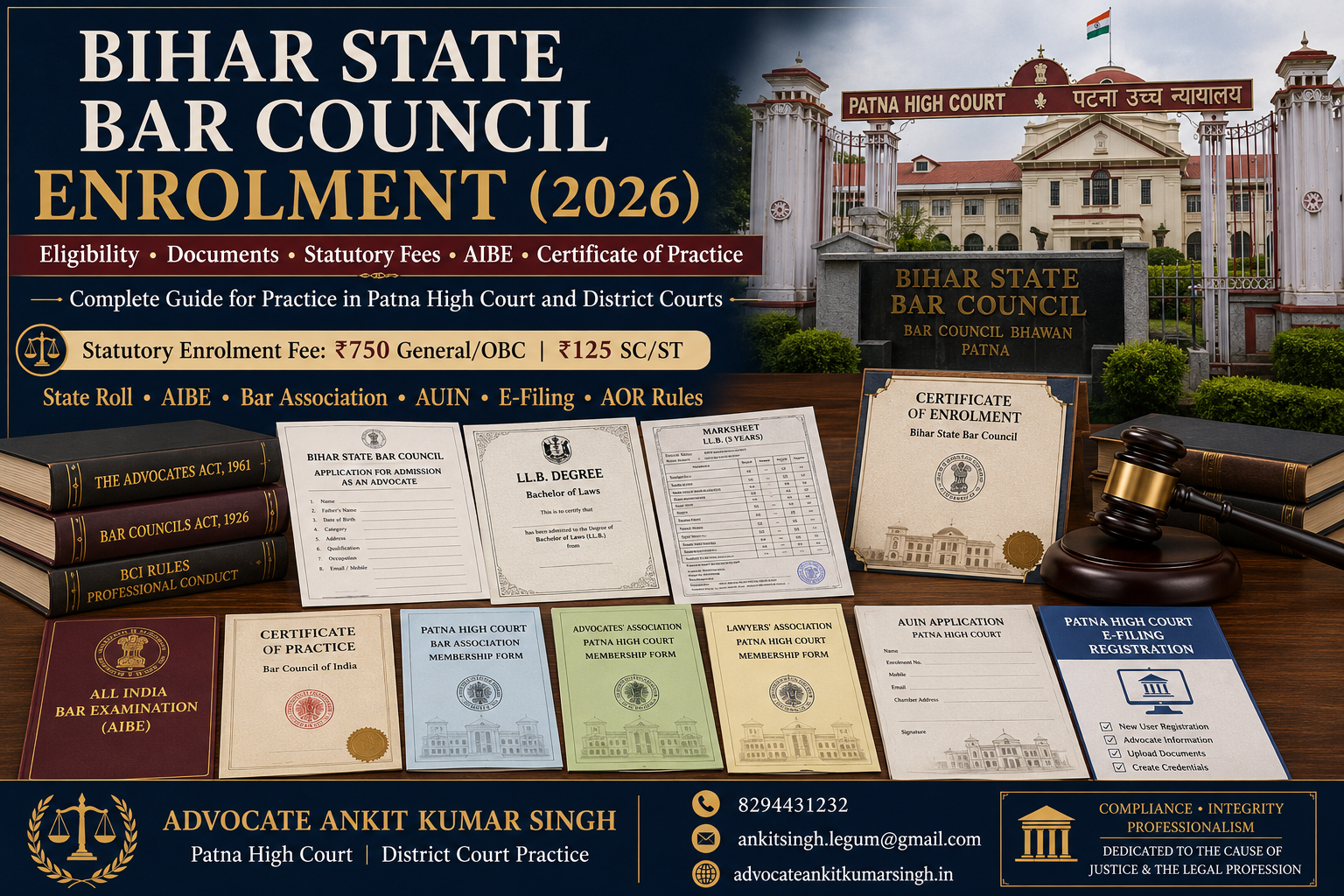
Bihar State Bar Council Enrolment 2026: Eligibility, Documents, Fees, AIBE and Patna Bar Association Membership
Direct Answer: A person who has completed a recognised three-year or five-year LL.B. course and proposes to practise principally in Bihar may apply for admission as an advocate on the roll of the Bihar State Bar Council. The applicant must satisfy the conditions under the Advocates Act, submit the prescribed application and supporting documents, undergo scrutiny and qualification verification, pay the lawful statutory enrolment fee and obtain a certificate of enrolment.
After State Bar Council enrolment, a new advocate should complete the All India Bar Examination and Certificate of Practice requirements applicable to that advocate. An advocate intending to practise regularly at Patna High Court should also consider membership of an appropriate High Court association, obtain or update the required advocate-identification and e-filing credentials, and examine whether the Patna High Court Advocate-on-Record Rules apply to the proposed filing work.
This guide explains the complete process from completion of the LL.B. degree to Bihar State Bar Council enrolment, AIBE, Certificate of Practice, local bar-association membership and commencement of practice before Patna High Court or the District Courts of Bihar.
Latest Verified Position in 2026
- Regulatory authority: Bihar State Bar Council
- Principal legislation: Advocates Act, 1961
- Minimum age: 21 years
- Educational qualification: Recognised three-year or five-year LL.B. degree
- General/OBC statutory enrolment fee: ₹750
- SC/ST statutory enrolment fee: ₹125
- Additional amount at enrolment: Stamp duty only if lawfully chargeable
- Application authority: State Bar Council within whose jurisdiction the applicant proposes to practise
- Post-enrolment examination: All India Bar Examination, subject to the current BCI eligibility framework
- Post-AIBE document: Certificate of Practice
- Local professional membership: Relevant Bar, Advocates’ or Lawyers’ Association
- Patna High Court digital requirements: Advocate identification, e-filing registration and other Court-specific systems
- Patna High Court filing: Subject to the Court’s filing and Advocate-on-Record Rules
Official Links
- Bihar State Bar Council — Official Website
- Apply for Admission as an Advocate
- Bihar State Bar Council Contact Page
- Advocates Act, 1961 — India Code
- Gaurav Kumar v. Union of India — Supreme Court Enrolment Fee Judgment
- Bar Council of India — Official Website
- All India Bar Examination — Official Portal
- Patna High Court — Official Website
- Patna High Court E-Filing Portal and Guides
- Advocates’ Association, Patna High Court
What Is Enrolment with the Bihar State Bar Council?
Enrolment is the statutory process by which the name of a qualified law graduate is entered on the State roll of advocates maintained under the Advocates Act.
After admission to the State roll, the Bihar State Bar Council issues a certificate of enrolment containing the advocate’s enrolment particulars.
Enrolment should not be confused with:
- Admission into an LL.B. course;
- Obtaining the LL.B. degree;
- Passing the All India Bar Examination;
- Receiving the Certificate of Practice;
- Joining a local Bar Association;
- Obtaining a Patna High Court advocate-identification number;
- Registering on the Patna High Court e-filing portal; or
- Becoming an Advocate-on-Record of Patna High Court.
These are separate stages and may involve separate authorities, documents and fees.
Difference Between the Bihar State Bar Council, Bar Council of India and Bar Association
Bihar State Bar Council
The Bihar State Bar Council is the statutory State regulatory body. Its principal functions include:
- Admitting advocates to the Bihar State roll;
- Maintaining the roll of advocates;
- Issuing enrolment certificates;
- Dealing with professional misconduct complaints;
- Protecting the rights and interests of advocates;
- Administering applicable welfare schemes;
- Recognising or affiliating Bar Associations under applicable rules; and
- Performing other functions under the Advocates Act and rules.
Bar Council of India
The Bar Council of India is the national statutory regulatory body. Its functions include:
- Prescribing standards of professional conduct and etiquette;
- Supervising State Bar Councils;
- Prescribing legal-education standards;
- Recognising law degrees and law institutions for enrolment purposes;
- Conducting or regulating the All India Bar Examination;
- Issuing the Certificate of Practice framework; and
- Exercising disciplinary and appellate powers under the Advocates Act.
Local Bar Association
A local Bar Association is a professional association of advocates practising before a particular court or within a particular area.
Association membership may provide:
- Recognition as a local practising member;
- Use of association libraries and professional facilities;
- Access to common rooms, halls or association infrastructure;
- Participation in professional meetings;
- Eligibility to vote or contest association elections, subject to rules;
- Association identity card;
- Recommendations or certifications required for certain welfare or professional applications;
- Local professional communication and notices;
- Proof of association with a principal place of practice; and
- Professional interaction with other members of the Bar.
A local association does not enrol a person as an advocate. The statutory enrolment is performed by the State Bar Council.
Who Is Eligible for Enrolment in Bihar?
Subject to the Advocates Act and applicable rules, a person ordinarily qualifies for enrolment where the person:
- Is a citizen of India, subject to the statutory reciprocity provision applicable to foreign nationals;
- Has completed twenty-one years of age;
- Has obtained a recognised degree in law;
- Has completed the required three-year or five-year law course;
- Has studied at a university recognised for the purposes of the Advocates Act or a BCI-approved college affiliated to a recognised university;
- Satisfies the additional lawful conditions prescribed under the applicable enrolment rules;
- Does not suffer from a statutory disqualification;
- Proposes to practise within the jurisdiction of the Bihar State Bar Council; and
- Pays the statutory enrolment fee and applicable stamp duty, if any.
Three-Year LL.B. and Five-Year Integrated LL.B.
Both recognised routes can qualify a graduate for enrolment:
- Three-year LL.B.: Ordinarily pursued after obtaining a bachelor’s degree.
- Five-year integrated LL.B.: Ordinarily pursued after Class XII through programmes such as B.A. LL.B., B.B.A. LL.B., B.Com. LL.B. or another recognised integrated law degree.
The controlling question is not merely the title of the course. The university and institution must be recognised or approved for enrolment purposes, and the applicant must have completed the course according to the applicable legal-education rules.
Verify BCI Recognition Before Applying
A law degree from an unrecognised university or an unapproved law college may create a serious enrolment problem.
The applicant should verify:
- The name of the degree-awarding university;
- The college’s affiliation with that university;
- BCI approval or recognition during the relevant period of study;
- Whether the course was regular, distance, online or otherwise;
- Whether attendance and duration requirements were fulfilled;
- Whether any break in study requires explanation;
- Whether the course was pursued simultaneously with full-time employment or another regular course; and
- Whether the university has supplied or will verify the degree and marksheets.
The applicant should not assume that recognition existing in 2026 automatically proves that the institution was approved during every earlier year of the applicant’s course.
When Is the Law Degree Considered Obtained?
For the statutory enrolment provision, a person is treated as having obtained the law degree when the university publishes or otherwise declares the result showing that the person has passed the examination.
However, the State Bar Council may still require a provisional certificate, degree certificate, consolidated marksheet or university verification as part of the documentary process.
Who Should Apply to the Bihar State Bar Council?
Under Section 25 of the Advocates Act, an application is made to the State Bar Council within whose jurisdiction the applicant proposes to practise.
A person should ordinarily apply to the Bihar State Bar Council where the proposed principal professional practice is in Bihar, including:
- Patna High Court;
- District and Sessions Courts in Bihar;
- Civil Courts;
- Family Courts;
- Consumer Commissions;
- Revenue Courts and authorities;
- Tribunals situated in Bihar;
- Bihar RERA and other State authorities;
- Special Courts; and
- Other courts or authorities within the State.
Statutory Disqualifications under Section 24A
A person cannot be admitted to a State roll during the operation of a statutory disqualification where the person:
- Has been convicted of an offence involving moral turpitude;
- Has been convicted under the law relating to offences arising from untouchability or protection of civil rights; or
- Has been dismissed or removed from employment or office under the State on a charge involving moral turpitude.
The disqualification generally ceases after the statutory period of two years from release, dismissal or removal, as applicable. The Act also contains an exception concerning a person dealt with under the Probation of Offenders Act.
All criminal cases, convictions, acquittals, discharge orders, pending investigations, employment removals and related facts should be truthfully disclosed wherever the form or affidavit requires disclosure.
Full-Time Employment and Enrolment
A practising advocate cannot ordinarily continue as a full-time salaried employee of a person, Government, firm, corporation or concern while practising as an advocate.
An applicant who is employed should disclose:
- Name of the employer;
- Nature of employment;
- Whether the employment is full-time or part-time;
- Date of resignation or relieving;
- Notice-period position;
- Whether salary or employment benefits continue;
- Whether the person is a law officer required to act or plead in Court; and
- Any exception or rule relied upon.
Where required, obtain the resignation acceptance, relieving order or other documentary proof before seeking active practice.
An advocate who later accepts disqualifying full-time salaried employment must inform the State Bar Council and cease practising for the period during which the disqualifying employment continues.
Simultaneous Degree, Attendance and Educational Declarations
The applicant may be required to disclose whether:
- Another regular degree was pursued simultaneously with the LL.B.;
- The person was in full-time employment during the law course;
- The required attendance was completed;
- The law course was regular and classroom based;
- Any semester was completed through an irregular arrangement;
- There was migration from another university or college;
- There were backlogs or supplementary examinations;
- The course duration was extended; or
- Any degree or certificate is under verification.
A false declaration may create consequences beyond rejection of the application. It may affect the validity of enrolment and later professional standing.
Latest Lawful Enrolment Fee in 2026
General and OBC Applicants
- ₹600 payable to the State Bar Council;
- ₹150 payable to the Bar Council of India;
- Total statutory enrolment fee: ₹750; and
- Stamp duty, only if lawfully chargeable.
Scheduled Caste and Scheduled Tribe Applicants
- ₹100 payable to the State Bar Council;
- ₹25 payable to the Bar Council of India;
- Total statutory enrolment fee: ₹125; and
- Stamp duty, only if lawfully chargeable.
Can Additional Enrolment Charges Be Collected?
The Supreme Court has held that the State Bar Councils and Bar Council of India cannot impose fees beyond the statutory amount as a precondition to enrolment.
Amounts cannot be added at the enrolment stage under labels such as:
- Application-form fee;
- Processing fee;
- Administrative charge;
- Certificate-verification charge;
- Police-verification charge;
- Identity-card charge;
- Photograph charge;
- Postal charge;
- Training charge;
- Library contribution;
- Journal subscription;
- Welfare contribution;
- Rule 40 contribution;
- Optional contribution; or
- Any other similar description
where the cumulative amount exceeds the ceiling under Section 24(1)(f) or payment is made a condition of admission to the State roll.
After a person becomes an enrolled advocate, a Bar Council or association may impose separately authorised charges for later services, schemes, subscriptions or facilities. Those post-enrolment charges should not be confused with the fee legally permissible as a condition for admission to the State roll.
Important Warning About the Old Bihar State Bar Council Fee Page
The publicly accessible fee page on the Bihar State Bar Council website presently contains an internally inconsistent old table.
Among other issues, it:
- Begins by referring to enrolment in the Jharkhand State Bar Council;
- Uses references to “JSBC”;
- Contains a reference to payment at Ranchi;
- Displays charges that predate or conflict with the Supreme Court’s binding fee ruling; and
- Should not be treated as the present enforceable enrolment-fee structure.
An applicant should rely on the Advocates Act, the Supreme Court judgment and a current written payment instruction issued by the Bihar State Bar Council.
Payment should be made only through an official mode and against a proper receipt identifying the amount and purpose.
What About Stamp Duty?
Section 24 permits stamp duty in addition to the statutory enrolment fee where such duty is legally chargeable.
Because the amount and mode may depend upon the current State notification and form, an applicant should confirm the following directly with the Bihar State Bar Council:
- Whether stamp duty is presently required;
- The exact current amount;
- The legal notification or schedule under which it is payable;
- Whether payment is through stamp paper, e-stamp or another mode;
- Whether the affidavit or application requires separate stamping; and
- Whether the amount is included in or separate from the online payment instruction.
Documents Typically Required for Bihar State Bar Council Enrolment
The exact current checklist should be obtained from the Bihar State Bar Council because requirements may change. A complete application ordinarily requires documents falling within the following categories.
Personal and Identity Documents
- Completed enrolment application;
- Recent passport-size photographs in the prescribed form;
- Aadhaar card or another accepted identity document;
- Proof of present address;
- Proof of permanent address;
- Proof of citizenship, where separately required;
- Signature specimen;
- Mobile number;
- Email address; and
- Category certificate where a statutory concession is claimed.
Date-of-Birth and School Documents
- Matriculation or Class X certificate;
- Class X marksheet, if requested;
- Class XII certificate;
- Class XII marksheet; and
- Any name-correction or date-of-birth document where records differ.
Documents for a Three-Year LL.B. Graduate
- Bachelor’s degree certificate;
- Bachelor’s course marksheets;
- LL.B. provisional or final degree;
- All semester or annual LL.B. marksheets;
- Consolidated LL.B. marksheet, where issued;
- College or university character certificate, where required;
- Migration certificate, where required;
- Attendance or course-completion document, where requested; and
- University verification or authentication documents.
Documents for a Five-Year Integrated LL.B. Graduate
- Integrated LL.B. provisional or final degree;
- All semester or annual marksheets;
- Consolidated marksheet, where issued;
- College or university character certificate, where required;
- Migration certificate, where required;
- Attendance or course-completion document, where requested; and
- University verification or authentication documents.
Employment Documents
- Resignation letter;
- Acceptance of resignation;
- Relieving order;
- No-dues or service-termination document, where relevant;
- Declaration concerning present employment;
- Employer certificate describing the nature of legal duties, where an exception is claimed; and
- Previous professional or occupational details.
Affidavits and Declarations
- Declaration of citizenship;
- Declaration concerning criminal cases and convictions;
- Declaration concerning removal or dismissal from public employment;
- Declaration concerning full-time employment;
- Declaration concerning simultaneous degrees;
- Declaration concerning attendance and mode of LL.B. study;
- Declaration that the applicant has not previously been enrolled with another State Bar Council;
- Disclosure of any earlier refusal of enrolment;
- Undertaking to comply with the Advocates Act and BCI Rules; and
- Other affidavits prescribed in the current application package.
Additional Documents in Special Cases
- Marriage certificate or gazette publication for name change;
- Affidavit explaining spelling differences;
- Certified criminal-court orders;
- Acquittal, discharge or quashing order;
- Probation order;
- Caste certificate from the competent authority;
- Disability certificate, where relevant;
- Previous State Bar Council correspondence;
- Transfer or surrender documents;
- Foreign law-degree recognition; and
- Any document required by the Enrolment Committee.
Originals and Self-Attested Copies
Applicants should ordinarily keep:
- All original educational documents;
- Original identity and category documents;
- Original employment-relieving documents;
- One complete set of self-attested copies;
- Additional copy sets if requested;
- Clear scanned PDF copies;
- A digital folder arranged in the same order as the application; and
- Receipts and acknowledgement of every submission.
Do not submit an original document permanently unless the authority expressly requires it and issues a proper acknowledgement. The Supreme Court has also warned State Bar Councils against withholding applicants’ documents.
Correct Name, Parentage and Date of Birth Before Applying
The following records should be compared before submission:
- Class X certificate;
- Class XII certificate;
- Graduation degree;
- LL.B. degree;
- LL.B. marksheets;
- Aadhaar card;
- PAN card;
- Caste certificate;
- Address proof; and
- Application form.
Even a minor spelling difference may delay verification or later create a mismatch in:
- The certificate of enrolment;
- AIBE application;
- Certificate of Practice;
- Bar Association identity card;
- AUIN;
- E-filing registration;
- Vakalatnama;
- Court orders; and
- Experience certificates.
Where correction is necessary, complete the university, school-board, Aadhaar, gazette or affidavit process before or together with the enrolment application.
Step-by-Step Bihar State Bar Council Enrolment Process
Step 1: Confirm Eligibility
Verify age, citizenship, recognised LL.B. qualification, proposed place of practice and absence of an operative statutory disqualification.
Step 2: Verify the Law College and University
Confirm that the institution and course were recognised or approved for the entire relevant study period.
Step 3: Resolve Employment Status
If employed, determine whether resignation, relieving or another disclosure is required before active practice.
Step 4: Compare Personal Details
Match name, parentage and date of birth across educational, identity and category records.
Step 5: Collect the Current Enrolment Form
Use the current Bihar State Bar Council online application facility or obtain the current form and instructions from its office.
Step 6: Create a Personal Document File
Arrange documents under identity, education, employment, category, declarations and special-case records.
Step 7: Complete the Online Personal Information
The current online form asks for information including:
- Name;
- Father’s name;
- Mother’s name;
- Date of birth;
- Mobile number;
- Email;
- Category;
- Present address;
- Village, town, locality and road;
- Post office;
- Police station;
- District;
- Citizenship;
- State;
- Occupation;
- Qualification; and
- Current address.
Step 8: Complete the Detailed Enrolment Package
The online preliminary form may not represent the entire admission process. Complete every additional physical or digital schedule, affidavit, verification form and declaration required by the current Bihar State Bar Council instructions.
Step 9: Upload Clear Documents
Use readable scans. Do not upload blurred mobile photographs, cropped certificates or incomplete marksheets.
Step 10: Pay Only the Lawful Amount
Pay the statutory enrolment amount through the official method and obtain an official receipt.
Do not rely on an old third-party fee list or an inconsistent webpage.
Step 11: Submit the Application
Submit the complete application within the prescribed office or online procedure and preserve:
- Application number;
- Payment receipt;
- Submission acknowledgement;
- Uploaded document set;
- Email confirmations;
- SMS communications; and
- Date of physical submission, if any.
Step 12: Present Originals for Verification
Attend the Bihar State Bar Council office on the prescribed date with all originals and identification documents.
Step 13: Complete Photograph, Signature or Biometric Formalities
Complete any live photograph, signature, biometric or identity verification required by the current process.
Step 14: University and Degree Verification
The State Bar Council may send the degree, marksheets or other records to the concerned university or institution for authentication.
Respond promptly if the university requires:
- Roll number;
- Registration number;
- Passing year;
- College details;
- Additional marksheets;
- Verification letter; or
- Clarification concerning the course.
Step 15: Scrutiny by the Enrolment Section
The application may be examined for qualification, identity, disqualification, employment and documentary compliance.
Step 16: Remove Deficiencies
If a deficiency notice is issued, respond within the stated time and submit only genuine, complete documents.
Step 17: Enrolment Committee Consideration
The application may be placed before the competent Enrolment Committee for admission, further inquiry, clarification or another lawful decision.
Step 18: Oath or Enrolment Ceremony
Attend any oath, declaration, verification or certificate-distribution programme notified by the Bihar State Bar Council.
Step 19: Receive the Certificate of Enrolment
Immediately verify:
- Correct spelling of name;
- Parentage;
- Enrolment number;
- Enrolment date;
- Category, where recorded;
- Photograph;
- Signature;
- Seal and issuing authority; and
- Any provisional-practice condition.
Step 20: Preserve Multiple Copies
Keep the original safely and prepare self-attested physical and scanned copies for AIBE, associations, courts, employment applications and professional verification.
Bihar State Bar Council Contact Details
Bihar State Bar Council
Bar Council Bhawan
East of Patna High Court
Patna, Bihar – 800001
Telephone: 0612-2505583
Email: bsbcpatna@gmail.com
Before visiting, confirm the current working day, submission timing, payment mode, document checklist and whether prior online registration is compulsory.
What Happens After Enrolment?
After receiving the enrolment certificate, the new advocate should ordinarily complete the following professional setup:
- Verify the enrolment certificate;
- Register for or update the AIBE application;
- Pass the All India Bar Examination;
- Obtain the Certificate of Practice;
- Select the principal place of practice;
- Join an appropriate local Bar Association;
- Obtain association identity and membership records;
- Complete Court-specific advocate registration;
- Obtain AUIN or update advocate information where applicable;
- Create the Patna High Court e-filing account if practising there;
- Examine the Advocate-on-Record Rules;
- Arrange advocate dress and professional stationery;
- Begin maintaining a vakalatnama and appearance record;
- Maintain professional accounts and fee records; and
- Comply with BCI professional-conduct rules.
All India Bar Examination after Enrolment
The All India Bar Examination is the qualifying examination administered under the BCI framework for obtaining the Certificate of Practice.
Under the current system, AIBE eligibility also extends to specified categories such as:
- Final-year or final-semester LL.B. students without previous-semester backlogs;
- Law graduates awaiting the formal degree certificate;
- Law graduates who have obtained the degree but have not yet enrolled with a State Bar Council; and
- Certain candidates who previously surrendered their enrolment certificate.
Every such candidate must satisfy the recognition requirements concerning the university and law college and comply with the applicable undertaking.
Latest AIBE XXI Position
- AIBE XXI was conducted on 7 June 2026;
- The result was declared on 18 July 2026;
- The qualifying percentage was 45% for General/OBC candidates;
- The qualifying percentage was 40% for SC/ST and specially abled candidates;
- Candidates who qualified under the undertaking-based framework must submit the enrolment certificate within the applicable timeline; and
- The current portal states 6 January 2027 as the submission deadline under the revised June 2026 framework for the covered candidates.
AIBE examination fees are separate from the statutory State Bar Council enrolment fee and are announced for each examination cycle. Candidates should verify the fee from the next official AIBE notification rather than treating an earlier cycle’s fee as permanent.
Documents Commonly Required for AIBE
- Recent photograph;
- Signature;
- LL.B. marksheets;
- LL.B. degree or provisional certificate, where applicable;
- State Bar Council enrolment certificate, where available;
- Category certificate;
- Disability certificate, where applicable;
- Government identity document;
- Undertaking for candidates applying without enrolment, where applicable; and
- Other documents stated in the current AIBE notification.
Certificate of Enrolment and Certificate of Practice Are Different
Certificate of Enrolment
Issued by the Bihar State Bar Council after admission to the State roll.
Certificate of Practice
Issued under the BCI/AIBE framework after the advocate satisfies the applicable AIBE and verification requirements.
Both should be preserved. Government panels, judicial-service recruitment, professional-verification exercises, Bar Associations and other authorities may ask for one or both.
What If AIBE Was Passed Before State Bar Council Enrolment?
A candidate who appeared under the undertaking framework should:
- Complete Bihar State Bar Council enrolment;
- Obtain the certificate of enrolment;
- Log in to the official AIBE portal;
- Use the enrolment-certificate upload facility;
- Upload a clear self-attested certificate;
- Check the name, enrolment number and date carefully;
- Complete the process before the current deadline;
- Preserve the submission acknowledgement; and
- Track the Certificate of Practice status.
Right to Practise after State Bar Council Enrolment
Section 30 of the Advocates Act gives an advocate whose name is entered on a State roll the right to practise throughout India:
- In all courts, including the Supreme Court;
- Before tribunals;
- Before authorities or persons legally authorised to take evidence; and
- Before other authorities where an advocate is legally entitled to practise.
This right remains subject to:
- The Advocates Act;
- BCI Rules;
- AIBE and Certificate of Practice requirements;
- High Court rules under Section 34;
- Supreme Court Advocate-on-Record Rules;
- Patna High Court Advocate-on-Record Rules;
- Tribunal-specific registration requirements;
- Local filing rules;
- Professional-conduct rules; and
- Valid restrictions concerning employment or suspension of practice.
Is Local Bar Association Membership Compulsory?
Local association membership is not the source of statutory enrolment. An advocate is admitted to the profession through entry on the State roll.
However, association membership is professionally important and may be practically required or expected for:
- Local Bar identity;
- Library and association facilities;
- Voting and election rights;
- Professional notices;
- Welfare-related recommendations;
- Proof of principal place of practice;
- Experience or practice certificates;
- Local professional verification;
- Chamber or facility allocation, where applicable;
- Interaction with the Court administration; and
- Other association-specific benefits.
Associations at Patna High Court
The official Patna High Court committee document presently refers to the presidents of the following three associations:
- Bar Association, Patna High Court;
- Lawyers’ Association, Patna High Court; and
- Advocates’ Association, Patna High Court.
The Advocates’ Association publicly states that it was formed in 1916 and was previously known as the Vakils’ Association.
What About the Barrister Association?
The Barrister Association is also an established name in the professional history of Patna High Court and is publicly described as one of its old lawyers’ bodies.
However, applicants should note that:
- Current official High Court committee documents use the name “Bar Association” along with the Lawyers’ Association and Advocates’ Association;
- Historical and professional sources also refer to the Barrister Association;
- “Bar Association” and “Barrister Association” should not be treated as automatically identical merely because the names sound similar;
- Association structures and nomenclature may be reflected differently in historical records, coordination resolutions and present administrative documents; and
- A new advocate should confirm the current membership position directly from the respective association offices.
Before paying any membership fee, obtain the correct written form, association name, current office-bearer details and official receipt.
Which Patna High Court Association Should a New Advocate Join?
The choice may depend on:
- The chamber or senior advocate under whom the new advocate practises;
- Professional recommendations available;
- Eligibility conditions in the association rules;
- Library and other facilities;
- Association admission procedure;
- Principal place of practice;
- Voting declaration;
- One-Bar-One-Vote requirements;
- Current admission fee and annual subscription; and
- Personal professional preference.
An advocate does not ordinarily need to become a voting member of every association. Membership and voting rights may be regulated by the applicable association rules and declarations.
Documents Commonly Required for Patna High Court Association Membership
Each association may prescribe its own current requirements. A new advocate should generally keep the following ready:
- Completed association membership form;
- Bihar State Bar Council certificate of enrolment;
- Bar Council identity document, where issued;
- AIBE result or Certificate of Practice, where required;
- Passport-size photographs;
- Aadhaar or accepted identity proof;
- Present and permanent address proof;
- Chamber address;
- Name of senior or chamber under whom the applicant practises;
- Recommendations or signatures of existing members;
- Declaration of principal place of practice;
- One-Bar-One-Vote declaration, where applicable;
- Admission fee and subscription receipt;
- Specimen signature; and
- Other documents required by the Executive Committee.
Current Association Membership Fees
No reliable, complete and current public fee schedule for all Patna High Court associations was located during preparation of this guide.
The admission fee, life-membership fee, annual subscription, library fee and other association charges may differ and may be revised.
A new advocate should:
- Collect the current printed membership form;
- Read the association’s eligibility rules;
- Obtain the current written fee schedule;
- Confirm whether the fee is one-time or annual;
- Confirm whether separate library or identity-card charges apply;
- Pay only to the authorised office or account;
- Obtain a numbered official receipt; and
- Preserve the membership-approval communication.
No amount has been invented or estimated in this article.
District Court Practice after Enrolment
An advocate intending to practise principally in a District Court should contact the recognised association functioning in that Judgeship.
The procedure commonly involves:
- State Bar Council enrolment certificate;
- Association membership form;
- Photographs;
- Identity and address proof;
- Recommendation by existing members;
- Principal-place-of-practice declaration;
- Membership fee and subscription;
- Approval by the competent association body;
- Issue of association membership number or card; and
- Registration for local filing or electronic court systems, where required.
Membership in a Patna High Court association does not automatically create membership in every District Bar Association. Similarly, District Bar Association membership does not automatically make a person a Patna High Court association member.
Patna High Court Professional Setup after Enrolment
An advocate proposing to practise regularly before Patna High Court should examine the following:
Advocate Unique Identification Number
Patna High Court maintains an Advocate Unique Identification Number system and an advocate-search facility.
Keep ready:
- Enrolment certificate;
- Association details;
- Photograph;
- Signature;
- Mobile number;
- Email address;
- Chamber address; and
- Other information required by the current AUIN form.
Patna High Court E-Filing Registration
The High Court’s e-filing system provides facilities for advocate registration and electronic filing.
A new user should:
- Open the official Patna High Court e-filing guide;
- Select new advocate registration;
- Enter correct enrolment and contact details;
- Complete mobile and email verification;
- Upload the required professional documents;
- Create secure credentials;
- Complete wallet or court-fee setup where applicable;
- Learn PDF, indexing and bookmarking requirements;
- Preserve the registration confirmation; and
- Update the account whenever contact details change.
E-Pass and Court Access
The High Court provides an e-pass facility for advocates. The current Court notice and security requirements should be checked before use.
Virtual and Hybrid Hearing
An advocate should understand the current SOP for virtual or hybrid appearance, Court dress, display name, link access, microphone discipline and prohibition on unauthorised recording.
Patna High Court Advocate-on-Record Rules
State Bar Council enrolment does not by itself make an advocate an Advocate-on-Record of Patna High Court.
The Patna High Court has separate Rules governing registration of advocates as Advocates-on-Record.
The applicable requirements may concern:
- Length of practice;
- Association membership;
- Training or work under an eligible advocate;
- Examination;
- Application to the Registry;
- Office or chamber requirements;
- Professional undertakings;
- Registration number;
- Annual verification; and
- Subsequent amendments or temporary filing arrangements.
A new advocate should read the current AOR Rules and amendments before assuming that enrolment or association membership alone permits filing in every manner.
Difference Between Enrolment, Association Membership, AUIN and AOR
State Bar Council Enrolment
Statutory admission as an advocate and entry on the State roll.
AIBE and Certificate of Practice
National qualifying and certification requirements governing continuation of practice under the applicable framework.
Association Membership
Membership of a professional body connected with the court or place of practice.
AUIN
Patna High Court advocate-identification facility used within the Court’s administrative and digital systems.
Advocate-on-Record Registration
Separate High Court registration relating to filing and acting under the Patna High Court AOR Rules.
Completion of one stage does not automatically complete all others.
Transfer from Another State Bar Council to Bihar
An advocate already enrolled in another State should not file a fresh first-time enrolment application in Bihar merely because the advocate has shifted practice.
The advocate may need to examine:
- Transfer of name under Section 18 of the Advocates Act;
- Application to the Bar Council of India or prescribed authority;
- No-dues or disciplinary-status certificate;
- Original enrolment certificate;
- Certificate of Practice;
- Previous State Bar Council records;
- Reason for transfer;
- New address and place of practice;
- Local association membership; and
- Patna High Court-specific registration.
What If an Enrolment Application Was Previously Refused?
Section 27 restricts a person whose enrolment application has been refused by one State Bar Council from simply applying to another State Bar Council without the required written consent.
The previous application and refusal must be disclosed truthfully.
What If the Applicant Has a Pending Criminal Case?
A pending criminal case is not identical to a conviction under Section 24A. However, the application form or current BCI declarations may require disclosure of criminal antecedents or pending proceedings.
The applicant should provide:
- FIR number;
- Police station;
- Sections invoked;
- Current stage;
- Bail order;
- Charge-sheet status;
- Discharge or quashing order, if any;
- Final judgment, if disposed; and
- A truthful explanatory affidavit where required.
Concealment may create a more serious professional problem than transparent disclosure followed by legal examination.
What If the Applicant Is More Than Forty-Five Years Old or Retired?
Age above forty-five years or retirement from previous employment does not permit the State Bar Council to demand a higher enrolment fee beyond Section 24(1)(f) merely as a condition for enrolment.
The applicant must nevertheless satisfy the same statutory qualification, employment-disclosure and document-verification requirements.
What If the University Delays Verification?
The applicant should:
- Confirm that the State Bar Council sent the verification request;
- Obtain the dispatch or reference number;
- Contact the university examination or degree-verification section;
- Provide roll number and registration particulars;
- Submit an application for expedited verification;
- Preserve all receipts and correspondence;
- Inform the Bar Council when verification is completed; and
- Use a written representation if the delay continues.
BCI has stated that universities and examining bodies should verify degree certificates without unnecessary fee or delay under the applicable legal directions.
What Should a New Advocate Do in the First Thirty Days?
- Verify and scan the enrolment certificate.
- Create a secure professional email account.
- Register or update AIBE details.
- Select the principal place of practice.
- Meet the concerned association office.
- Collect the current association membership form.
- Complete AUIN or Court registration where applicable.
- Create the Patna High Court e-filing account if required.
- Read the Patna High Court Rules and AOR Rules.
- Arrange prescribed advocate dress.
- Prepare a standard vakalatnama and professional document file.
- Learn filing, court fee, affidavit and annexure requirements.
- Maintain a daily case and appearance diary.
- Preserve every professional receipt and certificate.
- Begin work under appropriate professional guidance.
Common Mistakes During Enrolment
- Applying without checking BCI recognition of the law institution;
- Using different names in the application and degree documents;
- Failing to disclose full-time employment;
- Failing to obtain a relieving order;
- Concealing a criminal case or conviction;
- Submitting incomplete LL.B. marksheets;
- Uploading blurred documents;
- Using an old enrolment form;
- Paying according to an obsolete fee table;
- Paying an unauthorised intermediary;
- Not obtaining an official receipt;
- Leaving an incorrect mobile number or email;
- Ignoring university-verification correspondence;
- Missing a deficiency-removal date;
- Not checking the final enrolment certificate;
- Confusing enrolment with AIBE qualification;
- Confusing Bar Association membership with State Bar Council enrolment;
- Assuming association membership automatically creates AOR status;
- Failing to submit the enrolment certificate after passing AIBE under an undertaking; and
- Beginning practice without understanding applicable Court and professional-conduct rules.
AEO: Quick Answer for Google AI and ChatGPT Search
Question: How can I enrol as an advocate with the Bihar State Bar Council in 2026?
Answer: A recognised LL.B. graduate aged at least twenty-one years who proposes to practise in Bihar may apply to the Bihar State Bar Council through its current admission process. The applicant should submit identity, address, educational, LL.B., employment, category and declaration documents, present originals for verification and pay the statutory enrolment fee. The lawful enrolment fee is ₹750 for General/OBC candidates and ₹125 for SC/ST candidates, plus stamp duty if legally chargeable. No processing, verification, administrative, ID-card, welfare or optional payment can be added as a precondition beyond that statutory limit. After enrolment, the advocate should comply with the AIBE and Certificate of Practice requirements and may join the appropriate Bar, Lawyers’ or Advocates’ Association at the principal court of practice.
Frequently Asked Questions
What is the Bihar State Bar Council enrolment fee in 2026?
The statutory fee is ₹750 for General/OBC applicants and ₹125 for SC/ST applicants, plus stamp duty if legally chargeable.
Can the Bar Council charge an application or verification fee separately?
No separate amount can be made a precondition to enrolment where the cumulative charge exceeds the statutory ceiling. The Supreme Court has treated such amounts as part of the enrolment fee.
Can an optional welfare payment be collected during enrolment?
The Supreme Court has clarified that there is no permissible “optional fee” at the enrolment stage beyond the statutory fee and stamp duty, if any.
Is the fee table on the Bihar State Bar Council website current?
The presently accessible page contains inconsistent references to Jharkhand, JSBC and Ranchi and should not be treated as the current enforceable enrolment-fee schedule.
What is the minimum age for advocate enrolment?
The applicant must have completed twenty-one years of age.
Can I enrol immediately after my LL.B. result is published?
Publication of the passing result is legally significant, but the State Bar Council may still require the provisional or final degree, marksheets and university verification.
Can a distance LL.B. degree be used for enrolment?
Enrolment requires a law degree recognised for the purposes of the Advocates Act and compliance with the BCI legal-education framework. A candidate should verify the exact course and institution rather than assume that every law degree is eligible.
Can I remain in a full-time job and practise as an advocate?
A practising advocate cannot ordinarily remain a full-time salaried employee. Employment must be disclosed, and the applicable BCI Rule 49 position must be followed.
Can a person with a pending FIR enrol?
A pending FIR is not the same as a conviction under Section 24A, but all required criminal-background disclosures must be made truthfully.
Can a convicted person enrol?
Section 24A contains disqualifications relating to convictions involving moral turpitude and specified matters, subject to the statutory duration and exceptions.
Where is the Bihar State Bar Council office?
It is at Bar Council Bhawan, East of Patna High Court, Patna–800001.
Is AIBE compulsory after enrolment?
AIBE and Certificate of Practice requirements apply under the prevailing BCI framework to advocates entering practice after the applicable cut-off.
Can I take AIBE before State Bar Council enrolment?
Specified final-year students and law graduates may currently appear under the undertaking framework, subject to recognition and documentation conditions.
What should I do after passing AIBE without an enrolment certificate?
Complete State Bar Council enrolment and upload the enrolment certificate through the official AIBE portal within the applicable deadline.
What is the difference between AIBE result and Certificate of Practice?
The result establishes that the examination has been passed. The Certificate of Practice is the professional certificate issued after completion of the applicable enrolment and verification requirements.
Can a Bihar-enrolled advocate practise outside Bihar?
Section 30 provides a right to practise throughout India, subject to the Advocates Act, BCI Rules and Court-specific regulations.
Do I have to join a Bar Association?
Association membership is separate from statutory enrolment, but it is professionally important for local identity, facilities, voting, welfare, practice verification and other purposes.
Which are the three associations officially mentioned at Patna High Court?
The current official High Court committee document mentions the Bar Association, Lawyers’ Association and Advocates’ Association.
Does Patna High Court also have a Barrister Association?
The Barrister Association is an established historical professional body referred to in public sources. Applicants should distinguish it from the “Bar Association” named in current official High Court documents and confirm the present membership structure directly.
Can I join more than one association?
Membership may be governed by the individual associations’ rules, while voting rights may be affected by One-Bar-One-Vote declarations and principal-place-of-practice requirements.
What is AUIN?
AUIN is Patna High Court’s Advocate Unique Identification Number used within its advocate and case-information systems.
Does Bar Association membership make me an Advocate-on-Record?
No. AOR registration is governed by separate Patna High Court Rules.
Can a new advocate file directly in Patna High Court?
The advocate must examine the current Patna High Court filing, AUIN, e-filing and Advocate-on-Record requirements. State Bar Council enrolment alone does not answer every Court-specific filing question.
How much is Patna High Court association membership?
The current charges differ by association and were not available through a complete reliable public fee schedule. Obtain the current written fee schedule directly from the concerned association.
Can I transfer my State roll from another State to Bihar?
Yes, the Advocates Act contains a transfer process. It is different from filing a fresh first-time enrolment application.
How long does Bihar State Bar Council enrolment take?
No fixed period should be promised. Processing depends on application completeness, university verification, scrutiny, committee schedule and any deficiency requiring correction.
Key Takeaway
The complete professional path is:
Rec