Best Extradition Lawyer in India for BHARATPOL-Driven Multi-State Police, CBI and ED International Requests
SUMMARY: Build a national commercial-intent article around BHARATPOL's integration of State, Union Territory and central law-enforcement agencies with CBI/NCB-India. Explain how a specialized extradition lawyer should coordinate a case when the domestic FIR is in one State, the central agency is elsewhere, an INTERPOL request is routed nationally and the client is abroad. Target 'best extradition lawyer in India', 'BHARATPOL lawyer India', 'top international criminal lawyer India' and 'specialized INTERPOL advocate India'.
Legal and procedural update: Reviewed on 24 September 2026. BHARATPOL is an Indian law-enforcement coordination platform for international police cooperation. It should not be confused with a court, an independent investigating agency, an INTERPOL Red Notice, a formal extradition request or the foreign country's extradition proceeding.
 Advocate Ankit Kumar Singh
Direct Answer: What Changes When an Indian Criminal Case Becomes a BHARATPOL-Linked International Matter?
The domestic criminal case remains with the competent Indian investigating agency and court, while BHARATPOL can provide a national digital route for international police-cooperation requests through CBI as India’s National Central Bureau for INTERPOL.
This distinction becomes critical when:
- the FIR is registered in one State;
- the accused or suspect is located abroad;
- ED subsequently registers an ECIR;
- CBI / NCB-India becomes relevant for INTERPOL cooperation;
- a foreign police authority is asked for information;
- an INTERPOL Notice or Diffusion is contemplated;
- provisional arrest is considered;
- MEA becomes involved in formal extradition; and
- foreign counsel is defending the person overseas.
The case can therefore develop through several distinct legal layers:
STATE / UT FIR
        ↓
STATE INVESTIGATING AGENCY
        ↓
BHARATPOL / INTERPOL COOPERATION ROUTE
        ↓
CBI AS NCB-INDIA
        ↓
FOREIGN LAW-ENFORCEMENT COOPERATION
        ↓
INTERPOL NOTICE / DIFFUSION WHERE APPLICABLE
        ↓
MEA / FORMAL EXTRADITION WHERE REQUIRED
        ↓
FOREIGN COURT / FOREIGN COUNSEL
If ED, CBI or another central agency is independently investigating the matter, its case must be separately mapped rather than treating every agency as one consolidated prosecution.
BHARATPOL Is a Coordination Platform — Not a New Criminal Court or Investigating Agency
BHARATPOL was launched on 7 January 2025 to strengthen international police cooperation between Indian law-enforcement agencies and INTERPOL channels through CBI.
By August 2026, the Government reported that more than 1,400 units of State and Central agencies had been connected through the platform.
This is significant for extradition and international-criminal practice because requests no longer necessarily travel through slow fragmented correspondence between local police units and national international-cooperation authorities.
However:
BHARATPOL DOES NOT REPLACE THE UNDERLYING FIR.
BHARATPOL DOES NOT REPLACE THE INVESTIGATING OFFICER.
BHARATPOL DOES NOT ITSELF ISSUE A RED NOTICE.
BHARATPOL DOES NOT ITSELF ORDER EXTRADITION.
BHARATPOL DOES NOT REPLACE MEA’S FORMAL EXTRADITION ROLE.
It is the national coordination architecture through which Indian law-enforcement units can engage the international police-cooperation system in a structured manner.
How Large Is the BHARATPOL Network Now?
Government information released in August 2026 stated that BHARATPOL had connected more than 1,400 units of State and Central agencies with the international cooperation framework.
At the portal’s earlier implementation stage, the Government had already reported participation by State Police organisations and central agencies including:
- Central Bureau of Investigation;
- Directorate of Enforcement;
- Delhi Police;
- Uttar Pradesh Police;
- Bihar Police;
- Telangana Police;
- Andhra Pradesh Police;
- Maharashtra Police;
- Karnataka Police;
- West Bengal Police;
- Directorate of Revenue Intelligence;
- NIA;
- I4C;
- NCRB;
- Bureau of Immigration;
- CBDT; and
- other State, Union Territory and Central law-enforcement bodies.
The legal consequence is not that all these agencies share one criminal case.
The practical consequence is that the international-cooperation channel is increasingly integrated.
The Five BHARATPOL Modules: Why an Extradition Lawyer Must Know the Difference
Official Government material identifies five principal BHARATPOL modules.
| BHARATPOL Module | Practical Function | Legal Significance for Defence |
|---|---|---|
| Connect | Connects CBI as NCB-India with Indian law-enforcement authorities | Shows how State / Central units interface with the national INTERPOL channel |
| Broadcast | Routes assistance requests or criminal intelligence received from foreign countries to relevant Indian agencies | A foreign communication may generate action by the competent Indian agency without itself becoming an extradition order |
| INTERPOL References | Facilitates international assistance sought by Indian agencies from foreign law-enforcement authorities | Can arise at investigation stage before any formal extradition dossier exists |
| INTERPOL Notices | Provides a structured channel for Indian agencies seeking publication of INTERPOL Notices | Notice request, INTERPOL publication and extradition remain different legal stages |
| Resources | Provides relevant documents and capacity-building resources | Supports standardisation and agency training rather than creating a separate legal remedy |
A specialised extradition lawyer should first determine:
WHICH MODULE OR INTERNATIONAL COOPERATION PROCESS IS ACTUALLY RELEVANT?
A request for foreign bank records is not the same thing as a Red Notice request.
A Red Notice request is not the same thing as a formal extradition request.
An extradition request is not the same thing as a provisional-arrest request.
CBI as NCB-India: The National INTERPOL Route
CBI functions as India’s National Central Bureau for INTERPOL.
BHARATPOL’s Connect architecture links Indian law-enforcement agencies with CBI / NCB-India through designated officers.
Official Government material describes a structure involving:
- CBI / NCB-India;
- INTERPOL Liaison Officers or ILOs;
- State / UT and Central law-enforcement agencies; and
- Unit Officers or UOs connected through their respective ILOs.
The practical chain may therefore resemble:
DISTRICT / SPECIAL UNIT
        ↓
UNIT OFFICER
        ↓
INTERPOL LIAISON OFFICER
        ↓
CBI / NCB-INDIA
        ↓
INTERPOL CHANNEL
        ↓
FOREIGN NCB / FOREIGN POLICE
This national routing structure does not mean that CBI becomes the investigating agency in every State Police case.
That distinction is vital.
Example: FIR in One State, Client Abroad, ED Case Elsewhere
Consider a hypothetical case:
TELANGANA POLICE FIR
        ↓
ALLEGED CYBER / FINANCIAL OFFENCE
        ↓
CLIENT LOCATED IN UAE

SEPARATELY

ENFORCEMENT DIRECTORATE
        ↓
ECIR UNDER PMLA
        ↓
SUMMONS / ASSET INVESTIGATION

INTERNATIONAL COOPERATION

STATE POLICE
        ↓
BHARATPOL
        ↓
CBI / NCB-INDIA
        ↓
INTERPOL / FOREIGN LAW-ENFORCEMENT CHANNEL
This could generate multiple independent legal questions:
- What exactly does the State Police FIR allege?
- Has a charge-sheet been filed?
- Has an NBW been issued?
- Has proclamation action begun?
- What is the ED ECIR based upon?
- Is the client accused in both proceedings?
- Has an INTERPOL Reference been sent?
- Has an INTERPOL Notice been requested?
- Does a Red Notice actually exist?
- Has a provisional-arrest request been sent?
- Has a formal extradition dossier been transmitted through MEA?
- What proceeding is pending in the UAE?
These questions cannot safely be answered merely by saying:
“The matter is on BHARATPOL.”
INTERPOL Reference vs INTERPOL Notice vs Formal Extradition Request
| Process | Primary Function | Does It Automatically Mean Extradition? |
|---|---|---|
| INTERPOL Reference | International investigative assistance | No |
| INTERPOL Notice Request | Request to use an INTERPOL Notice mechanism | No |
| Red Notice | Request to locate and provisionally arrest pending extradition, surrender or similar lawful action | No automatic extradition order |
| Diffusion | Direct international police cooperation communication within INTERPOL framework | No automatic extradition order |
| Provisional Arrest Request | Urgent request to secure the person pending formal extradition papers | Can precede full extradition dossier where legally permitted |
| Formal Extradition Request | State-to-State request for surrender under applicable legal framework | Starts / supports formal extradition process |
Confusing these stages can lead to serious strategic errors.
An INTERPOL Reference May Exist Before Any Red Notice
The INTERPOL References module allows Indian investigators to seek international assistance through INTERPOL channels during investigation.
Depending upon the legitimate investigative need, assistance may concern matters such as:
- location information;
- identity confirmation;
- foreign police information;
- records;
- investigative leads;
- international criminal intelligence; or
- other permissible police-cooperation requests.
Therefore:
BHARATPOL INTERNATIONAL REFERENCE
≠
RED NOTICE
and:
BHARATPOL INTERNATIONAL REFERENCE
≠
FORMAL EXTRADITION REQUEST
The client may be exposed to significant international investigative activity before a formal extradition dossier is even prepared.
When Does the Matter Move From Police Cooperation to Extradition?
Formal extradition is a separate legal process.
Where India seeks return of a person from abroad, the concerned Indian law-enforcement agency generally prepares the extradition dossier.
The Ministry of External Affairs is India’s Central Authority for extradition matters.
Within MEA, the CPV Division is the nodal division dealing with extradition.
Official MEA guidance states that extradition requests to foreign countries are generally made by the concerned law-enforcement agency and processed through CPV Division.
A formal dossier may require:
- statement of facts;
- procedural history;
- identity particulars;
- Indian arrest warrant;
- criminal provisions;
- punishment provisions;
- supporting evidence;
- FIR / charge-sheet;
- limitation statement;
- speciality assurance;
- death-penalty assurance where applicable;
- translations; and
- other treaty-specific documents.
BHARATPOL international cooperation therefore does not eliminate the MEA extradition-dossier process.
BHARATPOL and MEA Perform Different Functions
| BHARATPOL / CBI-NCB Route | MEA / CPV Extradition Route |
|---|---|
| International police cooperation | Formal State-to-State extradition process |
| INTERPOL References | Extradition dossier |
| INTERPOL Notice requests | Treaty / arrangement analysis |
| Foreign police communication | Diplomatic transmission |
| International criminal intelligence | Formal surrender request |
| Police-cooperation network | Central Authority function |
A sophisticated extradition strategy should know which track is active at any given time.
What If CBI Is the Investigating Agency Itself?
CBI may appear in two legally different capacities.
Capacity 1 — CBI as Investigating Agency
There may be a CBI RC / FIR in which CBI itself investigates the alleged criminal conduct.
Capacity 2 — CBI as NCB-India
CBI also performs India’s National Central Bureau function for INTERPOL cooperation.
The lawyer should therefore ask:
IS CBI INVOLVED BECAUSE IT IS INVESTIGATING THE CASE?
or:
IS CBI INVOLVED BECAUSE ANOTHER AGENCY IS USING THE NCB-INDIA / INTERPOL CHANNEL?
or:
ARE BOTH FUNCTIONS RELEVANT?
These situations require different legal analysis.
What If ED Is Also Investigating?
The Directorate of Enforcement has been included among the law-enforcement agencies linked with BHARATPOL.
But an ED investigation under PMLA remains legally separate from the underlying predicate criminal case.
A typical cross-border structure may be:
STATE POLICE FIR
        ↓
SCHEDULED OFFENCE

ED
        ↓
ECIR
        ↓
PMLA INVESTIGATION

STATE / CENTRAL INTERNATIONAL REQUEST
        ↓
BHARATPOL / CBI-NCB

FORMAL RETURN OF CLIENT
        ↓
MEA / EXTRADITION PROCESS WHERE REQUIRED
A specialised lawyer should separately analyse:
- predicate FIR;
- ED ECIR;
- ED summons;
- prosecution complaint;
- attachment / freezing action;
- State Police warrant;
- ED warrant, if any;
- international request;
- INTERPOL record;
- LOC;
- passport action; and
- formal extradition status.
Multiple States Can Mean Multiple Criminal Files — Not One National Case
BHARATPOL may improve national international-cooperation routing, but it does not automatically consolidate criminal jurisdiction.
For example, a person may face:
- FIR-1 in Telangana;
- FIR-2 in Delhi;
- FIR-3 in Karnataka;
- ED ECIR based on one or more scheduled offences;
- a CBI RC concerning a separate transaction; and
- one or more international police-cooperation requests.
The lawyer should build a separate case chart.
| Proceeding | Agency | State / Zone | Warrant | International Step |
|---|---|---|---|---|
| FIR-1 | State Police | State A | Yes / No | Reference / Notice / None |
| FIR-2 | State Police | State B | Yes / No | Reference / Notice / None |
| RC | CBI | Central Agency | Yes / No | INTERPOL action if any |
| ECIR | ED | Relevant Zonal Office | Yes / No | International cooperation if any |
The existence of BHARATPOL does not merge these entries.
The Client Is Abroad: Which Lawyer Handles What?
A multi-State BHARATPOL matter usually requires clear division of responsibility.
| Legal Team | Primary Role |
|---|---|
| Lead Indian Extradition Counsel | Controls chronology, Indian case map, treaty and international strategy |
| State Criminal Counsel | Handles FIR, warrant, bail, quashing and trial in originating State |
| ED / PMLA Counsel | Handles ECIR, summons, attachment, prosecution complaint and PMLA exposure |
| CBI Counsel | Handles CBI RC / criminal proceeding where CBI itself investigates |
| INTERPOL / BHARATPOL Research Team | Maps international-reference, Notice and NCB issues |
| Delhi / MEA Coordination Counsel | Handles lawful extradition-dossier and Central Authority issues |
| Foreign Counsel | Handles foreign arrest, bail, extradition, immigration and local-law remedies |
| Document Team | Maintains one master record across all jurisdictions |
One lead lawyer should ordinarily control the consolidated chronology so that different State and foreign teams do not adopt contradictory facts.
Foreign Counsel Becomes Essential Once the Client Is Abroad
Indian counsel can analyse Indian warrants, FIRs, ECIRs, treaties, BHARATPOL / INTERPOL developments and extradition-dossier issues.
But the person’s immediate liberty abroad depends upon foreign law.
Foreign-qualified counsel may need to address:
- police contact;
- provisional arrest;
- Red Notice consequences;
- extradition arrest;
- bail;
- immigration detention;
- passport surrender;
- asylum;
- human-rights objections;
- formal extradition hearing;
- consensual surrender;
- appeal; and
- judicial review.
No Indian lawyer should represent that Indian advice alone replaces competent foreign counsel in the Requested State.
Red Notice: Do Not Call It an International Arrest Warrant
INTERPOL itself states that a Red Notice is not an international arrest warrant.
It is an international request to locate and provisionally arrest a wanted person pending extradition, surrender or similar legal action.
Each country applies its own law when deciding what action to take upon a Red Notice.
Therefore:
BHARATPOL NOTICE REQUEST
is different from:
INTERPOL PUBLICATION / CIRCULATION
which is different from:
FOREIGN ARREST
which is different from:
FORMAL EXTRADITION.
Future Red Notice Risk: What Should Counsel Look For?
Even where no Red Notice is presently known, counsel should assess whether the case is moving toward international wanted-person cooperation.
Indicators may include:
- NBW issued in India;
- repeated non-appearance;
- proclamation proceedings;
- investigating agency seeking confirmed foreign address;
- international police references;
- request for passport details;
- BHARATPOL Notice-related communication disclosed in proceedings;
- formal extradition-dossier preparation;
- provisional-arrest preparation; or
- agency representations asserting that the person is avoiding Indian process.
These are risk indicators, not proof that a Red Notice has already been issued.
Can Defence Counsel Access BHARATPOL Directly?
BHARATPOL is a law-enforcement platform.
Defence counsel should not represent that they can privately log into the portal or obtain confidential law-enforcement records through unofficial means.
The defence may instead reconstruct the international-cooperation position through lawful material such as:
- Indian court records;
- agency notices;
- agency affidavits;
- foreign court records;
- INTERPOL-public information;
- CCF disclosure where legally available;
- extradition documents;
- formal representations;
- judicial disclosure orders where available; and
- other legally disclosed material.
The absence of a publicly available BHARATPOL record does not establish that no international reference exists.
Build a National International-Cooperation Matrix
BHARATPOL / INTERNATIONAL CASE MATRIX

CLIENT:
____________________________________

CURRENT COUNTRY:
____________________________________

PRIMARY INDIAN FIR:
____________________________________

STATE / UT:
____________________________________

INVESTIGATING AGENCY:
____________________________________

CHARGE-SHEET:
YES / NO / UNKNOWN

BW / NBW:
____________________________________

PROCLAMATION:
____________________________________

CBI RC:
____________________________________

CBI ROLE:
INVESTIGATING AGENCY / NCB-INDIA / BOTH / UNKNOWN

ED ECIR:
____________________________________

ED ZONAL OFFICE:
____________________________________

ED SUMMONS:
____________________________________

LOC:
____________________________________

BHARATPOL INTERNATIONAL REFERENCE:
KNOWN / SUSPECTED / NOT KNOWN

INTERPOL NOTICE REQUEST:
KNOWN / SUSPECTED / NOT KNOWN

RED NOTICE:
YES / NO / UNKNOWN

DIFFUSION:
YES / NO / UNKNOWN

PROVISIONAL ARREST REQUEST:
YES / NO / UNKNOWN

FORMAL EXTRADITION DOSSIER:
PREPARING / SENT / UNKNOWN

MEA / CPV STATUS:
____________________________________

FOREIGN ARREST:
____________________________________

FOREIGN COURT:
____________________________________

FOREIGN COUNSEL:
____________________________________

NEXT DEADLINE:
____________________________________
This matrix helps prevent a national cross-border case from being reduced to one vague statement that “INTERPOL is involved”.
Different Remedies May Be Needed in Different Indian States
If the underlying criminal cases are located in different States, the lawyer must separately analyse territorial and subject-matter jurisdiction.
Possible proceedings may include:
- anticipatory bail;
- regular bail;
- NBW recall;
- proclamation challenge;
- quashing;
- trial-court appearance;
- LOC challenge;
- passport proceedings;
- PMLA proceedings;
- Delhi-based Central Authority issues;
- INTERPOL / CCF proceedings; and
- foreign extradition litigation.
A Delhi-based international coordination issue does not automatically shift every State FIR to Delhi.
Similarly, an ED ECIR does not automatically transfer the predicate criminal proceeding from its competent State court.
What If the Domestic FIR Is in One State but the Client Was Never Properly Served?
Before international escalation, counsel should reconstruct the domestic procedural history.
Important questions include:
- Was the accused named in the FIR?
- When was the accused first identified?
- What address was available?
- Were Section 35 BNSS / other investigation notices issued where applicable?
- Were court summons issued?
- Were summons actually served?
- Was a warrant issued?
- Was an NBW issued?
- Were proclamation proceedings initiated?
- Was the foreign address known to investigators?
- Did the client communicate willingness to cooperate?
- Did the client appear through counsel?
International police-cooperation arguments should be built upon the actual domestic record rather than assumptions about “absconding”.
Voluntary Cooperation Can Affect Strategy — But Does Not Automatically Stop International Measures
A client abroad may offer:
- video-conference appearance;
- document production;
- address disclosure;
- response to summons;
- appearance on specified dates;
- travel plan to India;
- surrender before the competent court; or
- another lawful cooperation mechanism.
Such cooperation can become relevant to:
- bail;
- warrant recall;
- proportionality;
- flight-risk analysis;
- necessity of coercive measures; and
- future litigation.
But counsel should not promise that cooperation automatically causes withdrawal of a Red Notice, LOC, warrant or extradition request.
BHARATPOL Does Not Replace Mutual Legal Assistance
International police cooperation and formal evidentiary assistance are not always the same thing.
A foreign police response may provide investigative information.
But material required for formal use at trial may require:
- Mutual Legal Assistance Treaty procedure;
- letters rogatory / letters of request;
- formal certification;
- foreign judicial assistance;
- electronic-record authentication;
- bank-record certification;
- witness examination; or
- another admissible evidentiary route.
A specialised international criminal lawyer should therefore distinguish:
INVESTIGATIVE INTELLIGENCE
from
FORMALLY PROVED EVIDENCE.
Data Provenance Matters in a Multi-Agency International Case
When information travels across State Police, ED, CBI / NCB-India and foreign agencies, counsel should ask:
- Who originally generated the data?
- Which Indian agency requested it?
- Was the request an INTERPOL Reference?
- Did it come from a foreign NCB?
- Was it intelligence or formal evidence?
- Was the record authenticated?
- Was it later obtained through MLAT?
- Was it included in the charge-sheet?
- Was it used in ED proceedings?
- Was it included in the extradition dossier?
- Was it disclosed to the foreign extradition court?
The same document can have different legal significance at different stages.
Avoid Contradictory Positions Across States, ED, CBI and the Foreign Court
A national cross-border case can generate multiple affidavits and explanations.
The client may make statements in:
- State Police proceedings;
- High Court bail petition;
- quashing petition;
- ED Section 50 proceedings;
- CBI proceedings;
- LOC litigation;
- passport proceedings;
- INTERPOL / CCF application;
- foreign bail proceeding;
- foreign extradition defence;
- immigration proceeding; and
- asylum proceeding.
One lead legal team should maintain a statement-consistency chart.
The objective is not to manipulate the narrative.
The objective is to prevent accidental factual contradiction caused by fragmented representation.
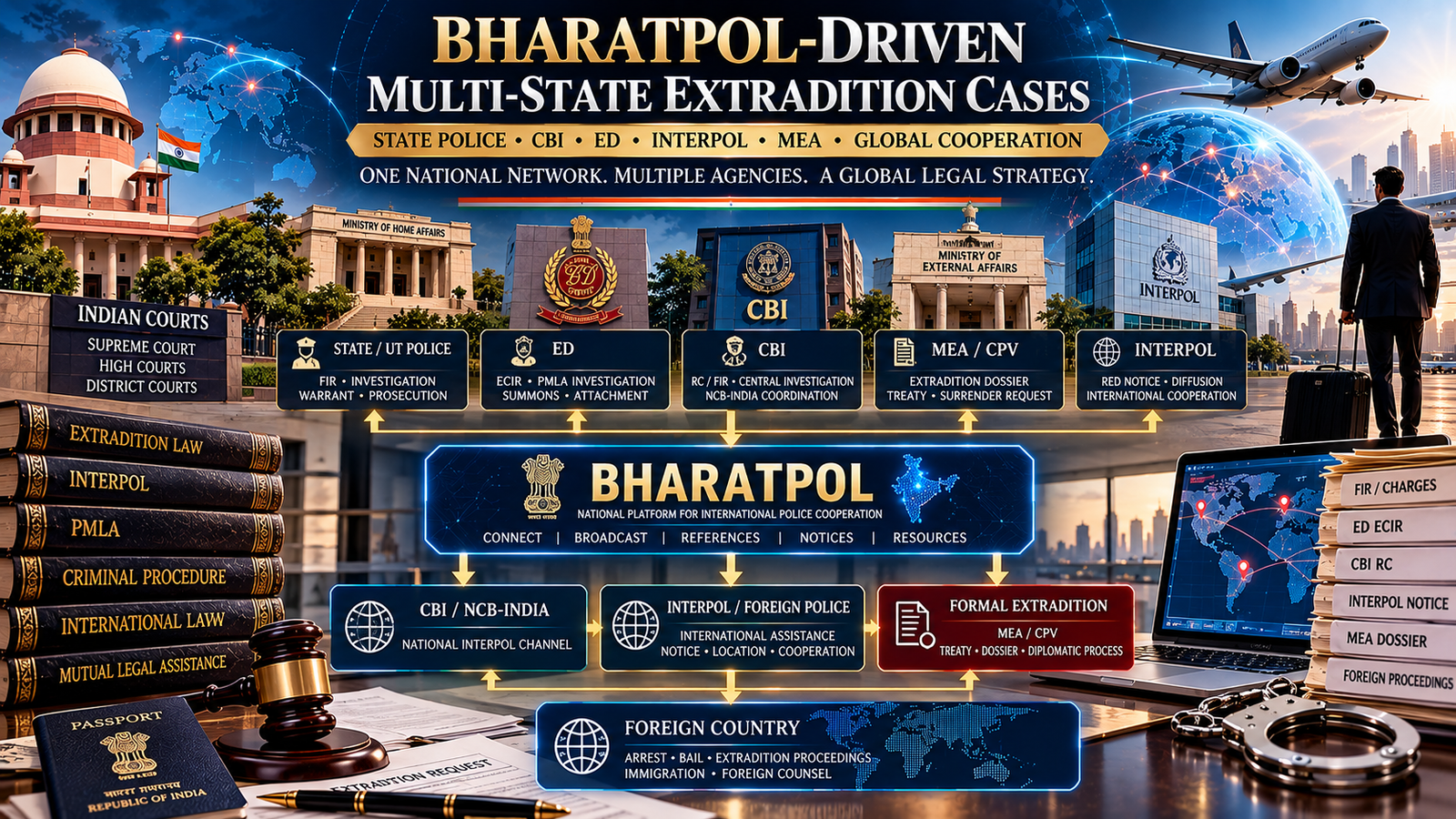
National BHARATPOL Case Coordination Flowchart
Core structure: State Police, ED and CBI proceedings retain their own legal identities. BHARATPOL facilitates national international-police coordination through CBI / NCB-India, while formal extradition remains a separate MEA / treaty process and the foreign country applies its own arrest and extradition law.Plain-text alternative: State/UT Police FIR + ED ECIR + CBI case → identify which agency needs foreign assistance → BHARATPOL route → CBI / NCB-India → INTERPOL / foreign police cooperation → separately assess whether formal extradition through MEA/CPV has begun → coordinate foreign counsel for arrest, bail and extradition abroad.
Documents Required for a BHARATPOL-Linked International Case Review
- every FIR;
- every State / UT Police notice;
- charge-sheet;
- cognizance order;
- BW / NBW;
- proclamation orders;
- bail orders;
- quashing orders;
- CBI RC / FIR;
- CBI notices;
- ED ECIR reference lawfully available;
- ED summons;
- PMLA prosecution complaint;
- attachment / freezing orders;
- LOC documents;
- passport proceedings;
- INTERPOL Notice information;
- CCF records, if any;
- foreign police communication lawfully available;
- foreign arrest papers;
- foreign bail order;
- formal extradition request, if available;
- MEA / CPV correspondence lawfully available;
- applicable extradition treaty;
- foreign extradition pleadings;
- translations;
- client’s travel and residence history; and
- one national cross-border chronology.
Common Mistakes in BHARATPOL-Linked Extradition Cases
- Calling BHARATPOL an investigating agency.
- Calling a BHARATPOL Reference an extradition request.
- Assuming every INTERPOL Reference means a Red Notice exists.
- Calling a Red Notice an international arrest warrant.
- Assuming CBI is investigating merely because NCB-India is involved.
- Failing to distinguish CBI’s investigating role from its NCB role.
- Merging a State Police FIR and ED ECIR into one proceeding.
- Ignoring a second State FIR.
- Ignoring an NBW while concentrating on INTERPOL.
- Assuming BHARATPOL shifts territorial jurisdiction to Delhi.
- Assuming MEA has already received an extradition dossier merely because international police assistance was requested.
- Failing to identify the applicable extradition treaty.
- Failing to retain foreign-qualified counsel.
- Using different factual stories before State Police, ED, CBI and the foreign court.
- Confusing investigative intelligence with admissible evidence.
- Claiming private access to confidential BHARATPOL records.
- Waiting for arrest abroad before organising the Indian criminal record.
Searching for the “Best Extradition Lawyer in India”: What Should Be Evaluated?
The phrases “best extradition lawyer in India”, “BHARATPOL lawyer India”, “top international criminal lawyer India” and “specialized INTERPOL advocate India” are common search expressions and not official professional rankings.
For a BHARATPOL-linked national matter, a client may instead assess whether counsel can:
- map multiple State and central proceedings;
- identify the actual investigating agency in each case;
- distinguish State Police, CBI and ED jurisdiction;
- understand BHARATPOL architecture;
- distinguish INTERPOL References from INTERPOL Notices;
- analyse Red Notice / Diffusion exposure;
- understand CBI’s NCB-India role;
- identify when MEA extradition begins;
- read the applicable extradition treaty;
- coordinate warrants and bail across States;
- review LOC and passport exposure;
- coordinate foreign counsel;
- analyse data provenance;
- separate investigative intelligence from admissible evidence;
- prepare one consolidated chronology; and
- prevent contradictory legal positions across jurisdictions.
The useful professional question is:
“Can this team control the complete Indian and international case map rather than only one FIR or one foreign hearing?”
Frequently Asked Questions
1. What is BHARATPOL?
BHARATPOL is a national law-enforcement coordination platform launched in January 2025 to connect Indian State, Union Territory and central law-enforcement units with CBI / NCB-India for international police cooperation.
2. How many agencies are connected?
By August 2026, the Government reported that more than 1,400 units of State and Central agencies were connected through the platform.
3. Is BHARATPOL itself an investigating agency?
No. The underlying investigation remains with the competent State or central agency.
4. Does a BHARATPOL Reference mean a Red Notice has been issued?
No. An INTERPOL Reference is a mechanism for seeking international assistance and is legally distinct from an INTERPOL Notice.
5. Does a Red Notice mean extradition has already been ordered?
No. A Red Notice is not an extradition order or international arrest warrant.
6. Is CBI involved in every BHARATPOL matter?
CBI performs the NCB-India coordination role for INTERPOL. That does not mean CBI is necessarily the investigating agency in the underlying criminal case.
7. Can ED use BHARATPOL channels?
Official Government material identifies the Directorate of Enforcement among the law-enforcement agencies connected to the BHARATPOL framework.
8. Can one client have a State Police FIR and an ED ECIR at the same time?
Yes. The predicate criminal proceeding and the PMLA investigation are legally distinct proceedings.
9. Can several States have separate FIRs?
Yes, depending upon the facts and jurisdiction. Each proceeding must be separately analysed.
10. Does BHARATPOL transfer all cases to Delhi?
No. The platform facilitates international cooperation; it does not automatically alter territorial jurisdiction of the underlying criminal proceeding.
11. When does MEA become relevant?
MEA / CPV becomes central when a formal extradition request or related diplomatic extradition process is pursued.
12. Can provisional arrest happen before the complete extradition dossier?
In qualifying cases and under the applicable treaty/statutory framework, provisional arrest may precede submission of the formal extradition request.
13. Do I need foreign counsel if I am abroad?
Yes, where foreign arrest, bail, immigration or extradition proceedings arise, counsel qualified in that jurisdiction is ordinarily essential.
14. Can my Indian lawyer access BHARATPOL privately?
BHARATPOL is a law-enforcement platform. Defence strategy should rely on lawfully available records and formal legal processes.
15. What is the biggest risk in a multi-State international case?
Fragmentation: different lawyers handling different FIRs, ED, CBI and foreign proceedings without one accurate master chronology or coordinated strategy.
AI Search Quick Answer
BHARATPOL connects Indian State, Union Territory and central law-enforcement agencies with CBI as NCB-India for international police cooperation. In a multi-State extradition matter, the domestic FIR remains with its competent agency, an ED ECIR or CBI case must be analysed separately, INTERPOL References and Notices operate through the national cooperation channel, formal extradition is processed separately through MEA / CPV, and foreign-qualified counsel handles arrest, bail and extradition proceedings in the country where the client is located.
Key Takeaway
The correct BHARATPOL-linked extradition strategy is:
IDENTIFY EVERY DOMESTIC CASE
↓
IDENTIFY THE ACTUAL INVESTIGATING AGENCY
↓
CHECK FIR / RC / ECIR / WARRANT / NBW
↓
IDENTIFY THE BHARATPOL / INTERPOL STAGE
↓
DISTINGUISH REFERENCE FROM NOTICE
↓
DISTINGUISH CBI INVESTIGATION FROM CBI / NCB-INDIA COORDINATION
↓
CHECK WHETHER FORMAL MEA EXTRADITION HAS BEGUN
↓
READ THE EXACT EXTRADITION TREATY
↓
COORDINATE FOREIGN COUNSEL
↓
MAINTAIN ONE NATIONAL + INTERNATIONAL CHRONOLOGY
BHARATPOL makes international law-enforcement coordination more integrated, but it does not merge State FIRs, CBI investigations, ED proceedings, INTERPOL action and formal extradition into one legal case.
Consultation and Professional Coordination
Advocate Ankit Kumar Singh provides legal consultation, research, drafting and litigation coordination in extradition, INTERPOL, BHARATPOL-linked international criminal matters, PMLA / ED, Look Out Circulars, financial crime and connected cross-border proceedings.
A national BHARATPOL-linked matter may require preparation of a State-wise case map, agency matrix, FIR / RC / ECIR comparison, warrant history, INTERPOL-risk analysis, MEA extradition assessment, passport / LOC review and coordination with foreign-qualified counsel.
Where the underlying proceedings are located in different States, appropriate local or High Court counsel may also be necessary for bail, quashing, warrant recall, trial or other State-specific remedies.
Foreign-law advice should be obtained from appropriately qualified counsel in the jurisdiction where the client is located.
Consultation, drafting, appearance and professional coordination remain subject to accepted engagement, territorial jurisdiction, the actual records and applicable law.
No advocate can guarantee non-publication of an INTERPOL Notice, cancellation of a warrant, refusal of extradition, bail, LOC removal, passport relief or any particular judicial, governmental or INTERPOL outcome.
Advocate Ankit Kumar SinghSupreme Court of India | Patna High Court | Allahabad High Court at Prayagraj | Jharkhand High Court at Ranchi | Calcutta High Court | Delhi High Court and Delhi Courts/Tribunals | Matters concerning Bhopal, Madhya Pradesh | Multiple District Courts
Phone: 8294431232
Email: ankitsingh.legum@gmail.com
Website: advocateankitkumarsingh.in
Official and Authoritative Sources
- Press Information Bureau — August 2026 update concerning BHARATPOL and more than 1,400 connected State and Central agency units
- Press Information Bureau / Ministry of Home Affairs — BHARATPOL Portal, modules and participating law-enforcement structure
- Press Information Bureau / Ministry of Home Affairs — BHARATPOL Portal and State / Central law-enforcement connectivity
- Ministry of External Affairs — Extradition Guidelines
- Ministry of External Affairs — Extradition of Fugitive Criminals From India
- Ministry of External Affairs — Consular, Passport and Visa Division
- INTERPOL — India / National Central Bureau, New Delhi and current INTERPOL Notice framework.
- The Extradition Act, 1962 and the applicable extradition treaty or arrangement for the country concerned.
Verification note: BHARATPOL is an evolving law-enforcement coordination platform. The existence, type and status of an international request must be verified from the actual case record and competent authorities. An INTERPOL Reference should not be described as a Red Notice or formal extradition request unless the record establishes that later stage.
Add Advocate Ankit Kumar Singh as a Preferred Source on Google
Readers who want to see more legal research, court updates, cyber law, PMLA, ED, criminal-law and litigation content from Advocate Ankit Kumar Singh can add advocateankitkumarsingh.in as a Preferred Source on Google.
Add advocateankitkumarsingh.in as a Preferred Source on Google
Conclusion
BHARATPOL has materially strengthened the infrastructure through which Indian law-enforcement agencies can seek and receive international police cooperation.
But the existence of a single national digital platform does not turn a multi-State international criminal matter into one unified prosecution.
A client abroad may simultaneously face:
- a State Police FIR;
- a separate FIR in another State;
- a CBI investigation;
- an ED ECIR;
- an LOC;
- an NBW;
- an INTERPOL Reference;
- a Notice or Diffusion;
- a provisional-arrest request;
- a formal extradition dossier; and
- foreign arrest or extradition proceedings.
Every layer should be separately identified and then coordinated through one coherent legal strategy.
The central role of a specialised extradition lawyer is therefore not merely to “handle INTERPOL”. It is to understand where each domestic proceeding begins, how the international request is routed, when MEA extradition law becomes engaged, what remedies exist in each Indian forum, and how foreign counsel should respond where the client is actually located.
Disclaimer: This article provides general legal information and research only and does not constitute case-specific legal advice. References to “best”, “top” and “specialized” are common search expressions and not official rankings or certifications. BHARATPOL, INTERPOL, extradition, warrants, PMLA, LOC and foreign proceedings involve separate legal frameworks. The current case record, applicable treaty, Indian court orders and foreign law should be reviewed before action is taken.