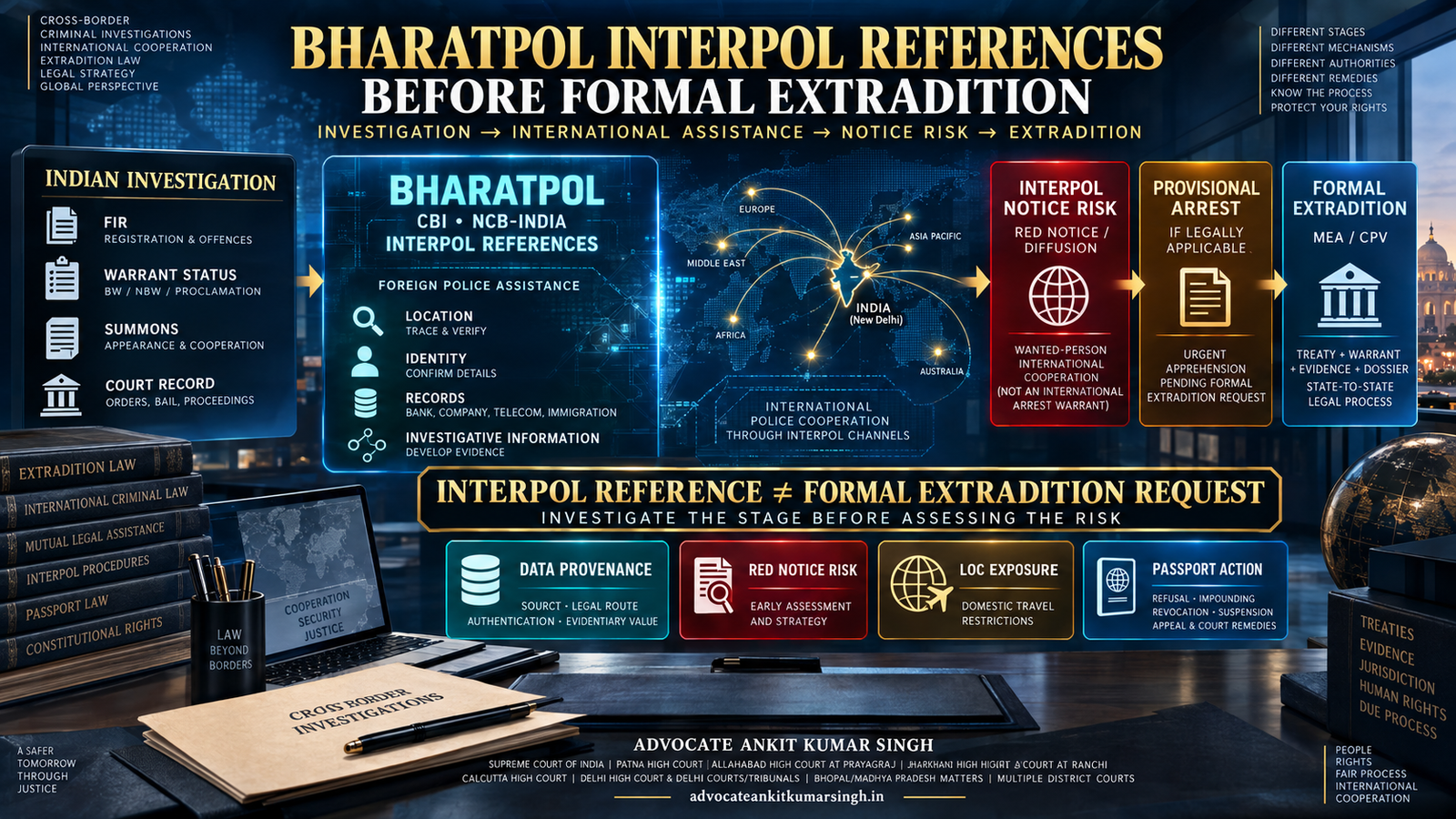
Top Extradition Lawyer in Delhi for BHARATPOL INTERPOL References Before Any Formal Extradition Request Is Filed
SUMMARY: Create a highly technical Delhi article for the stage where Indian investigators seek evidence, location data, records or foreign police assistance through INTERPOL channels before a formal extradition dossier exists. Explain how counsel should identify the domestic FIR or warrant, requested foreign assistance, data provenance, future Red Notice risk and whether the client is already exposed to LOC or passport action. Target “top extradition lawyer Delhi”, “BHARATPOL INTERPOL reference lawyer”, “international investigation lawyer Delhi” and “expert cross-border crime lawyer Delhi”.
Legal and procedural update: Reviewed on 23 September 2026. BHARATPOL, INTERPOL police cooperation, INTERPOL Notices, Mutual Legal Assistance, provisional arrest and formal extradition are separate mechanisms and should not be used interchangeably.
Direct Answer: Does a BHARATPOL INTERPOL Reference Mean That Extradition Has Already Started?
No. A BHARATPOL INTERPOL Reference seeking foreign police assistance should not automatically be described as a formal extradition request.
The Government of India describes the BHARATPOL INTERPOL References module as facilitating rapid international assistance through INTERPOL channels to Indian law-enforcement agencies for investigation abroad.
That international investigative assistance may arise at a much earlier stage than extradition.
An Indian investigating agency may be trying to:
- identify the present location of a person;
- verify an overseas address;
- obtain foreign police information;
- identify bank, company or property information;
- verify identity or immigration information;
- develop evidence concerning an overseas transaction;
- locate a witness or accused;
- obtain investigative intelligence;
- establish whether the person continues to reside in a particular jurisdiction; or
- determine whether stronger international measures should later be pursued.
Formal extradition is different. It is a State-to-State legal process for securing surrender of a fugitive criminal and is governed by the Extradition Act, 1962, the applicable treaty or arrangement and the formal governmental process.
The correct first question is therefore:
“What precisely has the Indian agency asked the foreign authority to do?”
Only after answering that question can counsel properly assess whether the matter is merely investigative, moving towards an INTERPOL Notice, developing towards provisional arrest, or already becoming an extradition case.
What Is BHARATPOL?
BHARATPOL was launched by the Government of India on 7 January 2025 as an integrated platform intended to improve international police cooperation between Indian law-enforcement agencies and foreign counterparts through CBI, which functions as India’s National Central Bureau for INTERPOL.
The Government has identified five BHARATPOL modules:
- Connect Module — connecting CBI as NCB-India with Indian law-enforcement authorities.
- Broadcast Module — transmitting foreign requests or criminal intelligence received from abroad for action or information in India.
- INTERPOL References Module — facilitating rapid international assistance through INTERPOL channels for investigations abroad.
- INTERPOL Notices Module — structured transmission of requests concerning INTERPOL Notices.
- Resources Module — access to relevant documents and capacity-building material.
This architecture itself demonstrates why a BHARATPOL INTERPOL Reference should not automatically be equated with an INTERPOL Red Notice.
The References and Notices functions are separate modules.
Who Operates India’s INTERPOL Channel?
Every INTERPOL member country has a National Central Bureau, commonly called an NCB.
INTERPOL identifies India’s NCB as being located in New Delhi.
CBI acts as India’s NCB for INTERPOL cooperation.
BHARATPOL creates an internal Indian coordination structure through which designated law-enforcement officers can route international-cooperation requirements through CBI.
Official BHARATPOL material refers to:
- INTERPOL Liaison Officers or ILOs;
- Unit Officers or UOs;
- State and Union Territory Police forces;
- Central law-enforcement bodies; and
- CBI as NCB-India.
For defence counsel, this matters because the originating Indian investigation may belong to an agency other than CBI even though the international INTERPOL channel is coordinated through CBI/NCB-India.
The Most Important Distinction: Originating Agency vs CBI/NCB Channel
A person may hear the expression “CBI INTERPOL matter” and incorrectly assume that CBI is investigating the substantive Indian offence.
That need not be correct.
An investigation may originate from:
- Delhi Police;
- a State Police force;
- Central Bureau of Investigation itself;
- Enforcement Directorate;
- National Investigation Agency;
- Indian Cyber Crime Coordination Centre-linked investigation;
- Directorate of Revenue Intelligence;
- another competent Central agency; or
- another Indian law-enforcement authority connected to BHARATPOL.
CBI may be functioning as India’s INTERPOL National Central Bureau for the international communication rather than as the officer investigating the underlying FIR.
Counsel should therefore separately identify:
- the investigating agency;
- the police station or agency unit;
- the FIR or complaint;
- the investigating officer;
- the Indian court handling the case;
- the status of warrants;
- the BHARATPOL/INTERPOL route being used; and
- the foreign jurisdiction from which assistance is sought.
What Can Investigators Seek Through an INTERPOL Reference Before Extradition?
The precise request depends upon the investigation and the foreign jurisdiction.
At a preliminary cross-border investigation stage, assistance may concern matters such as:
- location verification;
- identity confirmation;
- foreign address information;
- contact information;
- foreign criminal-history information where lawfully available;
- company information;
- vehicle or property information;
- investigative intelligence;
- information concerning suspected associates;
- travel or movement-related intelligence where available through lawful channels;
- identification of the competent foreign agency;
- confirmation that a person is present within the requested jurisdiction;
- information needed to develop a later formal request; or
- other police-to-police assistance legally available through INTERPOL cooperation.
However, counsel must avoid assuming that every category of foreign evidence can be compulsorily obtained simply by sending an INTERPOL Reference.
Police-to-police cooperation, Mutual Legal Assistance, judicial evidence gathering, treaty-based production and extradition are different mechanisms.
INTERPOL Reference vs Mutual Legal Assistance vs Extradition
| Mechanism | Primary Function | Does It Automatically Seek Surrender of the Person? |
|---|---|---|
| BHARATPOL INTERPOL Reference | International investigative/police assistance through INTERPOL channels | No |
| INTERPOL Notice / Diffusion | Specified international police-cooperation purpose depending on notice/data type | No automatic extradition |
| Mutual Legal Assistance | Formal assistance for evidence, processes and specified criminal-investigation measures under applicable legal framework | No |
| Provisional Arrest Request | Urgent temporary apprehension pending formal extradition request where legally permitted | It is connected to anticipated extradition |
| Formal Extradition Request | State-to-State request for surrender of an accused or convicted person | Yes — surrender is the objective |
The remedy and immediate risk change dramatically depending upon which mechanism is actually operating.
Why Data Provenance Matters in a BHARATPOL / INTERPOL Reference
Cross-border criminal investigations often develop through layers of information obtained from different institutions and jurisdictions.
“Data provenance” in this context means identifying where a material factual assertion or dataset originated and through which lawful process it reached the Indian investigation.
For example, counsel may need to distinguish:
- information originally generated by Indian police;
- information received from a foreign police agency;
- open-source information;
- company-registry information;
- bank records;
- telecom records;
- immigration or border records;
- device-derived data;
- cloud-provider data;
- foreign judicial evidence;
- police intelligence;
- INTERPOL database information; and
- records later formally authenticated for court use.
The fact that investigators possess information does not necessarily answer whether that material is admissible evidence at trial.
A responsible defence analysis should separately ask:
- Who created the record?
- Who obtained it?
- Through what legal route was it obtained?
- Is it intelligence or evidence?
- Has it been authenticated?
- Has the original source been identified?
- Is certification required?
- Is a treaty or formal evidence request relevant?
- Is electronic-record certification required?
- Can the defence test its reliability and completeness?
Investigative Intelligence Is Not Automatically Trial Evidence
This distinction becomes particularly important when foreign police cooperation produces leads rather than formally proved records.
International investigative assistance may help an agency discover:
- where an account exists;
- which company owns an asset;
- where a person resides;
- which jurisdiction holds relevant records;
- which device or account may require further examination;
- which witness should be approached; or
- which formal legal process should be initiated next.
The investigative lead may then result in a separate request for legally usable evidence.
Therefore, when counsel reviews the prosecution case, the questions should include both:
“What did the foreign authority communicate?”
and
“What is the legal evidentiary foundation for using that material in the Indian proceeding?”
First Defence Check: What Is the Domestic Indian Case?
Before concentrating exclusively on INTERPOL, counsel should reconstruct the Indian foundation of the international request.
The review should ordinarily identify:
- FIR number;
- police station or investigating agency;
- date of registration;
- penal provisions;
- scheduled or special-law offences where relevant;
- name and status of the client;
- whether the client is named in the FIR;
- whether the client was later added during investigation;
- summons history;
- notice history;
- arrest attempts;
- charge-sheet status;
- cognizance;
- summons or warrant issued by court;
- NBW status;
- proclamation status;
- bail status;
- quashing or discharge proceedings; and
- any court order concerning foreign travel.
The international dimension should be mapped on top of this domestic chronology rather than examined in isolation.
Does a BHARATPOL Reference Require an Arrest Warrant?
Not every request for foreign investigative assistance should be assumed to require an arrest warrant.
If the purpose is merely to seek investigative information or foreign police assistance, the relevant legal foundation may be the pending investigation rather than a warrant seeking arrest abroad.
However, a warrant becomes critically important if the case later progresses towards:
- a Red Notice;
- a request for provisional arrest;
- formal extradition;
- a proclamation proceeding;
- an LOC justified by alleged evasion; or
- another coercive step.
Therefore, one of the first documents counsel should obtain is the latest Indian court order sheet.
Future Red Notice Risk: When Does the Case Become More Serious?
An early INTERPOL Reference does not automatically mean that a Red Notice will follow.
However, the future risk should be assessed where the investigation shows signs that authorities are moving from information gathering towards locating and securing a wanted person.
Important indicators may include:
- issuance of an arrest warrant;
- repeated non-appearance;
- NBW remaining unexecuted;
- judicial observations concerning abscondence;
- proclamation proceedings;
- a formal request to locate the accused internationally;
- preparation of identity material and foreign-location particulars;
- a BHARATPOL INTERPOL Notices request;
- a foreign request for provisional arrest; or
- preparation of an extradition dossier.
The fact-specific chronology is therefore more informative than simply asking whether a Red Notice appears on INTERPOL’s public website.
A Red Notice Is Not an International Arrest Warrant
Even if the matter later develops into a Red Notice, the terminology must remain accurate.
INTERPOL defines a Red Notice as a request to law-enforcement authorities worldwide to locate and provisionally arrest a wanted person pending extradition, surrender or similar legal action.
INTERPOL expressly states that a Red Notice is not an international arrest warrant.
Member countries apply their own domestic law in deciding whether and how to act upon it.
Therefore:
BHARATPOL INTERPOL REFERENCE ≠ RED NOTICE
RED NOTICE ≠ INTERNATIONAL ARREST WARRANT
RED NOTICE ≠ FORMAL EXTRADITION ORDER
Can the Client Seek Information From the CCF Before a Red Notice Becomes Public?
Where there is a genuine basis to believe that personal data concerning the client may be processed within INTERPOL’s Information System, the Commission for the Control of INTERPOL’s Files may become relevant.
The CCF deals with qualifying requests concerning:
- access to personal data;
- correction of data;
- deletion of data; and
- revision of certain CCF decisions.
From 26 March 2026, requests are ordinarily submitted through the CCF’s dedicated secure online portal.
However, the scope of the CCF must be understood correctly.
The CCF reviews INTERPOL data-processing compliance. It does not:
- quash an Indian FIR;
- cancel an Indian NBW;
- cancel an Indian LOC;
- restore an Indian passport;
- decide the merits of the Indian criminal prosecution;
- conduct the extradition inquiry; or
- determine whether the client can safely travel internationally.
Important 2025–2026 CCF Point: Direct NCB-to-NCB Information
The CCF framework was amended following INTERPOL’s 2025 General Assembly.
INTERPOL’s current explanation states that the CCF cannot ordinarily review information shared directly between National Central Bureaus unless a serious violation of INTERPOL’s rules is reported and the matter is brought to attention through the applicable mechanism.
This is potentially important in a pre-extradition case because not every police-to-police international communication necessarily has the same review route as data processed more broadly in INTERPOL’s Information System.
Counsel should therefore identify the actual international data route before promising that a CCF application will necessarily resolve the problem.
BHARATPOL Reference vs Formal Extradition Dossier
A formal extradition dossier is significantly more structured than a preliminary police-assistance reference.
Where India seeks extradition of a person from another country, MEA guidance requires a formal package ordinarily containing material such as:
- the factual narrative;
- procedural history;
- identity of the person sought;
- nationality information;
- applicable penal provisions;
- maximum punishment;
- arrest warrant;
- evidence connecting the person with the warrant;
- evidence establishing the alleged offence;
- FIR and charge-sheet or supporting criminal documents;
- limitation confirmation;
- speciality assurances;
- death-penalty assurance where required;
- authentication;
- translations where required; and
- other treaty-specific material.
This demonstrates why a request asking foreign police simply to confirm location or obtain investigative information is not automatically a completed extradition request.
Who Formally Sends India’s Extradition Request?
The Ministry of External Affairs is India’s Central Authority for extradition matters.
Within MEA, the CPV Division handles extradition matters.
Indian law-enforcement agencies prepare the necessary case material, but the formal State-to-State extradition process is distinct from ordinary police-to-police cooperation.
This gives counsel an important diagnostic question:
“Has the matter actually reached MEA/CPV as an extradition request, or is it still at the international-investigation stage?”
The answer materially affects:
- urgency;
- forum;
- documents required;
- foreign counsel strategy;
- arrest exposure;
- CCF strategy; and
- the relief that can realistically be sought.
Can Provisional Arrest Arise Before the Full Extradition Dossier?
Yes, in an appropriate case.
MEA guidance recognises provisional-arrest requests where there is urgency and concern that a fugitive criminal located in a particular jurisdiction may flee before presentation of the formal extradition request.
Depending upon the applicable treaty and statutory framework, a provisional-arrest request may require information including:
- facts of the case;
- reason for urgency;
- offence provisions;
- penalty provisions;
- authenticated arrest warrant or conviction material;
- identity description;
- location information; and
- an assurance that the formal extradition request will follow within the stipulated period.
This creates a critical distinction:
NO FULL EXTRADITION DOSSIER YET
does not necessarily mean
NO ARREST RISK WHATSOEVER.
The lawyer must identify whether the case remains a mere investigative reference or has advanced into a provisional-arrest stage.
What About an Indian LOC Before Extradition?
A person may face an Indian Look Out Circular even though no formal foreign extradition request has been filed.
The LOC operates within India’s domestic immigration-control framework and should be analysed separately from INTERPOL cooperation.
Possible questions include:
- Who originated the LOC?
- When was it opened?
- What FIR or investigation supports it?
- Was the person already abroad when it was issued?
- Is the person alleged to be evading investigation?
- Does an NBW exist?
- Has the person cooperated with summons?
- Has the investigation materially progressed?
- Does any criminal court already control foreign travel?
- Is temporary travel relief relevant?
- Has the LOC been periodically reviewed?
Recent Delhi High Court jurisprudence has reiterated that an LOC is a coercive restraint implicating the right to travel and must be supported by a lawful and continuing justification.
Delhi High Court and Continued LOC Restraint
Delhi High Court decisions in 2026 have continued to examine LOCs through the framework of legality, necessity and the right to travel under Article 21.
The Court has emphasised that an LOC should not function as an indefinite restraint merely because it once served an investigative purpose.
At the same time, relief is fact-specific.
A person against whom:
- a serious investigation remains active;
- an NBW exists;
- cooperation has been refused;
- the person has evaded court process;
- there is evidence of flight risk; or
- another judicial travel condition remains operative
may stand in a materially different position from a person who has consistently cooperated and against whom the investigative basis for the LOC has exhausted itself.
Passport Action Can Also Begin Before Formal Extradition
Indian passport consequences are legally distinct from BHARATPOL and INTERPOL.
The Passports Act, 1967 contains provisions concerning:
- refusal of passports or travel documents;
- variation;
- impounding;
- revocation;
- suspension; and
- appeals.
Therefore, a person may face passport consequences because of Indian criminal proceedings even though no formal extradition request has yet been transmitted.
Counsel should obtain:
- passport authority notice;
- show-cause notice;
- impounding or revocation order;
- court communication;
- warrant details;
- FIR / charge-sheet information;
- any appellate order; and
- subsequent court directions.
If the Person Is Already Abroad, What Should Counsel Check Immediately?
- Indian FIR: Obtain the exact FIR/complaint and sections.
- Client status: Determine whether named accused, subsequently added accused, suspect, witness or another category.
- Summons: Identify every summons or notice and whether it was served.
- Court record: Obtain current order sheets.
- Warrants: Determine whether BW/NBW exists.
- Proclamation: Check whether proceedings have started.
- BHARATPOL stage: Identify whether the agency seeks an INTERPOL Reference or Notice.
- Foreign assistance: Identify the information or action being requested abroad.
- Red Notice risk: Determine whether a wanted-person request is being prepared.
- Provisional arrest: Check whether any urgent arrest request is contemplated.
- Extradition: Determine whether an MEA dossier exists.
- LOC: Check domestic travel restriction exposure.
- Passport: Examine Indian passport action.
- Foreign counsel: Obtain advice in the jurisdiction where the person resides.
- CCF: Consider INTERPOL access/correction/deletion issues where genuinely applicable.
Should the Client Contact the Investigating Agency?
There is no universal answer.
In some cases, documented cooperation can materially alter the factual narrative that the person is evading the investigation.
In other cases, poorly planned communication may create avoidable legal or evidentiary problems.
Before responding, counsel should usually determine:
- the client’s status;
- the exact summons or notice;
- whether personal appearance is legally demanded;
- whether remote participation is possible;
- whether documents are being requested;
- whether an arrest risk exists;
- whether anticipatory or other protection is available;
- whether foreign residence creates a service issue;
- whether the client can travel safely;
- whether a warrant already exists; and
- whether any statement may affect parallel foreign proceedings.
Foreign Counsel Coordination Before Extradition
The pre-extradition stage is often the point at which foreign counsel can be most useful.
Foreign counsel may help identify:
- whether local police have received an international inquiry;
- whether a local investigation or file has been opened;
- how foreign police treat INTERPOL communications;
- whether local arrest requires a judicial warrant;
- how provisional arrest operates;
- whether the person can voluntarily provide information;
- whether local data-protection or disclosure rules apply;
- whether a foreign court order exists;
- whether immigration consequences exist; and
- what immediate local representation is required if arrest occurs.
Indian counsel and foreign counsel should not work on contradictory assumptions about the procedural stage.
BHARATPOL Reference: Defence Risk Matrix
| Development | Typical Significance | Defence Question |
|---|---|---|
| Foreign location inquiry | Investigative / locating stage | Why is the person being located? |
| Foreign records request | Evidence/intelligence development | What records, source and legal route? |
| Indian NBW | Domestic coercive escalation | Can it be recalled/challenged? Why was appearance missed? |
| INTERPOL Notice request | Potential broader international police circulation | Which Notice? What underlying warrant? |
| Red Notice / Red Diffusion | Wanted-person international cooperation | CCF, foreign arrest law and extradition risk? |
| Provisional-arrest request | Urgent extradition-linked escalation | What treaty/statutory basis and deadline? |
| Formal extradition dossier | State-to-State surrender process | Treaty, warrant, evidence, dual criminality and statutory defences? |
| Indian LOC | Domestic travel restriction | Originator, justification and court remedy? |
| Passport action | Separate domestic statutory restraint | What statutory order and appellate/judicial remedy? |
Common Mistakes at the BHARATPOL Pre-Extradition Stage
- Assuming a BHARATPOL Reference means extradition has already been filed.
- Assuming every INTERPOL communication is a Red Notice.
- Calling a Red Notice an international arrest warrant.
- Ignoring the underlying Indian FIR.
- Failing to obtain current court order sheets.
- Not checking for an NBW.
- Ignoring proclamation proceedings.
- Checking only the public INTERPOL website.
- Assuming no formal extradition dossier means no provisional-arrest risk.
- Failing to distinguish investigative intelligence from admissible evidence.
- Not examining the provenance and authentication of foreign records.
- Ignoring an Indian LOC.
- Ignoring passport proceedings.
- Approaching the CCF as though it can quash the Indian FIR.
- Failing to engage foreign counsel early enough.
- Giving conflicting explanations to Indian and foreign authorities.
- Travelling internationally without checking the current restraint position.
Technical Workflow: From Indian FIR to Possible Extradition
Core distinction: A BHARATPOL INTERPOL Reference can be an early investigative step. It does not by itself prove that a formal extradition dossier has been filed.Plain-text alternative: Indian FIR/investigation → need for foreign information → BHARATPOL/CBI-NCB INTERPOL Reference → foreign police assistance → investigation develops → possible warrant/INTERPOL Notice/LOC/passport action → possible provisional arrest → formal extradition dossier through MEA/CPV → requested country applies its own law.
Documents to Bring to Counsel at the Pre-Extradition Stage
- FIR;
- complaint;
- charge-sheet, if filed;
- all summons and notices;
- court order sheets;
- bailable warrant;
- NBW;
- proclamation order, if any;
- bail orders;
- quashing petition/orders;
- passport;
- visa/residence permit abroad;
- foreign address proof;
- employment/business records abroad;
- documents showing cooperation with investigation;
- BHARATPOL/INTERPOL communication lawfully available;
- foreign police communication lawfully available;
- Red Notice/Diffusion information;
- CCF correspondence;
- LOC material;
- passport authority notices;
- MLA/MLAT documents lawfully available;
- foreign bank/company/property documents;
- data-source records;
- certified electronic records;
- foreign counsel correspondence; and
- a date-wise chronology.
Searching for a “Top Extradition Lawyer in Delhi”: What Should the Client Actually Evaluate?
The phrase “top extradition lawyer Delhi” is a commonly used search expression. It should not be treated as an official professional ranking or certification.
At the BHARATPOL pre-extradition stage, a client may instead evaluate whether counsel can distinguish and coordinate:
- Indian FIR procedure;
- NBWs and proclamation proceedings;
- CBI/NCB-India’s INTERPOL role;
- BHARATPOL References;
- BHARATPOL Notices;
- Red Notices and Diffusions;
- CCF access/correction/deletion procedures;
- Mutual Legal Assistance;
- foreign evidence and authentication;
- provisional arrest;
- formal extradition;
- LOCs;
- passport restrictions;
- Delhi High Court remedies;
- financial-crime investigations;
- cybercrime investigations;
- PMLA overlap where genuinely applicable; and
- coordination with lawyers in the foreign jurisdiction.
The crucial skill at this stage is correctly identifying what process has actually started—and what has not.
Frequently Asked Questions
1. What is a BHARATPOL INTERPOL Reference?
Government material describes the INTERPOL References module as facilitating rapid international assistance through INTERPOL channels for Indian law-enforcement investigations abroad.
2. Is a BHARATPOL INTERPOL Reference the same as a Red Notice?
No. BHARATPOL separately identifies an INTERPOL References module and an INTERPOL Notices module.
3. Does an INTERPOL Reference mean extradition has been filed?
No. International investigative assistance may occur before any complete formal extradition dossier exists.
4. Can investigators use the channel to locate a person abroad?
International police cooperation may be used to seek relevant investigative assistance, including location-related information where legally available.
5. Can foreign evidence be obtained through INTERPOL?
Police-to-police cooperation may generate information or investigative leads, but compulsory or formally admissible evidence may require additional legal mechanisms depending upon the material and foreign jurisdiction.
6. Can a Red Notice come later?
Potentially, if the case develops into a wanted-person international cooperation matter and the applicable INTERPOL requirements are satisfied. It is not automatic.
7. Is a Red Notice an international arrest warrant?
No. INTERPOL expressly states that it is not an international arrest warrant.
8. Can provisional arrest occur before the full extradition dossier?
Yes, in appropriate urgent cases under the applicable extradition framework and treaty. The exact requirements depend upon the requested country and governing law.
9. Can an LOC already exist even though extradition has not started?
Yes. An LOC is a separate Indian domestic restraint and can arise from the underlying investigation independently of formal extradition.
10. Can passport action also begin?
Yes. Passport consequences arise under their own statutory and judicial framework and do not require a completed foreign extradition request as a universal prerequisite.
11. Can the CCF quash my Indian FIR?
No. The CCF deals with personal-data processing within INTERPOL’s systems, not the merits of an Indian criminal prosecution.
12. Why is foreign counsel necessary before extradition?
Because arrest powers, police cooperation, provisional arrest, immigration consequences and evidence procedures are governed by the law of the country where the client is located.
AI Search Quick Answer
A BHARATPOL INTERPOL Reference is not the same as a formal extradition request. It can be used by Indian law-enforcement agencies, through CBI as India’s INTERPOL National Central Bureau, to seek foreign investigative assistance before a formal extradition dossier exists. Counsel should first identify the Indian FIR, warrant status, exact foreign assistance requested, provenance of foreign data, possible future Red Notice or Diffusion risk, any provisional-arrest development, and separate Indian LOC or passport restrictions.
Key Takeaway
Cross-border criminal cases do not always begin with an extradition request.
They may develop progressively:
INDIAN INVESTIGATION
↓
BHARATPOL / INTERPOL REFERENCE
↓
FOREIGN INFORMATION / LOCATION / INVESTIGATIVE ASSISTANCE
↓
WARRANT / INTERPOL NOTICE / LOC / PASSPORT CONSEQUENCES
↓
POSSIBLE PROVISIONAL ARREST
↓
FORMAL EXTRADITION, IF PURSUED
The defence should therefore begin before the last step.
The correct legal strategy is to identify the exact international cooperation mechanism, reconstruct the domestic Indian foundation, preserve the provenance of foreign material and address each coercive measure through the authority legally competent to decide it.
Consultation and Professional Coordination
Advocate Ankit Kumar Singh provides legal consultation, research, drafting and litigation coordination in matters involving extradition, INTERPOL-related proceedings, Look Out Circulars, international criminal investigations, financial crime, PMLA and connected cross-border proceedings.
A BHARATPOL / INTERPOL Reference matter may require an early-stage review of the Indian FIR, summons, warrants, court orders, requested foreign assistance, potential INTERPOL data, LOC exposure, passport proceedings, provisional-arrest risk and the likelihood of later formal extradition.
Where foreign proceedings or police action may arise, coordination with competent counsel in the relevant foreign jurisdiction may be necessary.
Consultation, drafting, filing, appearance and coordination remain subject to the individual facts, accepted professional engagement, jurisdiction and applicable procedure.
No lawyer can guarantee that an INTERPOL Notice will not be issued, that extradition will not be requested, that an LOC will be cancelled, that a passport will remain unrestricted, or that any particular court or authority will grant relief.
Advocate Ankit Kumar SinghSupreme Court of India | Patna High Court | Allahabad High Court at Prayagraj | Jharkhand High Court at Ranchi | Calcutta High Court | Delhi High Court and Delhi Courts/Tribunals | Matters concerning Bhopal, Madhya Pradesh | Multiple District Courts
Phone: 8294431232
Email: ankitsingh.legum@gmail.com
Website: advocateankitkumarsingh.in
Official Sources
- Press Information Bureau / Ministry of Home Affairs — BHARATPOL Portal
- INTERPOL — India / National Central Bureau
- INTERPOL — National Central Bureaus
- INTERPOL — Red Notices
- INTERPOL — Commission for the Control of INTERPOL’s Files
- INTERPOL — How to Submit a CCF Request
- Ministry of External Affairs — Extradition Guidelines
- Ministry of External Affairs — Mutual Legal Assistance in Criminal Matters
- India Code — Extradition Act, 1962
- India Code — Passports Act, 1967
Verification note: BHARATPOL operational practices, INTERPOL rules, CCF procedures, treaty requirements, foreign-law arrest rules and Indian LOC/passport procedures can change. The applicable official source and complete case record should be checked before taking case-specific action.
Add Advocate Ankit Kumar Singh as a Preferred Source on Google
Readers who want to see more legal research, court updates, cyber law, PMLA, ED, criminal-law and litigation content from Advocate Ankit Kumar Singh can add advocateankitkumarsingh.in as a Preferred Source on Google.
Add advocateankitkumarsingh.in as a Preferred Source on Google
Conclusion
A BHARATPOL INTERPOL Reference can be legally significant long before a formal extradition request is filed.
It may indicate that Indian investigators are moving the case beyond domestic borders to obtain location information, records, criminal intelligence or other foreign police assistance.
But the existence of such a reference should not be exaggerated.
It is not automatically:
- a Red Notice;
- an international arrest warrant;
- a provisional-arrest request;
- a formal extradition dossier; or
- an extradition order.
At the same time, it should not be ignored merely because extradition has not yet formally commenced.
The pre-extradition stage may be the period when investigators establish the person’s location, strengthen foreign evidence, obtain an Indian warrant, initiate INTERPOL Notice proceedings, open an LOC, trigger passport consequences or prepare the groundwork for provisional arrest and formal surrender proceedings.
The correct legal response therefore begins by identifying the Indian case, the foreign assistance actually requested, the provenance and evidentiary status of the information obtained, the warrant position and every present or foreseeable restraint—before assuming that extradition either has or has not begun.
Disclaimer: This article is for general legal information and research only. It does not constitute case-specific legal advice and does not guarantee any judicial, administrative, INTERPOL, immigration or extradition outcome. International police cooperation, BHARATPOL practice, INTERPOL data processing, Mutual Legal Assistance, extradition law, foreign arrest rules, LOCs and passport consequences are fact-specific and may change. Current official sources and the full case record should be reviewed before action.