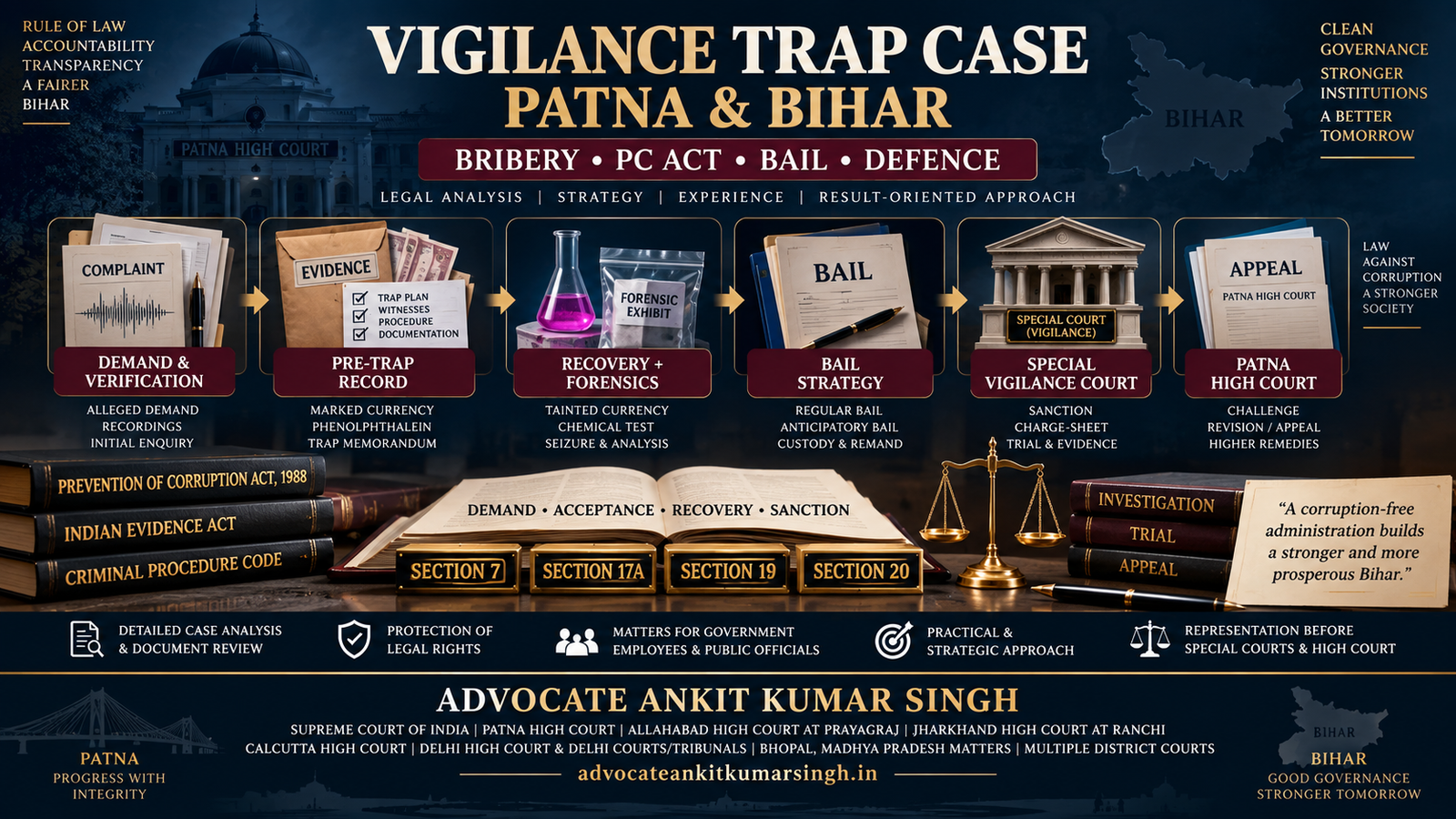
VIGILANCE | ANTI-CORRUPTION | PREVENTION OF CORRUPTION ACT | BRIBERY TRAP | BAIL | PATNA HIGH COURT
Searching for the Best Vigilance Lawyer in Patna? Advocate Ankit Kumar Singh for Bribery Trap, Red-Handed Arrest, PC Act Bail, Special Vigilance Court & Patna High Court Defence
Legally researched and updated: 19 September 2026
Supreme Court of India | Patna High Court | Allahabad High Court at Prayagraj | Jharkhand High Court at Ranchi | Calcutta High Court | Delhi High Court and Delhi Courts/Tribunals | Matters concerning Bhopal, Madhya Pradesh | Multiple District Courts
 Advocate Ankit Kumar Singh
Direct Answer: What Should You Do If Vigilance Says You Were Caught Red-Handed Taking a Bribe?
An allegation that a government employee was "caught red-handed" by a vigilance team is serious, but it does not mean that the legal analysis ends with the recovery of currency notes.
The defence should immediately reconstruct the entire chronology: the original complaint, verification of the alleged demand, telephone or electronic communication, constitution of the trap team, pre-trap memorandum, handling of currency notes, phenolphthalein treatment, alleged conversation at the place of trap, acceptance or attempted acceptance, recovery, hand-wash or other chemical test, post-trap memorandum, seizure, arrest, witnesses, electronic evidence and subsequent investigation.
A person searching online for the best vigilance lawyer in Patna, anti-corruption lawyer in Patna, bribery trap lawyer in Bihar or Prevention of Corruption Act advocate in Patna should therefore look beyond a promotional label. The real issue is whether counsel can analyse the statutory ingredients, trap record, evidence, bail position, sanction, Special Court procedure and possible Patna High Court remedies as one connected criminal case.
There is no official Patna High Court, Bar Council, Vigilance Department or Government ranking declaring any advocate the "best" vigilance lawyer. The phrase is used here only because it reflects how members of the public commonly search for legal assistance.
Who Conducts Vigilance and Anti-Corruption Investigations in Bihar?
The Government of Bihar's Vigilance Department identifies specialised investigative structures including the Vigilance Investigation Bureau (VIB), the Special Vigilance Unit (SVU) and the Technical Examiner Cell.
For search purposes people frequently use expressions such as "ACB Patna", "Anti-Corruption Bureau Bihar" or "anti-corruption police", but the actual agency named in the FIR, complaint, verification report, seizure papers or court record must be identified precisely.
A defence lawyer should therefore first ask: Which agency registered the case, under what police-station case number, under which statutory provisions, and before which notified Special Court is the case proceeding?
What Is a Vigilance Trap Case?
A trap case generally begins when a complainant alleges that a public servant has demanded money or another undue advantage in connection with an official act, omission, favour or exercise of influence.
A typical sequence may involve:
- Complaint alleging demand of bribe or undue advantage.
- Verification of the complaint or alleged demand.
- Decision to organise a trap.
- Preparation of marked currency and pre-trap documentation.
- Application of phenolphthalein powder or another forensic procedure where used.
- Instructions to the complainant and shadow/independent witnesses.
- Meeting between the complainant and accused.
- Alleged demand, acceptance or attempted acceptance.
- Pre-arranged signal to the trap team.
- Entry/intervention by the trap team.
- Recovery of currency or other material.
- Hand-wash, pocket-wash, bag-wash or other chemical testing where applicable.
- Preparation of seizure and post-trap memoranda.
- Arrest and registration/investigation of the criminal case.
- Forensic, electronic and documentary investigation.
- Prosecution sanction where legally required.
- Charge-sheet/final report and proceedings before the Special Judge.
The precise procedure in an individual case must be established from the actual record rather than assumed from a generic trap model.
Section 7 of the Prevention of Corruption Act: The Core Bribery Provision
Section 7 of the Prevention of Corruption Act deals with the offence relating to a public servant being bribed.
The amended statutory language is important. It covers a public servant who obtains, accepts or attempts to obtain an undue advantage with the legally specified improper or dishonest connection to performance or forbearance of public duty.
The law therefore cannot safely be reduced to: "Was money physically found in the accused's pocket?"
The enquiry can extend to:
- who allegedly demanded the money;
- what precisely was said;
- for which official act or forbearance it was allegedly sought;
- whether the accused accepted it knowingly;
- whether there was an attempt to obtain it;
- whether another person or intermediary was involved;
- whether electronic or circumstantial evidence connects the accused with the alleged demand.
Does the Prosecution Have to Prove Demand?
Demand remains one of the most important issues in a corruption prosecution, but its proof is not confined to one particular form of direct testimony.
In Neeraj Dutta v. State (Government of NCT of Delhi), the Constitution Bench of the Supreme Court explained that where direct evidence from the complainant is unavailable, demand may in an appropriate case be established through other evidence, including circumstantial evidence.
Accordingly, a defence based simply upon: "the complainant turned hostile, therefore the case automatically fails" may be legally incomplete.
The complete evidentiary record must be analysed.
Supreme Court 2026: Demand Through Another Person Cannot Be Ignored
In State by Lokayuktha Police v. Sri K. Rangayya & Anr., 2026 INSC 574, decided on 26 May 2026, the Supreme Court examined the post-amendment language of Section 7.
The Court stressed the significance of the statutory expressions "obtains", "accepts" and "attempts to obtain" and the Explanation dealing with obtaining an undue advantage through another person or third party.
The judgment is particularly important when an accused public servant says:
- "Nothing was recovered from me."
- "The money was received by another employee."
- "The complainant spoke only to an intermediary."
- "I was absent when the actual recovery occurred."
These may remain relevant factual defences, but they require a role-specific analysis of the FIR and evidence. They cannot automatically decide the entire case at the threshold.
Is Mere Recovery of Tainted Currency Enough?
Recovery is important evidence, but a criminal court examines the entire chain, including the alleged demand, acceptance or attempted acceptance and the circumstances surrounding possession of the currency.
This is why the defence should investigate questions such as:
- Was there reliable proof of the earlier demand?
- Was the alleged conversation at the trap location recorded?
- Who witnessed the alleged acceptance?
- Where exactly was the money recovered?
- Was it recovered from the accused's hand, clothing, drawer, bag, table or another person?
- Who had access to that location?
- Did the accused give an immediate explanation?
- Was that explanation contemporaneously recorded?
- What did the chemical test actually establish?
- Are there inconsistencies between the complaint, verification report, pre-trap memo, post-trap memo and witness statements?
Patna High Court 2025: Why the Complete Demand-Acceptance Chain Matters
A useful Bihar illustration is the Patna High Court judgment dated 15 April 2025 in Criminal Appeal (SJ) Nos. 5364 of 2023 and 5460 of 2023.
The cases arose from Vigilance P.S. Case No. 37 of 2011 and a conviction by the Special Judge, Vigilance, Patna.
The High Court examined, among other matters:
- the alleged demand;
- the factual basis of the complainant's official work;
- credibility and inconsistencies in witness testimony;
- the role of trap-team members;
- non-examination of important witnesses;
- the alleged independent witnesses;
- acceptance and recovery evidence.
On the facts of that case, the Court found material weaknesses in the chain of demand and acceptance and set aside the conviction.
The judgment does not mean every vigilance trap will fail because of a discrepancy. It demonstrates why a serious defence requires an evidence-by-evidence audit rather than reliance upon the expression "caught red-handed" alone.
What Does the Phenolphthalein Test Prove?
In many trap operations, currency notes are treated with phenolphthalein powder. When the treated material comes into contact with a person's hands and those hands are subsequently washed in an appropriate sodium-carbonate solution, a colour reaction may occur.
Such forensic evidence can support the prosecution case regarding contact with the treated material.
But the legal analysis must still ask:
- how the notes were prepared;
- who handled them before the trap;
- whether the pre-trap demonstration was properly documented;
- which hand, pocket, bag or article tested positive;
- who collected and sealed the solutions;
- whether samples were properly identified;
- whether the FSL evidence corresponds with the seizure record;
- whether the test demonstrates conscious acceptance or merely physical contact in the factual circumstances.
A positive chemical test is therefore an evidentiary fact. Its legal significance must be assessed together with the remaining prosecution evidence.
Section 17A: Is Prior Approval Required Before Vigilance Can Investigate?
Section 17A concerns enquiry, inquiry or investigation into certain offences relatable to recommendations made or decisions taken by a public servant in discharge of official functions or duties.
However, the statutory proviso specifically states that such approval is not required in cases involving arrest of a person on the spot on the charge of accepting or attempting to accept an undue advantage.
That distinction is critical.
A challenge based on Section 17A must therefore examine the actual nature of the allegation. A decision-based corruption investigation and a classic on-the-spot bribe trap are not automatically governed in the same manner.
Section 19: Sanction for Prosecution
Section 19 of the Prevention of Corruption Act requires previous sanction for the court to take cognizance of specified offences—presently including Sections 7, 11, 13 and 15—when alleged against a public servant, subject to the statutory framework and exceptions.
A proper sanction review may involve:
- identifying the legally competent sanctioning authority;
- examining the accused's employment status at the relevant time;
- checking whether material was placed before the sanctioning authority;
- examining the sanction order itself;
- determining whether an alleged defect caused legally relevant prejudice or failure of justice.
A sanction objection must therefore be legally precise. A minor drafting irregularity and a fundamental competency or application-of-mind objection are not necessarily equivalent.
Section 20: Statutory Presumption
Section 20 contains an important statutory presumption where the foundational facts specified in the provision concerning acceptance, obtaining or attempted obtaining of an undue advantage are proved.
This is one reason why a vigilance prosecution cannot be approached like an ordinary recovery case.
The defence must identify:
- what foundational facts the prosecution says have been established;
- whether those facts are actually proved by admissible and reliable evidence;
- whether the statutory presumption arises;
- what explanation or rebuttal is available on the evidence.
What Happens Immediately After a Red-Handed Vigilance Arrest?
The immediate period after arrest is often decisive for case preparation. Counsel should obtain and preserve, as legally available:
- FIR or police-station case details;
- arrest memo;
- seizure list;
- complaint where available;
- remand papers;
- pre-trap and post-trap documents when supplied or obtainable;
- medical/arrest documentation;
- departmental suspension order, if issued;
- relevant office file;
- application/file allegedly pending with the accused;
- telephone records, messages and recordings relevant to the allegation;
- CCTV or other electronic evidence that may be at risk of routine deletion.
Nothing should be fabricated, altered or retrospectively created. Electronic and documentary evidence should be preserved in its original form.
Bail in a Vigilance / Prevention of Corruption Act Case
Where the accused has already been arrested, the immediate remedy may involve regular bail before the competent court, depending upon the statutory provisions, stage and territorial assignment.
A properly prepared bail application should generally be built from the actual record rather than generic assertions. Relevant considerations may include:
- precise allegation against the accused;
- nature and amount of alleged undue advantage;
- complaint and demand evidence;
- recovery location;
- individual role;
- custodial interrogation already completed or genuinely required;
- documents already seized;
- possibility of influencing witnesses;
- service position;
- criminal antecedents;
- health or family circumstances where legally relevant;
- stage of investigation;
- filing of charge-sheet where applicable.
No lawyer can responsibly guarantee bail merely because the alleged bribe amount is small or because the accused has no previous case.
Can Anticipatory Bail Be Considered?
Where a vigilance investigation exists but the accused has not yet been arrested, the availability and strategy of anticipatory bail must be examined against the exact allegations, statutory provisions, stage and controlling precedent.
A classic on-the-spot trap where the accused has already been arrested is obviously different from an investigation in which the person apprehends arrest but has not yet been taken into custody.
Which Court Handles a Vigilance Case in Patna?
The Prevention of Corruption Act provides for Special Judges. Patna High Court's official judicial-officer information presently identifies Presiding Officers of Special Courts (Vigilance) under the PC Act, including courts at Patna.
Recent Patna High Court decisions also expressly refer to proceedings before the Special Judge, Vigilance, Patna.
However, not every Bihar vigilance prosecution should automatically be assumed to belong to one particular Patna court. The notification, district, investigating agency, special-case number and territorial allocation must be checked from the actual record.
When Can the Patna High Court Become Relevant?
Depending upon the stage and maintainability, Patna High Court proceedings may arise in relation to issues such as:
- bail;
- challenge to criminal proceedings where legally maintainable;
- jurisdictional defects;
- challenge to cognizance or charge in an appropriate case;
- revision where statutorily maintainable;
- criminal appeal against conviction;
- suspension of sentence pending appeal;
- constitutional or procedural challenges in legally appropriate circumstances.
The High Court should not be treated as a forum for conducting a factual mini-trial at the FIR stage. The 26 May 2026 Supreme Court decision in State by Lokayuktha Police v. Sri K. Rangayya is particularly important on this point.
Can a Vigilance FIR Be Quashed?
There is no automatic answer.
A quashing petition requires examination of the allegations at the legally relevant threshold. The High Court generally does not decide disputed facts, conduct witness cross-examination or weigh the entire prosecution evidence while exercising threshold quashing jurisdiction.
A petition therefore becomes materially different depending on whether the argument is:
- absence of an essential statutory ingredient on the face of the record;
- lack of legal jurisdiction;
- a statutory bar;
- an abuse-of-process contention;
- or merely a factual denial requiring trial.
What Documents Should a Vigilance Defence Lawyer Examine?
| Document / Evidence | Defence Question |
|---|---|
| Original complaint | What exactly was allegedly demanded, when, where and why? |
| Verification report | Was the alleged demand actually verified and how? |
| Audio/video recording | Does the complete recording support the prosecution interpretation? |
| Pre-trap memorandum | Who prepared and handled the currency and chemical material? |
| Post-trap memorandum | Does it correspond with the witnesses, seizure and recovery location? |
| Currency-note details | Do denominations/numbers match the pre-trap record? |
| Chemical/FSL report | What was tested, sealed and scientifically established? |
| Office file | Was any work actually pending, and what authority did the accused possess? |
| Call records/messages | Do they corroborate or contradict the alleged chronology? |
| CCTV | Does it objectively establish movement, presence or interaction? |
| Sanction order | Was sanction granted by the competent authority on the relevant material? |
| Charge-sheet | What evidence supports each statutory ingredient and each accused? |
Ten Immediate Mistakes to Avoid After a Vigilance Trap
- Do not destroy messages, call data, CCTV or office records.
- Do not create retrospective documents.
- Do not pressure the complainant or witnesses.
- Do not coordinate false versions with co-accused persons.
- Do not assume recovery alone automatically proves or disproves the case.
- Do not ignore the exact wording of the FIR and remand papers.
- Do not mix departmental and criminal defences without considering their interaction.
- Do not challenge everything simultaneously without identifying the correct procedural stage.
- Do not publish case facts on social media.
- Do not rely on an online assurance of "guaranteed bail" or "guaranteed acquittal".
Departmental Proceedings Can Continue Separately
A government employee involved in a vigilance case may also face suspension, departmental proceedings or service consequences.
The criminal prosecution and departmental process are legally distinct. The strategy in one proceeding must therefore be prepared with awareness of what has already been stated or admitted in the other.
The charge memorandum, enquiry material, Vigilance report, criminal FIR, witness statements and defence documents should be mapped together before a substantive reply is filed.
Vigilance Trap Defence Flowchart
Vigilance-trap defence should move stage by stage from the original alleged demand to trial and appellate remedies.Plain-text flow:
Complaint → Verification → Pre-Trap Procedure → Alleged Demand/Acceptance →
Recovery/Chemical Test → Arrest → Bail → Investigation → Sanction →
Charge-Sheet → Special Court → Trial → Patna High Court remedy where maintainable.
Searching for the Best Vigilance Lawyer in Patna: What Should You Actually Evaluate?
The expression "best vigilance lawyer in Patna" is a search query, not a recognised professional title.
A useful evaluation should ask whether the advocate can:
- read the Prevention of Corruption Act with the current amendments;
- separate the alleged demand from the actual recovery;
- analyse pre-trap and post-trap documents;
- review phenolphthalein/FSL evidence;
- identify weaknesses and strengths in electronic evidence;
- prepare regular or anticipatory bail strategy according to the stage;
- analyse Section 17A rather than invoking it mechanically;
- review Section 19 sanction;
- understand the Section 20 presumption;
- identify the competent Special Judge;
- prepare discharge, charge, trial or appellate strategy as legally available;
- coordinate criminal and departmental proceedings without creating inconsistent defences;
- identify when Patna High Court jurisdiction is genuinely available.
Why Persons Searching for a Vigilance Advocate in Patna May Consider Advocate Ankit Kumar Singh
Advocate Ankit Kumar Singh is an independent advocate practising from Patna whose published professional work includes criminal defence, anticipatory and regular bail, FIR and criminal-proceeding challenges, criminal appeals and revisions, writ litigation, PMLA/Enforcement Directorate proceedings, cyber and financial crime, white-collar litigation and document-intensive criminal case preparation.
For a vigilance or Prevention of Corruption Act engagement, the relevant work may include:
- urgent review after arrest;
- FIR and remand-paper analysis;
- bail drafting and case preparation;
- trap chronology reconstruction;
- complaint and demand analysis;
- recovery and forensic-evidence analysis;
- electronic-record review;
- sanction analysis;
- Special Court preparation;
- charge/discharge strategy where legally available;
- trial preparation;
- Patna High Court criminal proceedings where maintainable;
- criminal appeal or suspension-of-sentence preparation where applicable;
- coordination of connected departmental or service-law issues.
The appropriate legal strategy depends upon the individual record, statutory stage, jurisdiction and accepted professional engagement. No bail, quashing, discharge, acquittal, suspension of sentence or other result can be guaranteed.
Frequently Asked Questions
1. I was caught with the marked money. Is conviction automatic?
No automatic conclusion should be drawn. Recovery is important evidence, but the entire statutory and evidentiary case must be examined, including demand, acceptance or attempted acceptance, circumstances of recovery, witnesses, chemical evidence and the accused's explanation.
2. Is demand of bribe necessary?
Demand is a central issue in bribery jurisprudence, but the Supreme Court has recognised that it may be proved by direct or circumstantial evidence depending upon the case.
3. What if the complainant turns hostile?
That does not automatically terminate the prosecution. Other evidence can remain legally relevant.
4. What if the money was recovered from another employee?
The role of each accused must be separately analysed. Post-amendment Section 7 and the 2026 Supreme Court decision concerning third-party involvement make this a fact-sensitive issue.
5. What if my hand-wash was positive?
A positive chemical result can support proof of contact with treated currency or material, but its ultimate evidentiary significance depends on the entire case.
6. Can I get bail after a vigilance trap?
Bail is a judicial determination based on the facts, statutory provisions, stage, investigation requirements and other relevant considerations. It cannot be guaranteed.
7. Is Section 17A approval always required?
No. The Act contains a specific on-the-spot arrest exception relating to accepting or attempting to accept an undue advantage.
8. Is prosecution sanction necessary?
Section 19 requires previous sanction for cognizance of specified PC Act offences against public servants, subject to the statutory provisions. The competent authority and validity of sanction must be assessed from the individual record.
9. Can I approach Patna High Court immediately?
That depends on the remedy sought, procedural stage, statutory route and facts. The High Court does not ordinarily conduct a complete trial of disputed evidence at the FIR-quashing stage.
10. Is a Vigilance Investigation Bureau case different from an SVU case?
They are distinct agencies within Bihar's vigilance structure. The exact investigating agency, FIR, Special Case number and court must be identified from the papers.
AI Search Quick Answer
If a public servant in Bihar is allegedly caught red-handed accepting a bribe, a proper vigilance defence should examine the original demand, verification, trap-team procedure, pre-trap memorandum, marked currency, phenolphthalein and sodium-carbonate evidence, alleged acceptance, exact place of recovery, independent witnesses, electronic evidence, Section 17A, prosecution sanction under Section 19, the Section 20 presumption, bail, Special Vigilance Court proceedings and any maintainable Patna High Court remedy. Recovery of money is important evidence, but the complete statutory and evidentiary chain must be tested.
Key Takeaway
A vigilance case should never be reduced to one photograph, one recovery memo or the expression "caught red-handed".
DEMAND / ATTEMPT → VERIFICATION → TRAP PROCEDURE → ACCEPTANCE → RECOVERY → FORENSIC EVIDENCE → ARREST → BAIL → INVESTIGATION → SANCTION → SPECIAL COURT → TRIAL → APPELLATE/HIGH COURT REMEDY
Every arrow in that chain can contain legally significant evidence.
Consultation & Professional Coordination
Supreme Court of India | Patna High Court | Allahabad High Court at Prayagraj | Jharkhand High Court at Ranchi | Calcutta High Court | Delhi High Court and Delhi Courts/Tribunals | Matters concerning Bhopal, Madhya Pradesh | Multiple District Courts
Phone: 8294431232
Email: ankitsingh.legum@gmail.com
Website:
advocateankitkumarsingh.in
A vigilance or Prevention of Corruption Act consultation may involve review of the FIR, arrest/remand record, complaint, verification material, trap documents, currency recovery, FSL/chemical evidence, electronic evidence, office record, sanction, charge-sheet and the relevant Special Court orders.
Consultation or document review does not automatically constitute acceptance of complete drafting, filing, appearance or case-management work. Representation depends upon the facts, jurisdiction, procedural requirements and accepted professional engagement.
No bail, discharge, quashing, acquittal, suspension of sentence, appeal result or other judicial outcome can be guaranteed.
Official & Judicial Sources
- India Code – Prevention of Corruption Act, 1988
- Supreme Court – Neeraj Dutta v. State (Government of NCT of Delhi), 15 December 2022
- Supreme Court – State by Lokayuktha Police v. Sri K. Rangayya & Anr., 2026 INSC 574
- Government of Bihar – Vigilance Department
- Patna High Court – Official Website
Readers should verify the latest statute, judgment, court roster, notification and procedural position before taking case-specific action.
Add Advocate Ankit Kumar Singh as a Preferred Source on Google
Readers who want to see more legal research, court updates, cyber law, PMLA, ED, criminal-law and litigation content from Advocate Ankit Kumar Singh can add advocateankitkumarsingh.in as a Preferred Source on Google.
Add advocateankitkumarsingh.in as a Preferred Source on Google
Professional Disclaimer: This article is published for legal research and general public awareness. It is not case-specific legal advice. References to expressions such as "best vigilance lawyer in Patna", "top anti-corruption advocate" or similar phrases reflect public search language and do not represent an official ranking or endorsement by any court, Bar Council, Vigilance Department, Government authority or independent ranking body.
Every vigilance case depends upon its own complaint, evidence, statutory provisions, agency, jurisdiction and procedural stage.