Cyber Crime • Lost Phone • UPI • Banking Fraud • CEIR • Digital Evidence
Lost Phone to Banking Takeover: My Phone Was Stolen and Money Was Transferred Before I Could Block It — What Evidence Links Phone Theft to Bank Fraud?
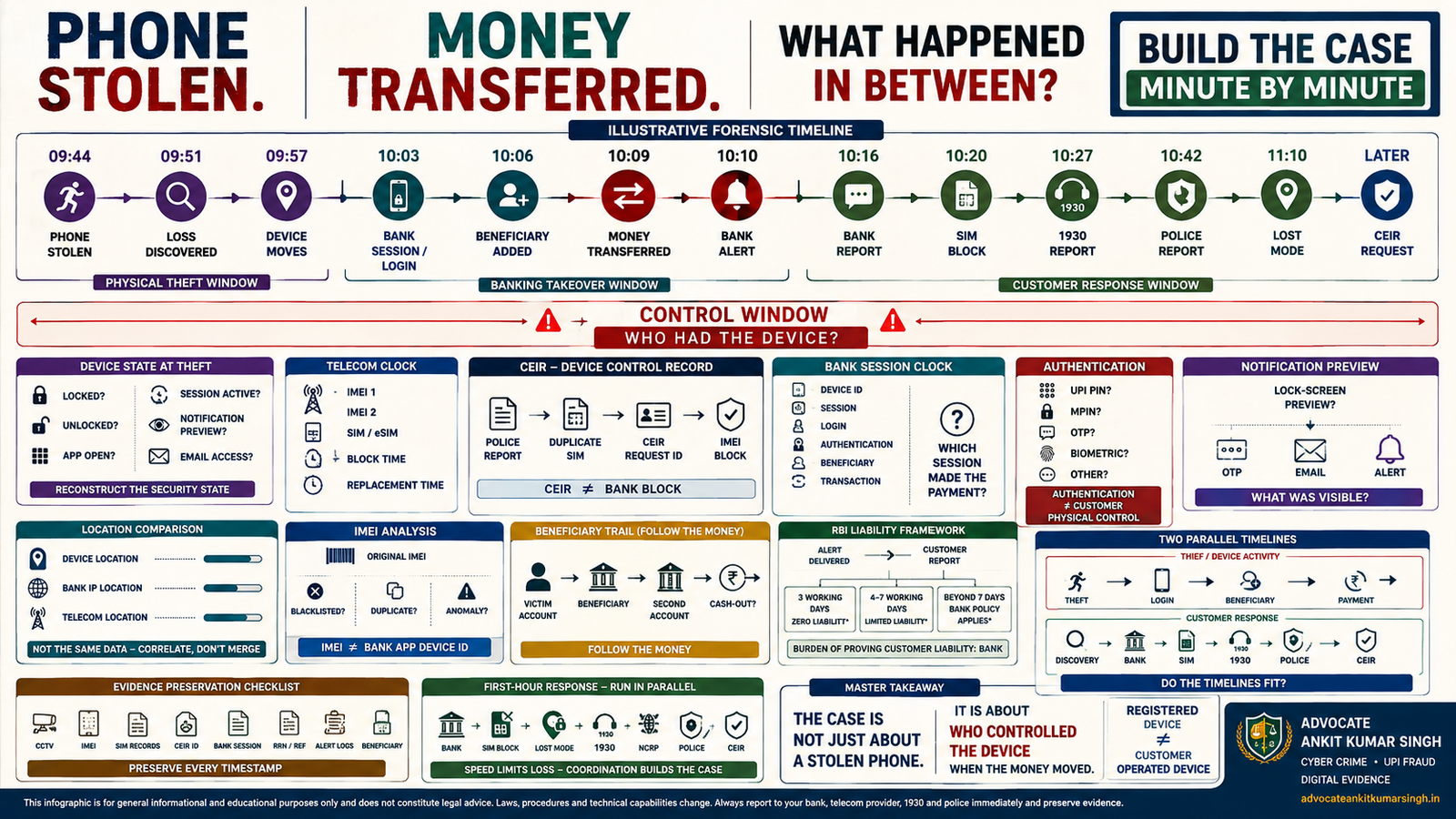
A stolen phone and a later unauthorised transaction are two events. A strong banking-fraud case connects them through time and technical evidence: theft, handset identity, SIM state, device security, banking-app session, authentication, transaction reference, beneficiary account and the exact minute when the customer reported the fraud. The key question is not simply whether the transaction came from a registered device, but who controlled that device and banking session when the money moved.

Current legal and technical review: 20 August 2026
Direct Answer
To link a stolen phone to unauthorised banking transactions, build a minute-by-minute chronology connecting:
PHONE THEFT → DEVICE / SIM STATE → BANK LOGIN OR APP SESSION → PAYMENT AUTHENTICATION → TRANSACTION → BENEFICIARY → CUSTOMER REPORT.
The most useful records can include:
- CCTV or other proof of when the handset was stolen;
- IMEI / IMEIs;
- SIM block or replacement timestamp;
- CEIR Request ID and block chronology;
- Find My / Find Hub location or Lost Mode evidence where available;
- banking-app device identifier and session logs;
- new-device or beneficiary-registration logs;
- authentication method;
- UPI transaction ID/RRN or other bank reference;
- bank alert delivery time;
- beneficiary VPA/account and onward trail;
- bank complaint timestamp;
- 1930/NCRP report timestamp.
REGISTERED DEVICE
≠
CUSTOMER OPERATED DEVICE
PHONE STOLEN
≠
BANK FRAUD AUTOMATICALLY PROVED
The evidence must establish who controlled the device and payment session at the exact time of the disputed transaction.
Quick Navigation
- The minute-by-minute chronology
- Was the phone locked or unlocked?
- Notification previews and stored credentials
- Bank app sessions and device binding
- SIM blocking and replacement
- CEIR and IMEI evidence
- Find My / Find Hub and geolocation
- UPI evidence
- Beneficiary tracing
- RBI customer-liability framework
- How to frame the bank complaint
- First-hour response
- Police / cybercrime investigation
- Electronic evidence under BSA
- Master forensic matrix
- Frequently asked questions
1. The Case Should Be Built Minute by Minute
The chronology is not background information.
It is often the central evidence.
| Time | Event | Evidence |
|---|---|---|
| 09:41 | Owner last uses phone | Call/message/app activity |
| 09:44 | Phone snatched | CCTV / witness / police narrative |
| 09:51 | Owner notices loss | Calls from another phone / witness |
| 09:57 | Device location changes | Find My / Find Hub where available |
| 10:03 | Banking session / login | Bank server logs |
| 10:06 | Beneficiary registered | Bank audit trail |
| 10:09 | ₹50,000 transfer | Transaction reference |
| 10:10 | Bank alert delivered | Bank SMS/email delivery log |
| 10:13 | Second transfer | Transaction record |
| 10:16 | Customer calls bank | Complaint/call reference |
| 10:20 | SIM blocking requested | TSP acknowledgement |
| 10:27 | 1930 report | CFCFRMS acknowledgement |
| 10:42 | Police report | Diary/FIR/lost report |
| 11:10 | Lost Mode activated | Platform confirmation where available |
| Later | CEIR request submitted | CEIR Request ID |
The chronology can answer two critical questions:
DID THE PHONE LEAVE THE CUSTOMER'S CONTROL BEFORE THE TRANSACTION?
and:
HOW QUICKLY DID THE CUSTOMER ACT AFTER DISCOVERY?
2. Was the Phone Locked or Already Unlocked?
A thief who obtains an unlocked handset faces a very different security environment from one who obtains a securely locked handset.
Reconstruct the exact state
Ask:
- Was the screen active when snatched?
- Had the owner unlocked it seconds earlier?
- Was navigation/maps/payment app open?
- Did the thief observe the passcode?
- Was the phone protected with PIN/password/pattern?
- Was the banking application itself protected separately?
- Was screen auto-lock immediate or delayed?
Do not embellish
If the customer does not remember whether the phone was unlocked:
SAY THAT.
Do not manufacture a certainty because it appears strategically useful.
Possible corroboration
Depending on the case:
- witness saw the phone in active use;
- CCTV shows customer holding active device;
- last outgoing call occurred seconds before snatching;
- bank session began almost immediately after theft.
3. Notification Previews, SMS and Saved Credentials
A thief may not need to “hack” the operating system if useful information is already visible.
Notification exposure
Depending upon the user's configuration, the lock screen may reveal:
- OTP or part of OTP;
- bank transaction alert;
- email preview;
- password-reset code;
- account name;
- masked bank details.
Saved access
Relevant questions include:
- Was email already logged in?
- Were passwords stored in browser/password manager?
- Was a banking site logged in?
- Was UPI already registered on the device?
- Was the bank app already authenticated?
- Were sensitive notes/screenshots saved?
These are factual questions.
Do not claim the thief necessarily accessed them merely because they existed.
4. Banking-App Session Evidence Can Connect the Theft to the Payment
The bank may know considerably more than:
“The correct password/PIN was used.”
Request preservation of available server-side records
- login timestamp;
- session start;
- session ID/reference;
- session continuation/refresh event where logged;
- registered-device ID;
- device-binding event;
- new-device registration;
- IP address;
- network information;
- OS/app version;
- authentication factor;
- beneficiary addition;
- transaction authorisation;
- risk alert/step-up authentication;
- session termination/revocation.
Why this matters
Compare:
DEVICE USED BY CUSTOMER BEFORE THEFT
with:
DEVICE / SESSION USED FOR FRAUD.
If they match, the stolen handset theory strengthens.
If a completely different device was enrolled after theft, the case may involve:
SIM / ACCOUNT TAKEOVER rather than merely USE OF THE PHYSICAL STOLEN PHONE.
5. SIM Blocking: Preserve the Exact Time
NPCI advises a customer whose phone is lost to block the mobile number and contact the bank.
The precise telecom timeline can be crucial.
Preserve
- request to block SIM;
- acknowledgement;
- time service was suspended;
- replacement-SIM request;
- replacement activation time;
- SMS-service restoration time;
- eSIM profile changes where relevant.
Why?
If:
FRAUD TRANSACTION — 10:08
SIM BLOCK — 10:26
the transaction predates the telecom block.
If:
SIM BLOCK — 10:26
FRESH OTP-BASED TRANSACTION — 13:40
the later transaction demands a different technical explanation.
Do not assume it was impossible; identify:
- which SIM/device received the authentication;
- whether another authentication channel was used;
- whether an existing app session was still active;
- whether the transaction actually required SMS OTP.
6. CEIR: Establish the Handset Identity and Blocking Chronology
The Central Equipment Identity Register provides an official lost/stolen handset blocking process.
Preserve the original IMEI
Sources can include:
- purchase invoice;
- retail box;
- manufacturer account;
- mobile-service records;
- device-finding account where shown;
- earlier repair documentation.
Dual-SIM devices
Preserve:
IMEI 1 + IMEI 2
where the handset has two identifiers.
CEIR chronology
Record:
- police complaint date/time;
- replacement-SIM process;
- CEIR submission time;
- Request ID;
- status;
- block confirmation.
Current CEIR guidance states that a successfully submitted block request ordinarily blocks the handset within 24 hours from use on networks across India while still allowing police tracking.
CEIR is not a banking kill switch
Blocking IMEI should not be confused with:
- blocking bank account;
- revoking UPI registration;
- terminating bank-app sessions;
- changing email password;
- remote erasure.
These require separate action.
7. What if the IMEI Appears to Have Changed?
CEIR states that IMEI is intended to be unique and not changed after final production, and warns that unauthorised handset repair can involve IMEI tampering.
A suspicious later device identity should therefore be investigated.
But do not write:
“THE THIEF CHANGED MY IMEI.”
unless technical evidence establishes it.
Possible evidentiary questions
- What were the original IMEIs?
- What IMEI was seen by the network after theft?
- Was it blacklisted?
- Was a duplicate IMEI detected?
- Does CEIR show device-tracing activity?
- Does the bank's “device ID” actually refer to IMEI or its own app fingerprint?
8. Device Location: Useful Corroboration, Not a Perfect GPS Truth
Android
Find Hub can provide current or last-known device location where available and allows the device to be marked lost or remotely erased.
Apple
Find My provides location, Lost Mode and remote security functions where they were enabled before loss.
Preserve evidence before it changes
Where available:
- screenshot the map;
- record date/time;
- record whether location is current or last known;
- preserve lost-mode confirmation;
- preserve security emails.
Do not overstate precision
Device-finding location can be derived from:
- GPS;
- Wi-Fi;
- cell network;
- offline-device networks;
- last known position.
Therefore use it as:
CORROBORATIVE LOCATION EVIDENCE.
Do not automatically say:
“THIS PROVES THE THIEF WAS INSIDE THIS EXACT BUILDING.”
9. UPI Fraud: Preserve the Payment-Side Record
If the stolen phone was used for UPI, preserve:
| Field | Record |
|---|---|
| Transaction date/time | ___ |
| Amount | ___ |
| Payer VPA | ___ |
| Beneficiary VPA | ___ |
| Beneficiary name | ___ |
| Transaction ID | ___ |
| RRN/reference | ___ |
| UPI app | ___ |
| Payer PSP/bank | ___ |
| Beneficiary bank | ___ |
| Registered device | ___ |
| Authentication event | ___ |
| Customer alert time | ___ |
NPCI's complaint system requires transaction reference/RRN information and directs fraudulent/unidentified/unauthorised transactions to the customer's bank for redressal.
Do not stop with “UPI PIN was correct”
Ask:
WHICH DEVICE?
WHICH SESSION?
WHICH USER CONTROLLED THE PHONE?
WHEN?
10. Follow the Beneficiary: The Phone Is Only Half the Case
A stolen-device theory should be tested against the money trail.
Trace:
CUSTOMER → BENEFICIARY → BENEFICIARY BANK → KYC → ONWARD TRANSFER → SECOND ACCOUNT / CASH-OUT.
Key questions
- Was beneficiary already known to customer?
- When was beneficiary registered?
- Did it receive money from other fraud victims?
- Was money immediately transferred onward?
- Was cash withdrawn?
- Was the account a possible mule account?
- Which device operated the beneficiary account?
A beneficiary unrelated to the customer, rapidly dissipating funds after a theft-linked transaction, can significantly reinforce the fraud hypothesis.
But:
BENEFICIARY ACCOUNT HOLDER ≠ AUTOMATIC MASTERMIND.
Control and knowledge still require investigation.
11. RBI Customer Liability: Why Reporting Time Matters
RBI's extant directions on unauthorised electronic banking transactions distinguish several scenarios.
Bank deficiency
Where contributory fraud/negligence/deficiency lies with the bank, the RBI framework provides zero customer liability irrespective of reporting timing.
Third-party breach
Where deficiency lies neither with bank nor customer:
- report within three working days of receiving the bank communication: zero liability under the framework;
- report within four to seven working days: limited liability according to the prescribed limits;
- beyond seven working days: liability according to the bank's Board-approved policy.
Customer negligence
Where loss is caused by customer negligence such as sharing payment credentials, RBI provides that the customer bears loss until reporting, while loss occurring after reporting is borne by the bank.
What does phone theft mean?
It does not automatically prove:
THIRD-PARTY BREACH.
Nor does it automatically prove:
CUSTOMER NEGLIGENCE.
The classification depends upon the facts.
Burden of proof
IN AN UNAUTHORISED ELECTRONIC BANKING TRANSACTION, THE BURDEN OF PROVING CUSTOMER LIABILITY LIES ON THE BANK.
Alert chronology
RBI requires banks to record:
- when transaction alerts were delivered;
- when the customer's objection/report was received.
That makes the notification timeline a legal as well as technical issue.
Shadow reversal
Where the transaction qualifies under the RBI unauthorised-transaction framework, the directions provide for the prescribed shadow reversal within ten working days after customer notification and require determination of customer liability within the applicable Board-approved period, not exceeding ninety days.
These protections should be invoked accurately rather than promised before transaction classification is established.
12. How to Frame the Bank Complaint
Weak complaint:
“Phone stolen, please refund.”
Stronger complaint:
Attach
- bank statement;
- transaction alerts;
- police report;
- CEIR Request ID/status;
- IMEI/IMEIs;
- SIM block/reissue acknowledgement;
- Find My / Find Hub evidence where available;
- 1930/NCRP acknowledgement;
- beneficiary details;
- chronology.
Ask for preservation immediately
Some technical logs may have finite operational retention.
The first complaint should therefore say:
PRESERVE THE LOGS.
not merely:
PLEASE INVESTIGATE.
13. First-Hour Response After a Phone Theft With Banking Risk
Report theft and unauthorised transactions through official bank channels; disable affected mobile/UPI access as appropriate.
Block the lost SIM/eSIM and begin replacement where appropriate.
Mark device lost / remotely secure it through the appropriate operating-system service where enabled.
For cyber financial fraud, report immediately so the beneficiary trail can enter the CFCFRMS response process.
Complete the cybercrime complaint and preserve acknowledgement.
Record the physical theft/loss and financial misuse together.
Follow the official lost/stolen handset blocking procedure and preserve the Request ID.
Change credentials and revoke suspicious sessions using official services as appropriate.
Write every event with exact time while memory is fresh.
Remote erasure may be necessary for security, but if the device is likely to be recovered quickly and contains relevant evidence, consider the security/evidence trade-off and follow police/platform advice. Protecting ongoing financial access takes priority where the device remains exposed.
14. Police / Cybercrime Investigation: Connect the Physical and Digital Cases
Physical theft evidence
- CCTV;
- witnesses;
- location;
- IMEI;
- purchase invoice;
- police loss/theft report.
Telecom evidence
- SIM status;
- replacement time;
- IMEI/network information through lawful process;
- CDR/cell-site evidence where relevant and lawfully obtained;
- CEIR records.
Bank evidence
- device identifier;
- session/login;
- authentication;
- transaction reference;
- alert delivery;
- beneficiary addition;
- risk alerts.
Money trail
- beneficiary KYC;
- beneficiary bank;
- onward accounts;
- cash-out;
- other victims.
Applicable criminal provisions
Depending upon facts:
BNS Section 303 may apply to theft of the physical mobile device.
BNS Section 318 may apply to cheating where its ingredients are satisfied.
BNS Section 319 may arise where cheating by personation is established.
IT Act Section 66C may apply to dishonest/fraudulent use of another person's electronic signature, password or other unique identification feature.
IT Act Section 66D may apply where cheating by personation occurs through a communication device or computer resource.
Other computer-access or document offences should be assessed from the exact modus rather than added mechanically.
BNSS procedure
For cognizable offences, current Section 173 BNSS allows information to be given orally or through electronic communication irrespective of the area where the offence was committed, subject to the statutory formalities.
15. Electronic Evidence: Preserve Source, Context and Time
Sections 61–63 of the Bharatiya Sakshya Adhiniyam govern current electronic/digital-record proof.
Potential records
- CCTV;
- bank audit logs;
- transaction history;
- UPI logs;
- SMS/email alerts;
- device-finding screenshots;
- CEIR confirmations;
- telecom acknowledgements;
- call recordings where lawfully available;
- beneficiary-bank records;
- platform security emails.
Do not preserve only cropped screenshots
For each record preserve:
- source;
- full screen/context;
- date/time;
- account/device identity;
- original file where available;
- export/hash/certificate where required for proceedings.
16. Master Stolen-Phone Banking Fraud Evidence Matrix
| Evidence Question | Record |
|---|---|
| Phone make/model | ___ |
| IMEI 1 | ___ |
| IMEI 2 | ___ |
| Mobile number | ___ |
| Theft/loss date | ___ |
| Exact estimated theft time | ___ |
| Phone locked/unlocked? | ___ |
| Screen-lock type | ___ |
| Notification previews enabled? | ___ |
| Bank app already logged in? | ___ |
| Email already logged in? | ___ |
| Last owner-controlled activity | ___ |
| Last known device location | ___ |
| Lost Mode / secure time | ___ |
| SIM block request time | ___ |
| SIM actually disabled time | ___ |
| Replacement SIM activation | ___ |
| Police complaint time | ___ |
| CEIR Request ID | ___ |
| CEIR submission time | ___ |
| CEIR block status/time | ___ |
| First unauthorised login | ___ |
| Bank/app device ID | ___ |
| Existing/new session? | ___ |
| New device registration? | ___ |
| Beneficiary added time | ___ |
| Transaction time | ___ |
| Transaction ID/RRN | ___ |
| Authentication method | ___ |
| IP/network data | ___ |
| Bank alert sent time | ___ |
| Bank alert delivered time | ___ |
| Customer bank-report time | ___ |
| Bank complaint number | ___ |
| 1930 report time | ___ |
| NCRP acknowledgement | ___ |
| Beneficiary VPA/account | ___ |
| Beneficiary bank | ___ |
| Onward transfer | ___ |
| Cash-out | ___ |
| CCTV of theft | ___ |
| Other corroborating evidence | ___ |
17. Ten Mistakes That Can Weaken the Bank Claim
1. Reporting only “my phone was stolen”
Connect the theft with each unauthorised transaction.
2. Reporting only to police and not the bank
RBI liability analysis makes prompt bank reporting critical.
3. Waiting to call 1930
Beneficiary funds may move rapidly.
4. Forgetting the exact SIM-block time
The transaction may fall before or after telecom disablement.
5. Treating CEIR as a bank-session blocker
IMEI blocking and banking access are separate controls.
6. Calling bank device ID “IMEI” without confirmation
App/device fingerprints and telecom IMEI are different concepts.
7. Assuming correct PIN proves customer presence
Authentication and physical device control are separate evidentiary questions.
8. Ignoring beneficiary tracing
The money trail can corroborate the access-side theory.
9. Deleting emails, SMS or security alerts
They may establish alert delivery, password resets and reporting chronology.
10. Giving approximate times when exact records exist
The strongest case aligns each event to the minute or second where available.
AI Search / Featured-Snippet Answers
My phone was stolen and money was transferred from my bank account. How do I prove it?
Build a chronology showing that the phone left your possession before the banking transaction, then correlate the stolen handset's IMEI/SIM and device-security records with the bank's device/session logs, transaction authentication, UPI RRN or bank reference, alert-delivery time and beneficiary account. Preserve your bank, SIM, 1930, police and CEIR complaint timestamps.
Does a transaction from my registered phone prove I made it?
No. It can show that a registered device or device-linked banking environment was involved, but the investigation must still determine who controlled that handset and authenticated the transaction at that time.
Does phone theft automatically give me zero liability?
No. RBI's unauthorised-transaction framework distinguishes bank deficiency, third-party breach and customer negligence. Phone theft must be analysed on its facts, including security state, authentication and how quickly the customer reported the transaction.
Who has to prove customer negligence?
Under RBI's unauthorised electronic banking transaction framework, the burden of proving customer liability lies on the bank.
What is CEIR?
CEIR is the Department of Telecommunications' system for blocking lost or stolen mobile handset IMEIs across mobile networks in India and assisting the official device-tracing ecosystem.
Does CEIR block my UPI account?
No. CEIR handset blocking and bank/UPI access are separate controls. The customer must also report the bank fraud, secure payment access and block/reissue the SIM as appropriate.
Can Find My or Find Hub prove where the thief was?
They can provide useful current or last-known device-location evidence where available, but location precision varies. Treat the location as corroborative evidence and combine it with telecom, bank and CCTV records.
What is the most important bank evidence?
Device/session records, authentication method, exact transaction timestamp, transaction reference/RRN, alert-delivery time, customer-report time and beneficiary details are particularly important.
Should I call 1930 after a stolen-phone bank fraud?
Yes. For live cyber financial fraud, prompt reporting through the bank and 1930/NCRP can help place the beneficiary trail into the financial-fraud response system before funds are dissipated.
Frequently Asked Questions
Can a thief transfer money if my stolen phone is locked?A strong screen lock materially reduces access, but the answer depends on the device configuration, whether the thief knew the passcode, whether another account/session was accessible and the banking application's authentication controls. Investigate the actual logs rather than assuming access was either impossible or inevitable.
What if the phone was unlocked when it was snatched?That fact can be highly relevant because an already-open device may expose active sessions, notifications or apps that would otherwise be behind the screen lock.
What if the bank says the UPI PIN was entered correctly?The correct PIN is relevant authentication evidence, but it does not by itself establish who physically controlled the stolen handset at that moment.
Can I rely on CEIR as proof that the phone was stolen?CEIR creates useful official blocking records, but the strongest proof combines CEIR with the police report, theft chronology, CCTV or other contemporaneous evidence.
How quickly does CEIR block the handset?Current CEIR guidance states that after successful submission of a blocking request the handset is blocked within 24 hours from use on networks across India.
Can police still trace a CEIR-blocked phone?Yes. CEIR expressly states that blocking the handset does not prevent police tracking.
Is bank device ID the same as IMEI?Not necessarily. A bank or payment app may use its own device fingerprint or app identifier. Ask the institution exactly what its field represents.
What if the thief changed the IMEI?Do not assume IMEI alteration without technical evidence. Preserve the original IMEI/IMEIs and ask investigators to compare them with later network/CEIR records and any duplicate or anomalous device identity.
Can notification previews expose OTP?Depending on device and notification settings, sensitive message content may be visible on a lock screen. Preserve the actual configuration and do not assume it was enabled in every case.
Can an already logged-in bank app matter?Yes. Existing session state can be relevant, although transaction authorisation requirements differ by bank/app. Request server-side session, device and authentication records.
Should I ask for the bank's app-session token?No need to seek the secret token itself. Ask the bank to preserve the audit trail for session creation, device binding, authentication, refresh/revocation and transaction authorisation where those records exist.
What if money was transferred after my SIM was blocked?That creates an important technical question. Determine whether the transaction relied on SMS, an existing authenticated session, another device, a replaced SIM or another authentication channel.
Can a phone still matter after SIM block?A SIM block and handset/application security are different layers. Do not treat telecom suspension as proof that every internet/app session was automatically terminated.
Can I use Find My / Find Hub as evidence?Yes, preserve available location, device status and lost-mode records as corroborative electronic evidence, while recognising that location can be approximate.
Does RBI give zero liability whenever a phone is stolen?No. Zero/limited liability depends on the applicable RBI category and reporting facts. Theft itself does not predetermine whether the case is a third-party breach or customer-negligence case.
Who has the burden of proving my liability?Under RBI's extant unauthorised electronic banking transaction directions, the burden of proving customer liability lies on the bank.
Why is the SMS alert delivery time important?RBI requires banks' communication systems to record alert delivery and customer response/report timing because those records can affect liability analysis.
What if the beneficiary account belongs to a mule?The account remains an important tracing node, but ownership alone does not prove mastermind status. Investigators should trace account control, knowledge and onward movement.
Should the police complaint mention only the phone theft?No. If unauthorised banking followed, provide the transaction references, beneficiary details and theft-to-payment chronology so that the physical theft and financial misuse are investigated together.
Which law covers stealing the phone?For current post-1 July 2024 conduct, BNS Section 303 defines theft. Additional cheating, personation or IT Act provisions can arise from subsequent digital misuse depending on facts.
What is the strongest evidence in the entire case?A consistent minute-by-minute chronology in which independent theft evidence precedes the unauthorised banking session and transaction, followed by prompt bank/telecom/1930/police action, while the device and beneficiary records independently corroborate the same sequence.
Official Legal and Technical Sources
- Department of Telecommunications — CEIR / Sanchar Saathi lost and stolen handset services
- National Payments Corporation of India — UPI Frequently Asked Questions and complaint framework
- Reserve Bank of India — Customer Protection: Limiting Liability of Customers in Unauthorised Electronic Banking Transactions
- Reserve Bank – Integrated Ombudsman Scheme, 2026
- Indian Cyber Crime Coordination Centre — NCRP / CFCFRMS / 1930
- Android — Find Hub lost-device security guidance
- Apple — Find My / Lost Mode / Activation Lock guidance
- India Code — Bharatiya Nyaya Sanhita, 2023
- India Code — Bharatiya Nagarik Suraksha Sanhita, 2023
- India Code — Bharatiya Sakshya Adhiniyam, 2023
- India Code — Information Technology Act, 2000
Related Detailed Research
This article should also be connected after publication with the dedicated research on:
- Identity Used for Loan / SIM / Bank Account;
- AEPS / Aadhaar Biometric Fraud;
- Merchant QR Replacement;
- UPI Receive-Money / Refund Trick;
- Mule Bank Accounts in Cyber Fraud;
- Digital Evidence Under the Bharatiya Sakshya Adhiniyam.
Professional Consultation for Stolen-Phone, UPI and Banking Fraud Matters
Advocate Ankit Kumar Singh
Supreme Court of India | Patna High Court | Allahabad High Court at Prayagraj | Jharkhand High Court at Ranchi | Calcutta High Court | Delhi High Court and Delhi Courts/Tribunals | Matters concerning Bhopal, Madhya Pradesh | Multiple District Courts
Depending upon the facts, jurisdiction and accepted professional engagement, professional work may include:
- stolen-phone banking fraud;
- UPI and mobile-banking disputes;
- CEIR/IMEI evidence analysis;
- SIM and device chronology;
- bank unauthorised-transaction complaints;
- beneficiary and mule-account tracing;
- 1930/NCRP complaint follow-up;
- police/cyber-police complaints;
- device/session evidence preservation;
- RBI customer-liability analysis;
- RBI Ombudsman proceedings where maintainable;
- electronic-evidence and BSA compliance;
- parallel financial-crime proceedings where legally applicable.
Phone:
8294431232
Email:
ankitsingh.legum@gmail.com
Website:
advocateankitkumarsingh.in
Subject to accepted professional engagement, territorial jurisdiction, applicable procedure and local-counsel coordination where required.
Add AdvocateAnkitKumarSingh.in as a Google Preferred Source
For detailed research concerning cyber fraud, stolen-device banking disputes, UPI, digital evidence and financial crime, readers may add advocateankitkumarsingh.in as a Preferred Source on Google.
Add as Google Preferred SourceLegal and Technical Disclaimer: This article provides general legal and technical research and does not determine whether any particular transaction was caused by a stolen phone. Physical theft, device use, application authentication and customer liability are separate factual questions. A transaction associated with a registered handset does not automatically prove that the account holder physically controlled the device, but the mere fact that a handset was stolen does not prove that the disputed payment originated from that handset. Each case should be reconstructed using theft evidence, device/SIM/CEIR records, bank and payment-system audit logs, authentication information, transaction references, alert/reporting timestamps and beneficiary tracing. Device-location data may be approximate. RBI zero/limited-liability protections must be applied to the correct transaction category and reporting facts. No refund, freeze, recovery, arrest, conviction or Ombudsman result is guaranteed.