Behavioural Cybersecurity • Online Fraud • Social Engineering • Victim Psychology
Psychology of Scam Compliance: Why Educated and Careful People Still Obey Cyber Scammers
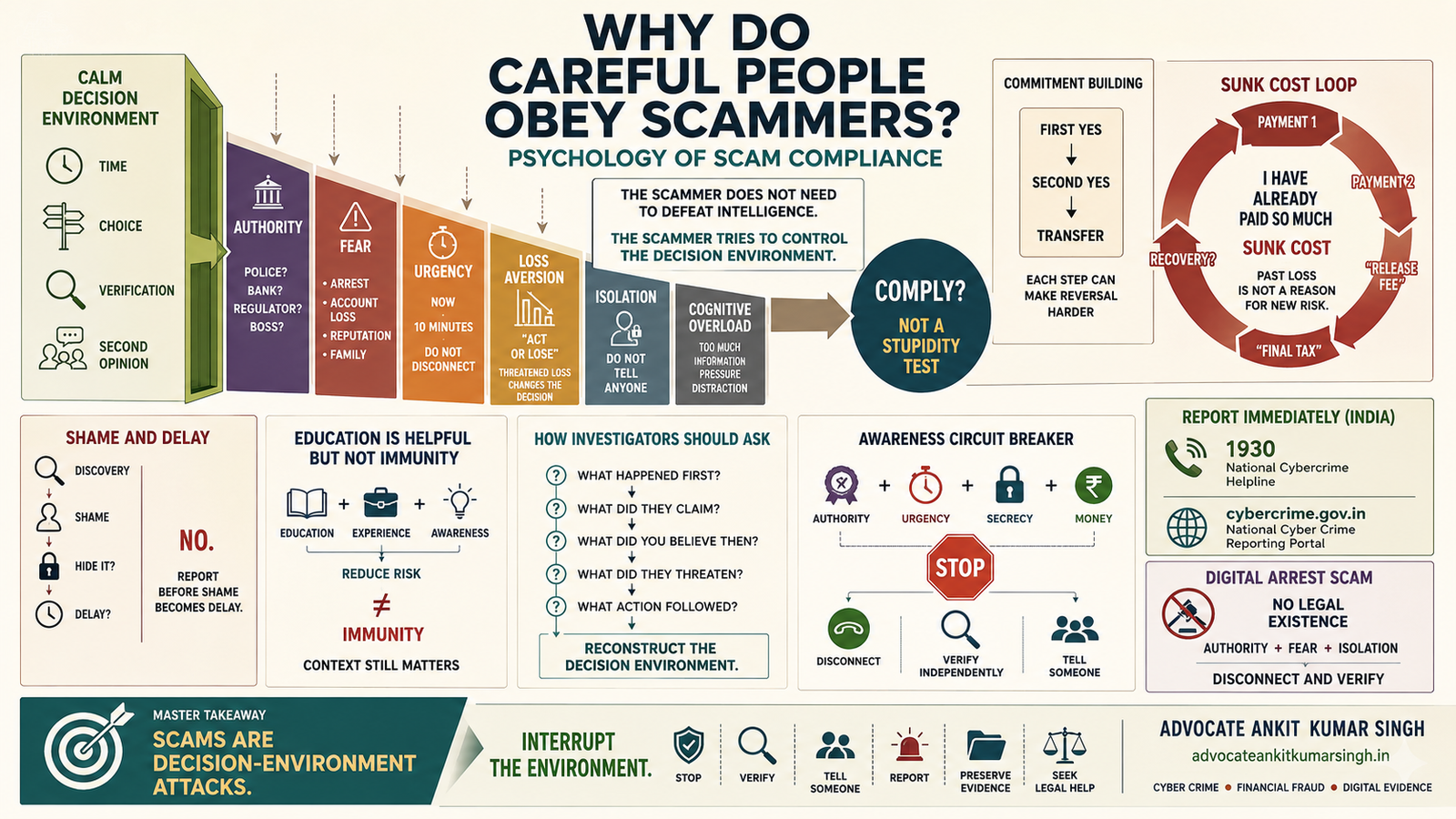
“Why did I fall for a cyber scam?” is often asked as though the answer must be stupidity or carelessness. Behavioural research suggests a different model. Sophisticated scams manufacture a temporary decision environment using authority, fear, urgency, loss avoidance, cognitive overload, secrecy, commitment and sunk cost. Understanding that process is essential not only for prevention, but also for better victim interviews, faster reporting and more accurate cybercrime investigation.

Current research and legal review: 20 August 2026
Direct Answer: Why Did I Fall for a Cyber Scam?
Because the scammer may have manipulated the conditions under which you were making decisions.
A sophisticated scam does not simply present a false fact and wait for a gullible person to believe it.
It can create:
- a credible authority figure;
- an immediate threat;
- a deadline;
- an instruction not to consult anyone;
- several apparently confirming documents or callers;
- a small first act of compliance;
- a larger second act;
- a threat that previous money will be lost unless one more payment is made.
The victim's cognitive problem therefore changes from:
“IS THIS PERSON A SCAMMER?”
to:
“HOW DO I STOP THE ARREST / ACCOUNT FREEZE / INVESTMENT LOSS / FAMILY PROBLEM THAT I HAVE BEEN TOLD IS HAPPENING RIGHT NOW?”
Education, professional status and digital knowledge can reduce some kinds of risk, but none creates immunity from deception under a carefully engineered combination of fear, authority, time pressure and commitment.
SCAMMERS DO NOT NEED TO DEFEAT YOUR INTELLIGENCE. THEY NEED TO CONTROL THE DECISION ENVIRONMENT LONG ENOUGH FOR ONE ACTION.
Quick Navigation
- Why scam victimisation is not a stupidity test
- Authority: “This is the police / bank / CBI”
- Fear and threat narrowing
- Urgency and time pressure
- Loss aversion
- Scarcity and artificial deadlines
- Social proof and manufactured normality
- Commitment and the compliance ladder
- Cognitive overload and distraction
- Sunk cost: why victims keep paying
- Secrecy and isolation
- Shame after fraud and delayed reporting
- How cyber-fraud victims should be interviewed
- Evidence reconstruction
- How anti-scam awareness should be redesigned
- Why immediate reporting matters in India
- Digital arrest: the psychology in one scam
- Frequently asked questions
1. Scam Victimisation Is Not an Intelligence Test
The stereotype of the cyber-fraud victim is usually:
careless, technically illiterate, greedy, or gullible.
That stereotype is both inaccurate and operationally harmful.
Education helps—but it does not create immunity
Research on financial literacy generally finds that relevant financial knowledge can reduce fraud vulnerability.
But other research also shows:
- fraud among educated populations;
- overconfidence increasing investment-fraud vulnerability;
- high-risk exposure affecting who becomes a victim;
- large situational effects from time pressure and scam framing.
The sensible conclusion is not:
“EDUCATION DOES NOT MATTER.”
It is:
“EDUCATION IS ONE PROTECTIVE FACTOR AMONG MANY, NOT A VACCINE AGAINST MANIPULATION.”
The person × scam × moment model
Fraud susceptibility therefore varies within the same person across different situations.
2. Authority: Why “This Is the Police” Changes Behaviour
Humans routinely rely on legitimate authority.
That is normally adaptive.
We follow:
- court directions;
- bank security procedures;
- tax notices;
- police instructions;
- employer requests;
- medical advice.
A scammer weaponises the same social shortcut.
Digital authority can be manufactured cheaply
The scammer may use:
- correct legal terminology;
- your real name and address;
- fake FIR or case number;
- official-looking PDF;
- copied institutional logo;
- video-call background resembling an office;
- multiple “departments” transferring your call;
- caller-ID manipulation;
- a calm procedural tone.
The target therefore experiences:
PERCEIVED AUTHORITY
before having an opportunity to verify:
REAL AUTHORITY.
Why careful people comply
A careful professional may actually be particularly motivated to cooperate with what appears to be a legitimate investigation.
Their thought may be:
“I have done nothing wrong, so I should cooperate and clear this misunderstanding.”
The scammer turns civic compliance into a fraud channel.
3. Fear Changes the Question the Brain Is Trying to Answer
Fear-based scams commonly threaten:
- arrest;
- bank-account freezing;
- property seizure;
- criminal prosecution;
- family consequences;
- reputation;
- job loss;
- investment loss.
Under ordinary conditions the victim may evaluate authenticity.
Under perceived immediate threat, attention may narrow toward:
THREAT TERMINATION.
Digital arrest illustrates the mechanism
The scammer first manufactures authority.
Then introduces criminal accusation.
Then creates urgency.
Then offers a route out:
“Cooperate.”
“Remain on video.”
“Transfer the funds for verification.”
The fraudulent payment is presented not as giving money to a stranger, but as the action that will make the threat disappear.
4. Urgency: The Scam Is Trying to Take Away Your Time
Time is one of the victim's most powerful defences.
Time allows:
- calling the bank;
- searching the official website;
- calling family;
- consulting a lawyer;
- visiting a police station;
- noticing inconsistencies;
- letting emotional arousal fall.
That is why scammers manufacture deadlines.
Experimental evidence
Recent controlled fraud research found significantly lower ability to discriminate fraudulent from legitimate material under time pressure.
Separate phishing experiments likewise found better phishing discrimination where participants had more time to inspect messages.
A behavioural rule
The more a stranger insists that a financial/legal decision cannot survive ten minutes of independent verification, the stronger the reason to create that pause.
5. Loss Aversion: “Pay Now or Lose Everything”
Many scams are not framed around greed.
They are framed around avoiding loss.
Examples
“Your bank account will be blocked.”
“Your parcel contains illegal material.”
“Your investment will be forfeited.”
“Your refund expires tonight.”
“Your previous deposit will be lost unless tax is paid.”
Why it matters
Experimental online-fraud research has found greater susceptibility to loss-avoidance fraud than profit-seeking fraud, with time pressure particularly worsening performance in the loss-avoidance condition.
The scam therefore creates:
A THREATENED LOSS
and then sells:
COMPLIANCE AS THE ESCAPE ROUTE.
6. Scarcity and Artificial Deadlines
Scarcity makes an option appear temporary.
Examples include:
- one-time settlement;
- limited investment allocation;
- last withdrawal window;
- only remaining appointment;
- final compliance opportunity.
But do not oversimplify the science
Not every persuasion technique is equally effective in every scam.
Recent phishing experiments have sometimes found obvious scarcity cues easier to recognise than subtler authority or reciprocity cues.
Therefore the correct behavioural model is:
COMBINED PRESSURE SYSTEM
rather than:
ONE UNIVERSAL PSYCHOLOGICAL TRICK.
7. Social Proof: Manufacturing the Feeling That This Is Normal
When uncertain, humans look at what other people appear to be doing.
Scammers fabricate that reference point.
Examples
“Everyone in your organisation has already verified.”
“Thousands of investors have withdrawn successfully.”
“Other customers paid the security deposit.”
“This is the standard RBI verification procedure.”
“Your colleague has already approved it.”
The scammer is trying to remove the psychological cost of acting:
IF EVERYONE DOES THIS, MAYBE IT IS SAFE.
8. Commitment and Consistency: The Compliance Ladder
Many successful scams begin with something that does not look financially dangerous.
Every prior action can make the next action feel more consistent.
Stopping requires the victim to conclude:
“Everything I believed during the last hour may be false.”
Continuing allows:
“I am simply finishing the process I already verified.”
Why scammers prefer incremental compliance
A person who would immediately refuse:
“Transfer ₹10 lakh to me”
may nevertheless move through ten smaller behavioural steps that eventually produce the same transfer.
9. Cognitive Overload: Too Much Information Can Reduce Verification
Cyber scams often resemble multitasking exercises.
The victim may be:
- on a video call;
- receiving WhatsApp documents;
- logging into online banking;
- answering questions;
- reading account numbers;
- being threatened;
- receiving repeated calls;
- trying to remember legal or financial terminology.
Under high workload, the victim can allocate attention to the scammer's immediate task instead of authenticity cues.
The practical implication
Awareness training should not assume that a person will carefully inspect:
- URL;
- sender address;
- document spelling;
- designation;
- account beneficiary
while being simultaneously threatened with arrest.
The safer intervention is to remove the person from the high-load environment:
END THE CALL.
10. Sunk Cost: Why the Second and Third Payments Happen
Sunk-cost escalation is one of the most misunderstood parts of repeated-payment fraud.
Example
| Stage | Scammer Explanation | Victim's Psychological Problem |
|---|---|---|
| ₹50,000 | Initial investment | Looks manageable. |
| ₹1 lakh | Upgrade required | Initial deposit now depends on continuing. |
| ₹2 lakh | Withdrawal tax | Stopping appears to crystallise earlier loss. |
| ₹3 lakh | AML / security clearance | Victim may believe one final payment retrieves everything. |
| ₹5 lakh | Recovery / legal release | Escalation is reframed as recovery rather than new investment. |
The critical prevention message is:
MONEY ALREADY LOST IS NOT A REASON TO RISK NEW MONEY.
Recovery scams
After the first scam, victims can become targets of a second scam promising:
- refund;
- chargeback;
- asset tracing;
- crypto recovery;
- government compensation;
- release of frozen investment.
This second fraud exploits both sunk cost and shame.
11. Secrecy and Isolation: Why the Scammer Says “Do Not Tell Anyone”
An independent person is dangerous to the scam.
A spouse, colleague, lawyer, bank employee or police officer has:
- no emotional investment in the story;
- no sunk cost;
- lower fear;
- no commitment to previous instructions.
They can ask:
“Why would CBI ask you to transfer money?”
or:
“Why can't we call the bank ourselves?”
That question can collapse the entire scam.
Therefore isolation is functional
The scammer may claim:
- investigation confidentiality;
- national-security secrecy;
- banking confidentiality;
- risk of arrest if anyone is told;
- investment terms prohibit disclosure.
The real objective may be:
PREVENT REALITY CHECKING.
12. Shame After the Scam: Why Victims Sometimes Do Not Report Immediately
Fraud produces a distinctive form of self-blame because the victim often performed the transfer personally.
They may say:
“I sent the money myself.”
“I entered the OTP.”
“I downloaded the application.”
“I ignored my daughter's warning.”
This can create the false internal conclusion:
“THEREFORE I AM RESPONSIBLE FOR THE CRIME.”
But active participation can be part of the deception
Many frauds are specifically designed so that the victim:
- authorises the transfer;
- reveals the credential;
- approves the wallet permission;
- hands over remote access.
The fact that the victim performed an act voluntarily does not erase the preceding deception or inducement.
Why shame is operationally dangerous
Shame can cause:
- delayed bank contact;
- delayed 1930 complaint;
- deleted chats;
- concealed transactions from family;
- continued negotiations with the scammer;
- acceptance of a recovery scam.
13. How Cyber-Fraud Victims Should Be Interviewed
This section is a practical research-informed interviewing framework, not a statutory interviewing rule.
Do not begin with blame
Weak question:
“Why would an educated person send money to a stranger?”
Better:
“What did you believe was happening when you made that transfer?”
Reconstruct the perceived reality
At each important decision point ask:
- Who did the caller claim to be?
- What exactly were you accused of?
- What did they say would happen if you did nothing?
- How much time did they give you?
- What document or screen did they show?
- Did another caller appear to confirm the first caller?
- Were you told to keep the matter secret?
- Were you prevented from disconnecting?
- What payment had already been made?
- What did they say would happen to that payment?
- When did you first become doubtful?
- What happened when you questioned them?
Why this produces better evidence
It helps distinguish:
- fraudulent representation;
- threat;
- inducement;
- authority impersonation;
- secrecy;
- payment chronology;
- continued deception;
- first point of discovery.
Avoid hindsight contamination
After discovering fraud, the victim knows the caller was fake.
The investigator needs to understand what the victim knew before that discovery.
Therefore reconstruct:
INFORMATION AVAILABLE THEN
rather than:
OBVIOUSNESS NOW.
14. Build a Decision-and-Evidence Timeline
| Field | Evidence / Answer |
|---|---|
| First contact | ___ |
| Phone / WhatsApp / Telegram / email | ___ |
| Claimed identity | ___ |
| Claimed institution | ___ |
| Threat / promised gain | ___ |
| Authority cue | ___ |
| Case / FIR / notice number shown | ___ |
| Time deadline | ___ |
| Secrecy instruction | ___ |
| Remote-access / screen-share app | ___ |
| First action by victim | ___ |
| First payment | ___ |
| Beneficiary account / UPI / wallet | ___ |
| Transaction reference | ___ |
| Reason given for next payment | ___ |
| Second / later payments | ___ |
| First doubt | ___ |
| Attempt to stop | ___ |
| Scammer response | ___ |
| Discovery of fraud | ___ |
| Bank informed | ___ |
| 1930 complaint | ___ |
| NCRP acknowledgement | ___ |
| Police complaint / FIR | ___ |
Preserve the digital trail
Potentially relevant material includes:
- call logs;
- recordings;
- WhatsApp/Telegram chats;
- emails;
- SMS;
- screenshots;
- PDF notices;
- UPI IDs;
- beneficiary bank details;
- transaction references;
- wallet addresses;
- transaction hashes;
- remote-access applications;
- downloaded APKs;
- browser history;
- device notifications;
- bank statements.
Do not delete embarrassing messages.
They may explain precisely how the deception operated.
15. Anti-Scam Awareness Should Create Behavioural Circuit Breakers
Traditional warning:
“BE ALERT.”
Behaviourally stronger warning:
“WHEN AUTHORITY + URGENCY + SECRECY + MONEY APPEAR TOGETHER, END THE INTERACTION AND VERIFY INDEPENDENTLY.”
Circuit breaker 1 — No financial decision while remaining on the caller's channel
End the call first.
Circuit breaker 2 — Independent-channel verification
Do not call the number supplied by the caller.
Use:
- official government website;
- official bank application;
- number printed on bank card;
- physical police station;
- known professional adviser.
Circuit breaker 3 — Two-person rule
Before an unusual high-value transfer, involve one independent trusted person.
Circuit breaker 4 — Permission to disobey apparent authority
Use a prepared sentence:
“I will verify independently and contact your department through its official channel.”
Circuit breaker 5 — Sunk-cost rule
Never send new money merely because previous money is at risk.
Circuit breaker 6 — Shame interruption
If money has already gone:
DO NOT TRY TO SECRETLY WIN IT BACK FROM THE SAME PERSON.
Stop and report.
16. Why Immediate Reporting Matters in India
India's cyber-financial-fraud response architecture is specifically built around speed.
For a cyber financial fraud
Use:
1930
and:
National Cyber Crime Reporting Portal — cybercrime.gov.in
Why speed matters
The money may move:
VICTIM → MULE ACCOUNT 1 → MULE ACCOUNT 2 → PAYMENT AGGREGATOR → WALLET / CASH / WITHDRAWAL.
CFCFRMS was created for immediate financial-fraud reporting and coordination among law enforcement and financial institutions to interrupt that movement.
Current Government position
As of 30 June 2026, Government data stated that more than ₹11,158 crore had been saved in more than 32.80 lakh complaints through CFCFRMS.
The Central Government also issued a victim-centric NCRP-CFCFRMS SOP in January 2026 covering complaint processing, bank coordination, lien issues, grievance redressal and restoration mechanisms.
AFTER A CYBER FINANCIAL FRAUD: STOP PAYMENT. PRESERVE EVIDENCE. CONTACT THE BANK. CALL 1930. REPORT ON NCRP. DO NOT DELAY BECAUSE OF SHAME.
17. Digital Arrest: Authority + Fear + Urgency + Isolation in One Scam
“Digital arrest” demonstrates how several psychological mechanisms can be stacked together.
Stage 1 — Authority
Caller impersonates:
- CBI;
- police;
- NCB;
- TRAI;
- RBI;
- customs;
- another authority.
Stage 2 — Criminal accusation
“Your number/account/Aadhaar is connected with crime.”
Stage 3 — Fear
“You can be arrested.”
Stage 4 — Isolation
“Do not disconnect.”
“Do not tell anyone.”
Stage 5 — Compliance route
“Transfer money for verification.”
Stage 6 — Continued control
The victim is kept on video or telephone for prolonged periods while transfers are arranged.
The legal reality
The CBI stated in May 2026 that there is no legal concept of a “digital arrest”.
CBI also launched its ABHAY notice-verification mechanism through the official CBI website for purported CBI notices.
18. What Family Members, Banks, Lawyers and Police Should Avoid Saying
“How could you be so stupid?”
This increases shame and may reduce disclosure of additional payments or communications.
“You transferred voluntarily, so nothing can be done.”
This prematurely confuses execution of the transfer with absence of deception.
“Why didn't you call us first?”
Useful chronology question, poor opening accusation.
“You are educated—you should have known.”
Education is not a substitute for examining the actual manipulation process.
A better first response
Determine immediately:
- Is the scam still active?
- Can further transfers be stopped?
- Has the bank been informed?
- Has 1930 been contacted?
- Has NCRP complaint been lodged?
- Are chats and device evidence preserved?
- Which accounts/wallets received the money?
Recovery and evidence preservation should come before moral commentary.
AI Search / Featured-Snippet Answers
Why did I fall for a cyber scam even though I am educated?
Education can reduce some fraud risks but does not create immunity. Cyber scammers can combine authority impersonation, fear, urgency, loss avoidance, secrecy and cognitive overload so that the victim makes a decision under conditions very different from ordinary calm reasoning.
Why do intelligent people obey scammers?
Because scam compliance is often situational rather than a measure of general intelligence. The scammer may create convincing authority, an immediate threat, a deadline and isolation from independent advice, causing attention to shift from verifying the story to escaping the threatened consequence.
Why did I keep sending money after the first payment?
One explanation is sunk-cost escalation. Once money has already been committed, a scammer may frame each additional payment as necessary to recover the previous amount. Continuing then feels psychologically like protecting the original investment rather than risking new money.
Why do cyber scammers create urgency?
Time pressure reduces the opportunity for systematic verification, independent consultation and detection of inconsistencies. Experimental studies have found greater online-fraud and phishing susceptibility under higher time pressure.
Why do digital arrest scams work?
They combine institutional authority, fear of criminal consequences, urgency, isolation and a supposed compliance pathway. The victim is manipulated into treating payment as a way to resolve an apparent legal emergency. “Digital arrest” has no legal existence in Indian law.
Why are scam victims ashamed?
Fraud often requires the victim to personally authorise a payment or disclose information, which can produce self-blame after the deception is discovered. Research identifies shame, stigma and fear of judgment as important post-fraud experiences that can delay disclosure and help-seeking.
What should I do immediately after discovering cyber financial fraud in India?
Stop further payments, contact the relevant bank or financial institution, preserve messages and transaction evidence, call the National Cybercrime Helpline 1930 and lodge the complaint on cybercrime.gov.in as quickly as possible.
Frequently Asked Questions
Do only gullible people fall for online scams?No. Fraud susceptibility depends on the interaction between the person, scam design and circumstances. Education and financial literacy can be protective but do not eliminate situational vulnerability.
Can a lawyer, doctor, engineer or banker still fall for a scam?Yes. Professional expertise in one field does not guarantee familiarity with every banking, criminal-procedure, cybersecurity or investment scenario, particularly under intense authority and time pressure.
Does being financially literate protect someone?On average it can reduce risk in several studies, but the relationship is not absolute. Exposure, risk taking, overconfidence, scam type and situational pressure also matter.
What is authority bias in cyber fraud?It is the tendency to give greater weight or compliance to a request because it appears to come from a legitimate authority such as police, a bank, regulator, court or senior executive.
Why do scammers threaten arrest?Fear of legal consequences can narrow attention toward immediate threat avoidance and make the scammer's proposed “solution” feel urgent.
Why does urgency make scams more effective?Urgency reduces deliberation time and makes it harder to consult another person or independently verify the communication.
What is loss aversion in scams?It is exploited when the fraud is framed around preventing a threatened loss—such as losing an account, refund, investment, reputation or freedom—rather than merely obtaining a reward.
What is sunk-cost psychology in investment scams?After the victim has already paid, stopping may feel like accepting the existing loss. Scammers exploit this by promising that one additional tax, fee or deposit will release all previous money.
Why do scam victims sometimes believe a second recovery scam?The victim still wants to reverse the earlier loss and may be reluctant to disclose the fraud. A recovery scam directly targets that sunk-cost pressure and shame.
Why do scammers tell victims not to speak to family?Independent people can challenge the scam story without the victim's fear or sunk cost. Isolation protects the scammer's control over the information environment.
Is shame common after online fraud?Yes. Research repeatedly reports shame, embarrassment, self-blame and fear of judgment among fraud victims, and these reactions can impede disclosure and help-seeking.
Does delayed reporting mean the complaint is false?No automatic inference should be made. Reporting delay should be investigated factually. Shame, continued manipulation, denial, fear and attempts to recover money can all affect when a victim reports.
How should police or lawyers interview a cyber-fraud victim?A useful approach is chronological and non-judgmental: reconstruct what the scammer claimed, what threat or reward was presented, what the victim believed at each stage, the time pressure, secrecy instructions, transfers, first doubts and discovery of fraud.
Why is “Why were you so careless?” a poor interview question?It invites shame and hindsight explanations rather than reconstructing the representations and pressures that caused the transaction.
Should a victim delete embarrassing messages?No. Messages, screenshots, call records, payment instructions and fake notices can be important evidence of the fraudulent representation and inducement.
What is the best anti-scam rule?When authority, urgency, secrecy and money appear together, stop the interaction and verify independently through the institution's genuine channel.
What is the two-person rule?Before making an unusual or emergency high-value transfer, involve an independent trusted person who is not emotionally involved in the situation.
Is “digital arrest” legally valid in India?No. The CBI has expressly stated that there is no legal concept of a “digital arrest”.
How can I verify a purported CBI notice?CBI announced the ABHAY notice-verification mechanism in May 2026 through the CBI's official website. Do not use a link or number supplied by the suspicious caller to perform verification.
What is 1930?1930 is India's national helpline for assistance in reporting cyber financial fraud.
Where can cybercrime be reported online in India?The official National Cyber Crime Reporting Portal is cybercrime.gov.in.
Why should financial fraud be reported immediately?Fraudulent money can be rapidly layered through multiple accounts. CFCFRMS is designed for immediate reporting and coordinated action with banks and other stakeholders, so delay can reduce intervention opportunities.
Research and Official Sources
- Frontiers in Psychology — The impact of time pressure and type of fraud on susceptibility to online fraud
- Journal of Cybersecurity — The unpredictability of phishing susceptibility
- Frontiers in Psychology — Digital arrest in the cyber age: fear, authority and compliance
- Frontiers in Psychology — Systematic review of mental-health and psychosocial consequences of fraud victimisation
- UK Government — Understanding the cybercrime and fraud victim journey
- Government of India — National Cyber Crime Reporting Portal
- Ministry of Home Affairs / PIB — CFCFRMS 2.0 and 1930, July 2026
- CBI / PIB — ABHAY notice verification and digital-arrest warning, May 2026
Related Legal Research
- From Cyber Police FIR to Enforcement Directorate: How a Cyber-Fraud Case Can Develop Into a PMLA Investigation
- Section 50 PMLA Summons: Rights, Documents and Statement Preparation
Future behavioural cluster articles should separately cover digital-arrest psychology, investment-scam escalation, romance-scam grooming, recovery scams, mule-account recruitment and AI voice/deepfake impersonation without duplicating this article's core “why people comply” search intent.
Professional Consultation for Cyber Fraud, Online Scam and Financial-Crime Matters
Advocate Ankit Kumar Singh
Supreme Court of India | Patna High Court | Allahabad High Court at Prayagraj | Jharkhand High Court at Ranchi | Calcutta High Court | Delhi High Court and Delhi Courts/Tribunals | Matters concerning Bhopal, Madhya Pradesh | Multiple District Courts
Depending upon the facts, jurisdiction and accepted professional engagement, professional analysis may include:
- cyber financial fraud complaints;
- digital-arrest fraud;
- investment and trading scams;
- UPI and bank-transfer fraud;
- crypto and wallet fraud;
- mule-account allegations;
- account freezing and lien issues;
- NCRP / 1930 complaint follow-up;
- evidence preservation and transaction reconstruction;
- victim chronology and inducement analysis;
- police / cyber-cell proceedings;
- parallel ED / PMLA issues where legally applicable.
Phone:
8294431232
Email:
ankitsingh.legum@gmail.com
Website:
advocateankitkumarsingh.in
Subject to accepted professional engagement, territorial jurisdiction, applicable procedure and local-counsel coordination where required.
Add AdvocateAnkitKumarSingh.in as a Google Preferred Source
For detailed research on cyber fraud, financial crime, PMLA, online scams and digital evidence, readers may add advocateankitkumarsingh.in as a Preferred Source on Google.
Add as Google Preferred SourceLegal and Research Disclaimer: This article provides general legal, behavioural and cyber-fraud research and is not a psychological diagnosis or case-specific legal advice. Individual reactions to deception vary considerably. The behavioural mechanisms discussed here are probabilistic explanations supported to differing degrees across scam types and experimental settings; they should not be used to presume that every victim experienced the same mechanism or that every delayed report is explained by shame. Conversely, education, professional status or voluntary execution of a transaction should not be treated as automatic evidence that deception was absent. Each case requires independent examination of representations, communications, payment records, digital evidence, chronology and applicable law. In a live cyber-financial fraud, immediate contact with the relevant financial institution and prompt reporting through official channels may materially improve intervention opportunities.