Cyber Crime • Identity Theft • PAN • Aadhaar • Loan • Bank Account • SIM
Identity Used for Loan / SIM / Bank Account: Someone Used My PAN or Aadhaar — How Do I Clear My Name?
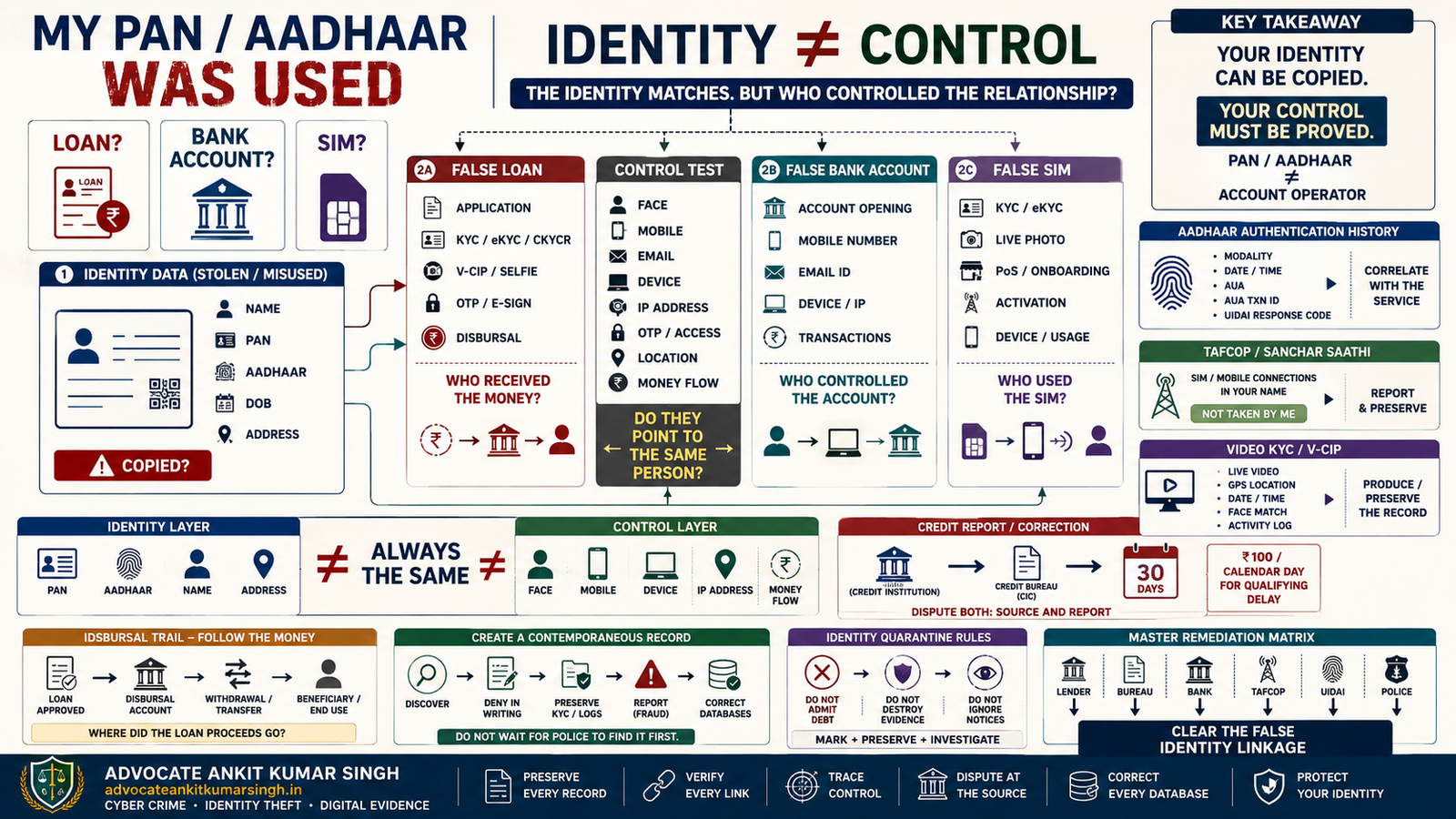
Discovering a loan, SIM or bank account in your name does not mean the criminal actually became you. Identity documents create one layer of the record. The real forensic question is who completed the onboarding, whose face appeared in KYC, which mobile/email/device was used, where the loan proceeds went and who subsequently controlled the account or SIM. Clearing your name therefore requires coordinated correction of the source institution, external databases and the police record—not merely saying “that PAN/Aadhaar belongs to me”.

Current legal and regulatory review: 20 August 2026
Direct Answer: How Do I Clear My Name?
If someone used your PAN or Aadhaar to take a loan, open a bank account or obtain a mobile connection, do not treat the identity document as the complete evidence of who opened or controlled the relationship.
Immediately create a written identity-theft record and pursue the relevant institution at source:
- Fake loan: dispute with the lender and every affected Credit Information Company;
- Fake bank account: notify the bank, deny opening/control, request fraud restriction and evidence preservation;
- Fake SIM: check Sanchar Saathi/TAFCOP, report the connection as not taken by you and notify the telecom operator;
- Aadhaar misuse: examine UIDAI Authentication History and correlate any AUA Transaction ID/Response Code;
- Criminal misuse: lodge the police/cybercrime complaint and preserve every acknowledgement.
Then obtain or preserve the evidence showing who actually performed the onboarding:
KYC FORM + LIVE PHOTO / SELFIE + V-CIP + OTP / E-SIGN + MOBILE + EMAIL + DEVICE / IP WHERE AVAILABLE + DISBURSAL ACCOUNT + TRANSACTION HISTORY.
PAN / AADHAAR
IDENTIFIES YOU.
IT DOES NOT AUTOMATICALLY PROVE
THAT YOU OPENED, CONTROLLED
OR USED THE ACCOUNT.
IDENTITY
≠
CONTROL
Quick Navigation
- The five-ledger identity-theft model
- Unknown loan on PAN/Aadhaar
- How to correct CIBIL and other credit bureaus
- Video KYC / V-CIP evidence
- Where did the loan money go?
- Bank account opened in your identity
- How to stop the account becoming evidence against you
- SIM opened on your Aadhaar/PAN
- TAFCOP / Sanchar Saathi
- Aadhaar Authentication History
- PAN misuse: what it proves and what it does not
- Device, IP and control evidence
- Police complaint and criminal law
- Identity-theft remediation matrix
- Common mistakes
- Frequently asked questions
The Five-Ledger Identity-Theft Model
Identity theft should be analysed as a contamination problem across several separate records.
| Ledger | What It Contains | What It Can Prove | What It Does Not Automatically Prove |
|---|---|---|---|
| Identity | PAN, Aadhaar, name, DOB, address, photograph | Identity information used in onboarding | Who actually applied |
| Onboarding | KYC, e-KYC, CKYCR, selfie, V-CIP, OTP, e-sign | How the relationship was created | Who later controlled it |
| Control | Mobile, email, device, IP, login, password reset | Who may have operated the relationship | Criminal intention by itself |
| Money / Usage | Disbursal, withdrawal, transfers, repayment, calls/data | Where value/use actually moved | That the KYC identity directed each act |
| External Reporting | CIC, recovery, TAFCOP, police, fraud flags | Consequences created by earlier records | Independent proof that the original relationship was genuine |
The central forensic question
Do the five ledgers point to the same human being?
If they do not, the contradiction must be investigated.
Someone Took a Loan Using My PAN or Aadhaar
The victim often discovers the fraud through:
- credit-score drop;
- CIBIL/other bureau report;
- loan-recovery call;
- default SMS;
- credit enquiry alert;
- legal notice;
- debit or mandate request.
First rule: do not acknowledge the debt casually
If you genuinely never borrowed:
do not begin by negotiating instalments.
Begin by stating:
I DISPUTE THE CREATION, OWNERSHIP AND LIABILITY OF THIS LOAN.
Ask the lender for the complete origination file
| Evidence | Question |
|---|---|
| Loan application | Who applied and what information was entered? |
| Application ID / timestamp | When did onboarding start? |
| PAN verification | Was PAN merely matched to data, or was stronger identity verification conducted? |
| Aadhaar / CKYC method | Was e-KYC, offline verification, CKYCR or another method used? |
| Selfie / live photograph | Whose face appears? |
| V-CIP recording | Who appeared in the video? |
| GPS / timestamp | Where and when was V-CIP performed? |
| Mobile / email | Were your genuine contacts used? |
| OTP / e-sign | Where were authentication messages delivered? |
| KFS / loan agreement | Who accepted the contractual documents? |
| Device/IP data | What technical session data exists? |
| Disbursal account | Who received the money? |
| Repayment source | Who made instalments, if any? |
Identity document match is only one column
A lender cannot logically transform:
PAN = YOUR PAN
into:
EVERY OTHER ONBOARDING ACT = YOUR ACT
without examining the remaining evidence.
Unknown Loan in CIBIL / Experian / Equifax / CRIF High Mark
A false credit entry should be challenged at two levels simultaneously:
THE CREDIT INSTITUTION
and
THE CREDIT INFORMATION COMPANY.
Why both?
The bureau reflects information furnished through the credit-reporting ecosystem.
If the lender's source record remains unchanged, the false account can continue to contaminate subsequent reporting.
Obtain all relevant reports
Review the reports for:
- unknown loan accounts;
- unknown credit cards;
- unknown enquiries;
- wrong addresses;
- unknown mobile numbers;
- wrong email;
- defaults associated with accounts you never opened.
Preserve unexplained credit-enquiry alerts
An unknown lender accessing your credit report can pre-date the loan itself.
Create:
ENQUIRY DATE → LOAN OPEN DATE → DISBURSAL DATE → FIRST DEFAULT → DISCOVERY DATE.
30-day correction architecture
RBI's framework provides an overall 30-calendar-day period for correction.
For qualifying cases, delay beyond that period can attract ₹100 per calendar day compensation.
Do not ask only for “score improvement”
The requested correction should identify the disputed account and state:
THE LOAN RELATIONSHIP ITSELF IS DENIED AS IDENTITY THEFT.
Video KYC / V-CIP: One of the Strongest Identity-Theft Tests
If a bank or RBI-regulated lender says the account was opened through Video-based Customer Identification Process, that creates a potentially rich forensic record.
Current RBI safeguards include
- auditable and alteration-proof customer consent;
- live video interaction;
- GPS coordinates;
- date and time;
- face liveness/spoof detection;
- face matching;
- PAN/e-PAN verification;
- document-to-person matching by the authorised official;
- secure storage of the recording;
- preserved activity logs;
- credentials of the official performing V-CIP.
Therefore demand preservation before arguing
A useful first step is:
“PLEASE PRESERVE THE ORIGINAL V-CIP RECORDING AND ALL ASSOCIATED METADATA AND ACTIVITY LOGS.”
Do not let the dispute remain:
YOUR WORD vs LENDER'S SCREEN ENTRY.
Let the onboarding evidence speak.
What if the video shows another person?
That can be powerful evidence of impersonation.
What if the lender says the video is unavailable?
That raises its own evidentiary and regulatory questions because V-CIP recordings and associated records are subject to preservation requirements.
Follow the Loan Money: Who Actually Received the Benefit?
One of the most important identity-theft questions is often ignored:
WHERE DID THE LOAN PROCEEDS GO?
Build the disbursal chain
LENDER → DISBURSAL → BANK ACCOUNT → ACCOUNT HOLDER → MOBILE / DEVICE → WITHDRAWAL / TRANSFER.
Important comparison
Loan KYC:
YOUR PAN / AADHAAR.
Disbursal bank account:
SOMEONE ELSE'S CONTROL.
That divergence can be highly significant.
If the proceeds entered another fraudulent account in your name
Then investigate both relationships together:
FAKE LOAN + FAKE BANK ACCOUNT.
Do not treat the second fraudulent account as proof that the first loan was genuine.
Someone Opened a Bank Account Using My Aadhaar or PAN
This can be more serious than a false loan entry because the account may later be used as a mule account.
Immediately tell the bank in writing
State clearly:
I DID NOT OPEN, CONTROL OR OPERATE THIS ACCOUNT.
Request:
- fraud/identity-theft marking;
- appropriate restriction to prevent further misuse;
- preservation of all onboarding and transaction evidence;
- details sufficient to identify the disputed account;
- internal investigation;
- written acknowledgement.
Onboarding evidence to preserve
Then follow the transactions
If the account received fraud proceeds:
WHO INITIATED THE TRANSFERS?
WHO REGISTERED UPI?
WHICH DEVICE?
WHICH MOBILE?
WHERE WERE CASH WITHDRAWALS MADE?
WHO BENEFITED?
How to Prevent a Fraudulent Account From Becoming Evidence Against You
This is one of the most important practical sections.
Create the “identity quarantine” file immediately
The file should contain:
- date you discovered the fraud;
- credit report / notice / SMS through which it was discovered;
- written denial to lender/bank/operator;
- ticket/complaint numbers;
- police/NCRP acknowledgement;
- UIDAI Authentication History where relevant;
- TAFCOP report where relevant;
- your genuine mobile/email details;
- evidence of your actual location/device where relevant;
- requests for preservation of KYC and technical logs.
Why chronology matters
Suppose police contact you six months later because an account in your name received fraud proceeds.
Two records are very different:
CASE A:
No complaint until police arrived.
CASE B:
You independently reported the account as identity theft months earlier.
The second chronology can strongly support the position that you were the identity victim rather than the operator.
Ask the institution to preserve — not merely delete
Do not demand:
“DELETE EVERYTHING TODAY.”
A better demand is:
“STOP FURTHER MISUSE, MARK THE RELATIONSHIP AS DISPUTED AND PRESERVE ALL ORIGINAL ONBOARDING AND OPERATIONAL EVIDENCE.”
Closing does not erase history
RBI-regulated entities are subject to record-retention duties.
The evidence can remain available for investigation even after the relationship is closed.
Do not let the fraudster's KYC become the prosecution's only story
Separate:
NAME ON ACCOUNT
from:
PERSON WHO CONTROLLED ACCOUNT.
That requires control evidence.
Someone Opened a SIM Using My Aadhaar or PAN
A fraudulent mobile connection can become the infrastructure for:
- OTP fraud;
- bank-account onboarding;
- fake loan applications;
- WhatsApp scams;
- UPI fraud;
- mule-account operation;
- criminal communications.
The SIM can therefore contaminate every other evidence chain
Example:
FAKE SIM IN YOUR IDENTITY ↓ FAKE BANK ACCOUNT ↓ FAKE DIGITAL LOAN ↓ FRAUD TRANSACTIONS.
An investigator who looks only at the first line may wrongly conclude:
“THE OTP WENT TO YOUR MOBILE NUMBER.”
The correct question is:
WHO POSSESSED AND USED THAT SIM?
Demand preservation of the onboarding route
Depending on the activation date and KYC method, relevant records can include:
- CAF / subscriber record;
- identity documents;
- live photograph;
- KYC/e-KYC/D-KYC data;
- PoS details;
- customer authentication/signature/OTP record;
- transaction/reference ID;
- activation date;
- SIM identifiers.
Usage-level records may require police process
Important evidence can include:
- IMEI/device association;
- CDR;
- cell location;
- recharge/payment trail;
- first activation/usage records.
A customer may not be entitled to receive every sensitive network record directly.
The police/investigating agency can seek appropriate preservation and production through lawful process.
TAFCOP / Sanchar Saathi: Check Every Mobile Connection in Your Name
DoT's Sanchar Saathi platform provides the “Know Mobile Connections in Your Name” service through TAFCOP.
Use it to identify mobile connections associated with your identity and report a connection that:
- you did not take; or
- you no longer require.
Official portal:
Preserve the TAFCOP evidence
Before submitting the report, preserve:
- number shown;
- date discovered;
- portal screenshot;
- complaint/request reference;
- operator identification where available.
Do not stop at disconnection
If the SIM was involved in fraud, also request preservation of the historical KYC and usage evidence.
DISCONNECTION STOPS FUTURE USE.
PRESERVATION EXPLAINS PAST USE.
Check UIDAI Authentication History
Where Aadhaar authentication may have been used, UIDAI Authentication History can show:
| Field | Why It Matters |
|---|---|
| Authentication modality | OTP, demographic, biometric or other mode. |
| Date and time | Can be matched to loan/account/SIM onboarding. |
| AUA | Which Authentication User Agency submitted the request? |
| AUA Transaction ID | Identifier for enquiry with the AUA. |
| UIDAI Response Code | Identifier for the authentication response. |
| Success / Failure | Was the authentication accepted? |
Unknown authentication?
UIDAI itself advises Aadhaar holders to contact the relevant AUA for details where an authentication is not recognised.
But do not stop at “success”
Ask:
WHAT SERVICE WAS REQUESTED?
WHAT PURPOSE WAS DISCLOSED?
WHAT CONSENT WAS CAPTURED?
WHAT ACCOUNT / LOAN / SIM WAS CREATED?
Consumer history has a limited window
UIDAI currently provides authentication history for the last six months, subject to the interface limits.
Therefore check quickly after discovering fraud.
PAN Misuse: What PAN Proves—and What It Does Not
PAN is often the first common identifier connecting a false loan to the victim's credit report.
But PAN alone does not create:
- a genuine contract;
- a genuine V-CIP;
- a genuine e-sign;
- a genuine borrower device;
- a genuine disbursal;
- a genuine repayment obligation.
Three different PAN scenarios
| Scenario | Legal / Forensic Issue |
|---|---|
| Genuine PAN data copied and used without permission | Identity misuse / personation; document itself may not be forged. |
| Victim's PAN details combined with another person's face | Hybrid identity / KYC failure / impersonation. |
| Altered or fabricated PAN document/electronic record | Forgery analysis may arise depending upon how it was created and used. |
Device, IP, Mobile and Email: The Control Layer
Identity theft cases often turn on the control layer.
Ask for available data concerning
- registered mobile;
- registered email;
- OTP destination;
- device identifier;
- IP address;
- session timestamps;
- login history;
- password reset;
- mobile-number change;
- UPI registration;
- digital-lending application activity;
- e-sign process;
- loan disbursal device/session.
Not every product records every one of these fields.
The correct request is:
PRODUCE/PRESERVE ALL SUCH CONTROL AND SESSION METADATA AS WAS GENERATED OR RETAINED.
Digital lending
RBI's digital-lending framework requires need-based data collection with prior explicit consent and an audit trail.
Therefore ask the lender:
WHAT DATA DID YOUR DLA/LSP COLLECT?
WHAT CONSENT ARTEFACT EXISTS?
WHAT AUDIT TRAIL CONNECTS MY IDENTITY TO THE APPLICATION?
Control evidence can reverse the narrative
KYC: VICTIM.
Mobile: UNKNOWN NUMBER.
Device: UNKNOWN.
IP: DIFFERENT REGION.
Selfie: DIFFERENT PERSON.
Disbursal: THIRD-PARTY ACCOUNT.
That is a very different case from:
KYC + DEVICE + MOBILE + FACE + MONEY all belonging to the same person.
Police / Cybercrime Complaint: Build the Case as Identity Theft, Not Merely “Wrong Data”
For current post-1 July 2024 incidents, BNSS Section 173 governs information relating to cognizable offences.
The provision permits such information to be given orally or by electronic communication irrespective of where the offence was committed, subject to the statutory formalities.
Complaint should identify every contaminated asset
For example:
- false loan account;
- false bank account;
- false mobile number;
- unknown Aadhaar authentication;
- credit-report entry;
- disbursal beneficiary;
- recovery calls;
- subsequent fraudulent transactions.
Request preservation—not just registration
The complaint should specifically identify evidence at risk:
- V-CIP video;
- KYC application;
- OTP/e-sign logs;
- loan app/LSP logs;
- IP/device data;
- bank transaction logs;
- SIM KYC records;
- CDR/device association through lawful process;
- CCTV where relevant.
Potential criminal provisions
Depending upon the evidence:
IT Act Section 66C — identity theft.
IT Act Section 66D — cheating by personation through communication device/computer resource.
BNS Section 318 — cheating.
BNS Section 319 — cheating by personation.
BNS Section 336 — forgery where a false document/electronic record is made with the required intent.
BNS Section 337 — forgery of specified public/government identity documents, expressly including Aadhaar Card.
BNS Section 340 — use of a forged document/electronic record as genuine, where its ingredients exist.
Do not mechanically add all provisions to every identity-theft complaint.
Master Identity-Theft Remediation Matrix
| Problem | Immediate Action | Evidence to Preserve | Correction / Remedy |
|---|---|---|---|
| Unknown Loan | Written lender fraud dispute | Application, KYC, V-CIP, e-sign, mobile, device/IP, disbursal | Lender investigation + account correction |
| False Credit Entry | Dispute with lender and CIC | CIR, enquiry alert, account details, lender complaint | 30-day correction framework; compensation for qualifying delay |
| Unknown Bank Account | Notify bank, deny opening/control, request restriction | KYC, V-CIP, mobile/email, transaction logs, device/UPI records | Fraud investigation + correction/closure as appropriate |
| Unknown SIM | TAFCOP + operator complaint | CAF/subscriber data, KYC, live photo, PoS, activation records | Report connection not taken / disconnection + preservation |
| Unknown Aadhaar Authentication | Check history and contact AUA | AUA Txn ID, Response Code, modality, time | AUA/UIDAI enquiry + correlate to service |
| Criminal Misuse | Police/NCRP complaint | Complete identity-quarantine chronology | Investigation and evidence attribution |
The order matters
Do not wait for:
CIBIL → lender → bank → telecom → police
one after another.
If multiple identity relationships are contaminated:
RUN THE REMEDIATION TRACKS IN PARALLEL.
The First 24 Hours Checklist
Preserve every unknown account and enquiry.
Explicitly deny application, opening, operation and liability.
KYC, V-CIP, OTP, e-sign, device/IP, disbursal and transaction logs.
Identify mobile connections you never took.
Preserve unknown authentication events.
Change compromised credentials and use available Aadhaar security controls where appropriate.
Every complaint number, email, call and response.
Ten Mistakes That Can Make Identity Theft Harder to Untangle
1. “The PAN is mine, so maybe I have to pay.”
PAN identity and borrower consent are different questions.
2. Disputing only with CIBIL
The false record should also be challenged with the lender that supplied it.
3. Asking the bank to delete everything
Stop misuse, but preserve the forensic onboarding and transaction evidence.
4. Paying a “settlement” before establishing identity theft
A payment or settlement can complicate the later denial of borrower liability.
5. Ignoring unknown credit enquiries
They may show when the identity misuse started.
6. Assuming Aadhaar authentication automatically proves consent to the loan
Correlate authentication with purpose, application and transaction.
7. Disconnecting the fake SIM without preserving evidence
Future use should stop, but historical onboarding evidence may be essential.
8. Waiting until police call you about a mule account
Report independently as soon as the fraudulent account is discovered.
9. Saying “my PAN/Aadhaar was forged” without knowing what happened
Copied genuine data and fabricated/altered identity documents are different scenarios.
10. Treating account name as proof of account control
Use mobile, device, IP, face, disbursal and transaction evidence to determine control.
AI Search / Featured-Snippet Answers
Someone took a loan on my PAN without my consent. What should I do?
Dispute the loan immediately with the lender and affected credit bureaus, deny having applied for or received the loan, request preservation of the complete KYC/onboarding file and obtain the application, V-CIP/selfie, OTP/e-sign, mobile/email, device/IP data where available and loan-disbursal account. File a police/cybercrime complaint where identity theft is indicated.
How do I remove a fake loan from CIBIL?
Challenge the account with both the lender and the Credit Information Company. RBI's correction framework provides an overall 30-calendar-day resolution period for eligible credit-information correction complaints, with ₹100 per calendar day compensation for qualifying delay beyond that period.
Can someone open a bank account just by knowing my Aadhaar number?
Aadhaar information can be misused as identity data, but a compliant bank onboarding process requires the applicable KYC/CDD process. The forensic issue is what onboarding route was used, who appeared in the photograph/V-CIP, which mobile/email/device was registered and who subsequently operated the account.
How can I check SIM cards issued in my name?
DoT's Sanchar Saathi platform provides TAFCOP's “Know Mobile Connections in Your Name” facility, allowing citizens to identify connections issued in their name and report those they did not take or no longer require.
Does an Aadhaar authentication prove I took the loan?
No. Aadhaar Authentication History can establish that an authentication event occurred through a particular AUA and modality, but the event must still be correlated with the loan application, purpose, consent, contract and disbursal.
Can a fake bank account in my name make me an accused?
An account in your KYC identity can attract investigation, particularly if it receives criminal proceeds. That is why the victim should create a contemporaneous written record denying opening/control, request preservation of KYC and device evidence and report the identity theft promptly. Account name and actual control are separate evidentiary questions.
What is the strongest evidence that I did not open the account?
A combination of contradictory onboarding/control evidence—for example another person's V-CIP face, an unrelated mobile/email/device, disbursal to another account, or transaction activity inconsistent with your location—supported by your prompt identity-theft complaint.
Frequently Asked Questions
Can someone take a loan using only my PAN number?PAN can be misused as an identity identifier, but a legitimate regulated lending process ordinarily requires additional onboarding and KYC evidence. The investigation should determine what other authentication, KYC, mobile, device and disbursal data were used.
Does a loan appearing in my CIBIL report legally prove I borrowed it?No. A credit report records credit information supplied through the reporting system. Where identity theft is alleged, the underlying lender onboarding and disbursal evidence must be examined.
Should I dispute the fake loan with CIBIL or the bank/NBFC?Both. The lender is the source of the loan relationship and the CIC is the external reporting layer.
How long should credit-report correction take?RBI's framework provides an overall 30-calendar-day period for resolution of an eligible correction complaint, with the Credit Institution generally having 21 days to send corrected particulars.
Is compensation available if my credit report is not corrected?For qualifying delayed correction complaints, RBI's framework provides ₹100 per calendar day beyond the 30-day resolution period, subject to the framework's terms and exclusions.
Should I pay the fake loan to improve my score?Do not casually acknowledge or settle a debt that you genuinely deny as identity theft without considering the legal consequences. First establish the onboarding and disbursal evidence and obtain case-specific advice.
What is V-CIP?Video-based Customer Identification Process is an RBI-recognised remote customer-identification process with safeguards including live video, geolocation, timestamp, face/liveness controls and preserved records.
Can I ask for the video KYC recording?You can require the lender/bank to preserve it and seek disclosure through the institution's complaint process and, where necessary, regulatory, police or judicial procedure. Whether the complete original recording is supplied directly to the customer can depend on applicable process and confidentiality/security considerations.
Why is the loan-disbursal account important?It identifies who actually received the money. If the proceeds went to an unrelated account or another fraudulently opened account, that can materially support the identity-theft investigation.
Someone opened a bank account using my Aadhaar. What should I do?Notify the bank immediately in writing, deny opening/control, request appropriate restriction and evidence preservation, obtain the onboarding details and report criminal misuse to police/cybercrime authorities.
Can the bank simply close the fake account?Stopping future misuse may require restriction or closure, but the original KYC, V-CIP, mobile/device and transaction records should be preserved for investigation.
If a mule account is in my name, does that prove I was the mule?Not automatically. Investigators should distinguish the KYC identity from the person who actually controlled the mobile, device, credentials, transactions and funds.
How do I check SIMs opened in my name?Use Sanchar Saathi/TAFCOP's facility for mobile connections issued in your name and report numbers you did not take.
Does disconnecting the unknown SIM clear the criminal record?No. Disconnection stops future service. Historical KYC and usage evidence may still need to be preserved and investigated.
Can I get call records of the fake SIM myself?Some telecom records are subject to privacy, security and lawful-disclosure restrictions. The police/investigating agency can seek the appropriate network and device records during investigation.
How can UIDAI Authentication History help?It can show authentication modality, date/time, AUA, AUA Transaction ID, UIDAI Response Code and success/failure, allowing the event to be correlated with the alleged loan/account/SIM onboarding.
What if I do not recognise an Aadhaar authentication?UIDAI advises contacting the relevant AUA for further details using the authentication identifiers.
Is PAN misuse the same as PAN forgery?No. A genuine PAN copy may be used without authority, or a document may be altered/fabricated. The criminal and evidentiary analysis differs.
Which law covers identity theft online?Section 66C of the Information Technology Act addresses fraudulent or dishonest use of another person's electronic signature, password or other unique identification feature. Section 66D addresses cheating by personation using a communication device or computer resource.
Which BNS provisions may apply?Depending on the facts, cheating, cheating by personation and forgery/use-of-forged-record provisions may require examination, including Sections 318, 319, 336, 337 and 340 BNS.
Can I file a police complaint even if the fraud happened in another State?BNSS Section 173 permits information concerning a cognizable offence to be given irrespective of the area where the offence occurred, subject to the statutory process.
Can I approach RBI Ombudsman?For a qualifying deficiency-in-service complaint against an entity covered by the Reserve Bank – Integrated Ombudsman Scheme, 2026, the RBI Ombudsman route may become available after first complaining to the Regulated Entity and complying with the Scheme's maintainability and timing requirements.
Will a police complaint automatically remove the loan from my credit report?No. The police complaint establishes the criminal dispute, while credit correction requires action through the lender/Credit Institution and Credit Information Company.
What is the most important rule?Your PAN or Aadhaar being attached to an account proves an identity linkage. It does not automatically prove that you personally created, controlled or used that account.
Official Legal and Regulatory Sources
- Reserve Bank of India
- RBI Complaint Management System
- Unique Identification Authority of India
- Sanchar Saathi / TAFCOP
- Department of Telecommunications — Telecom eServices
- National Cyber Crime Reporting Portal
- India Code — Bharatiya Nyaya Sanhita, 2023
- India Code — Bharatiya Nagarik Suraksha Sanhita, 2023
- India Code — Information Technology Act, 2000
Related Detailed Research
This article should also be connected after publication with the dedicated research on:
- AEPS / Aadhaar Biometric Fraud;
- Merchant QR Replacement Fraud;
- UPI Receive-Money / Refund Trick;
- Psychology of Scam Compliance;
- mule bank accounts and innocent account-holder disputes;
- fake digital loan apps and identity misuse.
Professional Consultation for PAN, Aadhaar, Loan, SIM and Bank-Account Identity Theft
Advocate Ankit Kumar Singh
Supreme Court of India | Patna High Court | Allahabad High Court at Prayagraj | Jharkhand High Court at Ranchi | Calcutta High Court | Delhi High Court and Delhi Courts/Tribunals | Matters concerning Bhopal, Madhya Pradesh | Multiple District Courts
Depending upon the facts, jurisdiction and accepted professional engagement, professional work may include:
- fraudulent loan / credit-report disputes;
- PAN and Aadhaar identity-theft analysis;
- bank-account impersonation and mule-account disputes;
- CIBIL / CIC correction strategy;
- digital KYC and V-CIP evidence review;
- UIDAI authentication analysis;
- TAFCOP / telecom identity misuse;
- police and cybercrime complaints;
- device/IP/transaction evidence reconstruction;
- bank/NBFC regulatory grievances;
- RBI Ombudsman matters where maintainable;
- criminal and financial-crime proceedings arising from identity misuse.
Phone:
8294431232
Email:
ankitsingh.legum@gmail.com
Website:
advocateankitkumarsingh.in
Subject to accepted professional engagement, territorial jurisdiction, applicable procedure and local-counsel coordination where required.
Add AdvocateAnkitKumarSingh.in as a Google Preferred Source
For detailed research concerning cyber fraud, digital identity, PAN/Aadhaar misuse, banking disputes, digital evidence and financial crime, readers may add advocateankitkumarsingh.in as a Preferred Source on Google.
Add as Google Preferred SourceLegal Disclaimer: This article provides general legal, regulatory and digital-forensic research and does not determine whether any specific loan, bank account, SIM or Aadhaar authentication was fraudulent. A PAN/Aadhaar match does not automatically prove account opening or control, but equally a person's denial does not by itself establish impersonation. Each case should be tested against the applicable onboarding method, KYC records, consent and authentication artefacts, mobile/email/device information, V-CIP or live-photo evidence, disbursal and transaction records, telecom onboarding data and contemporaneous complaints. Credit-report correction, telecom disconnection, police investigation, regulatory complaints and civil remedies are separate processes and may need to proceed simultaneously. Criminal provisions should be applied only where their statutory ingredients are established. No correction, refund, deletion, account closure, police outcome or compensation is guaranteed.