Important privacy note: “Rahul Das” is a fictionalised name used for legal education. Identifying numbers, personal email addresses, account details and direct officer details have been removed or changed. The sequence is based on a documented incident, but every case must be examined independently.
Direct answer: What should you do when a cyber complaint freezes your bank account, SIM and UPI app?
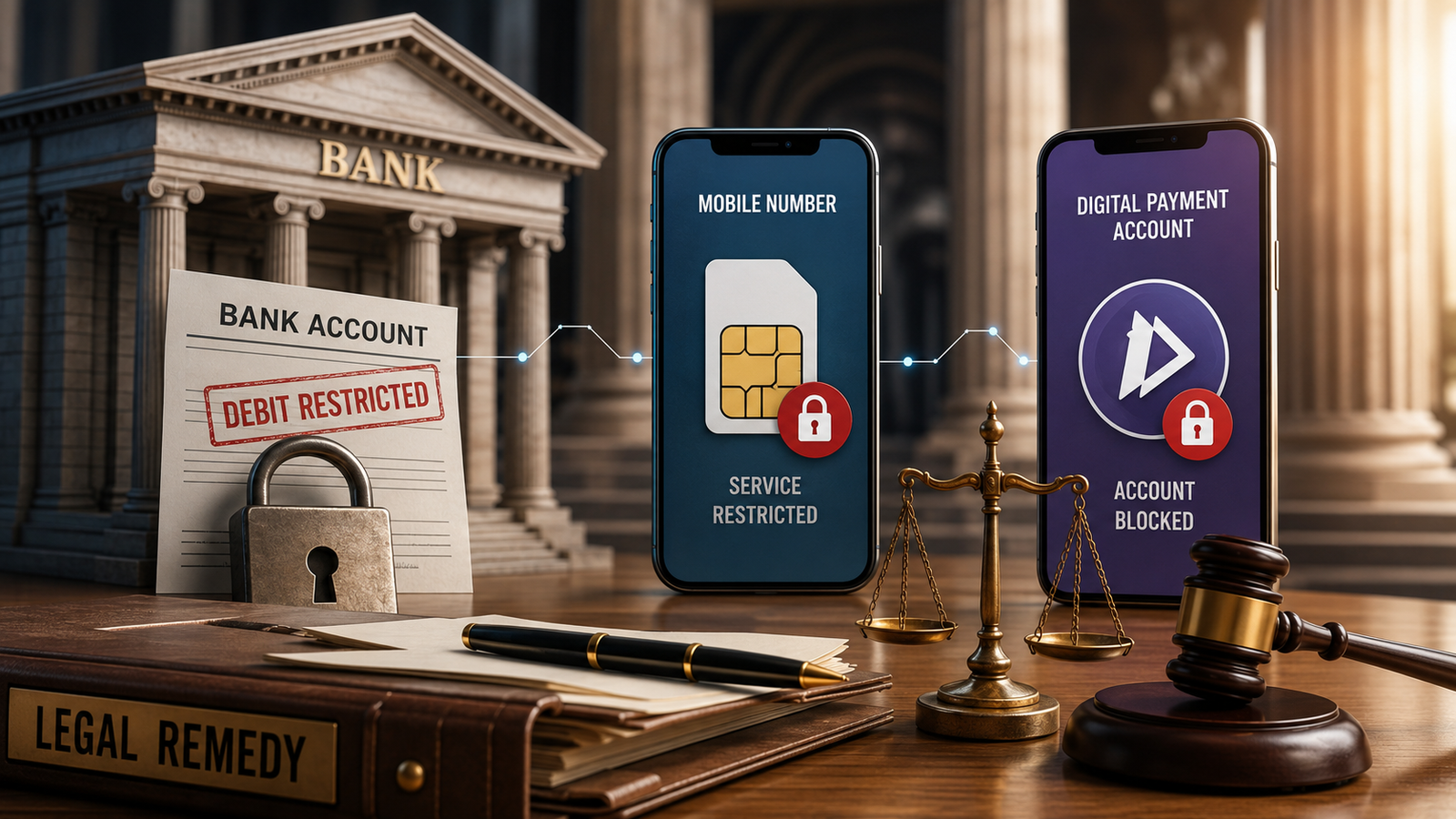
If your bank account has been placed under a complete debit freeze, a particular amount is under lien, your mobile number has been barred, or your UPI application has blocked access after an NCRP cyber complaint, do not treat all these restrictions as one problem.
They are usually maintained by different organisations and must be addressed separately:
- Obtain the NCRP acknowledgement number, police-station details and investigating officer’s particulars.
- Ask the bank in writing whether the restriction is a complete debit freeze, a debit-only restriction or a lien over a specified amount.
- Submit a documented representation to the investigating officer and the SHO.
- Request a clear closure, de-freezing or no-objection communication addressed separately to the bank, telecom operator and payment platform.
- Escalate the telecom restriction through the operator’s complaint centre and appellate authority.
- Raise the payment-app restriction through its support, grievance and nodal-officer levels.
- Approach the bank’s grievance officer and, where legally maintainable, the RBI Ombudsman.
- Consider an application before the jurisdictional Magistrate or appropriate High Court proceedings when administrative representations do not produce relief.
The most important lesson is that closure of the original complaint does not always automatically update the bank, telecom operator, NCRP-linked systems and payment application at the same time.
Illustrative case study: What happened to Rahul Das?
Rahul Das discovered that several essential services had been affected after his mobile number and banking transaction appeared in a cyber-fraud complaint:
- His bank account was placed under a debit restriction.
- A sum of approximately ₹15,000 was reflected as a lien or disputed amount.
- Outgoing calls and SMS on his mobile number were barred.
- His PhonePe account was placed under a security restriction.
- The restrictions continued even after the underlying matter was resolved and the police complaint was closed.
Rahul’s difficulty was not limited to proving that the police complaint had ended. His real difficulty was ensuring that every authority and private service provider received, understood and implemented the closure communication.
Why can one cyber complaint affect several different services?
Cyber-financial-fraud complaints may generate information or requests involving several systems. A disputed transaction may cause the bank to place a lien or debit restriction. A mobile number reflected in the complaint may be marked for law-enforcement action. A UPI or payment application may separately apply its own risk-control or security restriction.
These consequences are not necessarily removed together. The bank may restore the account while the SIM remains restricted. The SIM may be reconnected while the payment app continues to show a security block. The NCRP complaint may appear resolved at the police-station level while a downstream service provider still sees an earlier restriction.
First understand the restriction: freeze, lien and app block are different
| Restriction | What it generally means | What should be requested |
|---|---|---|
| Complete debit freeze | Outgoing transfers, withdrawals, card payments or UPI debits may be stopped. | Written reasons, authority details, disputed transaction particulars and removal or modification of the debit restriction. |
| Amount-specific lien or hold | A specified amount is kept unavailable while the remainder of the balance may remain usable. | Confirmation of the lien amount, transaction reference and release after police or court clearance. |
| Credit freeze | The account may not accept incoming credits, depending on the bank’s system and instruction. | Exact scope of the restriction and the written instruction relied upon. |
| SIM or LEA restriction | Calls, SMS or other telecom services may be barred because of a law-enforcement-linked instruction. | Reconnection after police confirmation and synchronisation of the updated LEA status. |
| UPI or payment-app security block | The payment platform may independently restrict login, registration or transactions. | Platform-level review and removal of the security restriction after police, bank and telecom clearance. |
Step 1: Do not panic and do not start sending random emails
The first twenty-four hours should be used to identify the exact nature and source of the restriction. Do not send Aadhaar, PAN, bank statements or police papers to an address merely because someone claims to be an officer or company representative.
Verify every email domain from the official website of the police department, bank, telecom operator or payment platform. Keep sensitive numbers partly masked unless the verified authority specifically requires the complete number.
Record these details immediately
- Date and approximate time when the restriction was first noticed.
- Exact error message shown by the bank, ATM, UPI app or telecom operator.
- NCRP acknowledgement number, where available.
- Name and location of the concerned cyber police station.
- Name, rank, official telephone number and official email address of the investigating officer.
- Complaint or FIR number, if one has been registered.
- Disputed transaction date, amount, UTR or transaction reference.
- Bank complaint number and branch details.
- Telecom service-request or docket number.
- Payment-app ticket number.
Step 2: Approach the bank first and demand a written explanation
Visit the branch or submit a written complaint through the bank’s official grievance channel. A verbal statement such as “cyber hold”, “police freeze” or “NCRP block” is not sufficient for planning the next legal step.
Ask the bank these precise questions
- Is the account fully frozen or is only the debit function restricted?
- Is there a lien over a specific amount?
- What is the exact lien or disputed amount?
- Which police station, cyber unit or law-enforcement agency requested the restriction?
- What complaint, FIR, NCRP acknowledgement or reference number is mentioned?
- On what date did the bank receive the instruction?
- Was the instruction reported to or received from a court or Magistrate?
- What document will the bank accept for de-freezing: police email, signed letter, court order or portal update?
Request the bank to provide the available particulars in writing. The bank may refuse to share confidential investigative material, but it should still be asked to identify the authority and reference necessary for the account holder to pursue lawful redress.
Relief that may be requested from the bank
- Removal of the complete debit freeze.
- Restriction limited only to the genuinely disputed amount.
- Permission to operate the undisputed balance.
- Release of salary, pension, statutory dues or essential-business payments, depending on the case.
- Written confirmation after the account is restored.
Whether any of these requests will be accepted depends on the police instruction, transaction trail, applicable law and any order passed by the competent court.
Step 3: Identify the correct police authority
The most common mistake is repeatedly contacting officers who are not handling the complaint. The account holder should identify the officer or police station shown against the relevant NCRP complaint or bank communication.
The first police representation should ordinarily be sent to:
- The investigating officer;
- The SHO of the concerned cyber police station;
- The supervising ACP or equivalent officer, when necessary;
- The district DCP or SP cyber unit if no action is taken;
- The relevant State or Union Territory NCRP nodal or grievance officer when the portal response is inadequate.
Current State and Union Territory nodal-officer details should be verified through the official National Cyber Crime Reporting Portal. Do not assume that an email address used in another person’s case will apply to your complaint.
Step 4: Submit one complete police representation
The representation should be factual, chronological and supported by documents. Avoid emotional allegations or threats. The objective is to help the investigating officer verify the transaction and issue the correct communication.
Recommended police-representation subject
Subject: Request for Review and Removal of Bank Debit Freeze, Amount Lien and Connected Digital Restrictions — NCRP Acknowledgement No. [NUMBER]
Information to include
- Full name and contact details of the account holder.
- Masked bank-account and mobile-number details.
- NCRP acknowledgement, complaint or FIR reference.
- Exact disputed transaction and amount.
- Explanation of the legitimate source and purpose of the transaction.
- Whether the person is a victim, merchant, intermediary, account holder or unrelated recipient.
- Whether any settlement, refund or complaint closure has occurred.
- Present status of the bank account, SIM and UPI app.
- Precise relief required from the investigating officer.
Documents to attach
- NCRP acknowledgement or available complaint screenshot;
- Bank statement highlighting the disputed entry;
- Invoice, agreement, payment proof or transaction correspondence;
- Bank freeze or lien communication;
- Identity and address proof with unnecessary details masked;
- Prior complaint and follow-up emails;
- Settlement or refund proof, where lawful and applicable;
- Any court order already obtained.
Step 5: Ask for a legally clear closure or unblocking communication
A vague email stating that the “matter is resolved” may not be enough. The receiving company may require an express instruction identifying the service and clearly stating what must be restored.
The police communication should ideally specify:
- The relevant NCRP or complaint number;
- That the matter has been resolved, closed or no longer requires the restriction;
- The affected bank account, mobile number or platform, preferably in masked form;
- That no further debit freeze, lien, SIM bar or platform restriction is required, where that is the investigating authority’s conclusion;
- A clear request to de-freeze, release, reconnect or unblock;
- The official name, designation and contact details of the issuing officer.
Why wording matters
In Rahul Das’s case, one official communication stated that the complaint had been resolved, mutually settled and closed. It also requested that the mobile number be unblocked. However, an intervening sentence was worded in a contradictory manner and could literally have been interpreted as saying that unblocking was not required.
The overall communication supported reconnection, but the contradiction created avoidable uncertainty. Whenever an official communication contains such an error, request a corrected email or clarification immediately rather than expecting the company to interpret the intended meaning.
Step 6: The fictionalised Rahul Das timeline
| Stage | What happened | Practical lesson |
|---|---|---|
| 14 February 2026 | Rahul sent his first written representation to the concerned SHO regarding the bank debit restriction and SIM bar. | Start with the officer and police station actually handling the complaint. |
| 14 February 2026 | The matter was escalated to senior cyber-police authorities and the national cyber-crime framework. | Escalate with the original representation and attachments, not a new disconnected story. |
| 19 February 2026 | The concerned police station communicated that the dispute had been resolved and the complaint closed, and requested unblocking of the mobile number. | Obtain an express restoration instruction rather than relying only on oral closure. |
| 21 February 2026 | Rahul sought NCRP or law-enforcement-status synchronisation and approached the telecom operator’s customer-care, nodal and appellate levels. | A police email does not always automatically update the telecom operator’s system. |
| 23–24 February 2026 | Identity documents, SIM proof, police correspondence and available court papers were supplied through verified channels. | Companies may require both police clearance and subscriber verification. |
| 24 February 2026 | A separate grievance was raised with PhonePe because its security block continued independently. | UPI-app restrictions require a separate platform ticket. |
| 25 February 2026 | The mobile connection was restored after the reconnection request was processed. | Obtain written confirmation of the actual reconnection date. |
| 26 February 2026 | The grievance was forwarded internally by the supervising police authority. | Preserve forwarded emails because they prove official escalation. |
| 3–5 March 2026 | Rahul requested a separate police confirmation for PhonePe; the request was forwarded to the concerned police officers. | Payment platforms may require a communication naming the platform specifically. |
| 7 March 2026 | The bank and mobile services had been restored, but PhonePe remained restricted. | Restoration at one institution does not compel automatic restoration at another. |
| 15–17 March 2026 | Further written follow-up was made with the investigating and supervising police authorities. The telecom reconnection date was formally confirmed. | Continue following up until each organisation confirms closure in writing. |
Step 7: How to escalate a telecom SIM restriction
Start with the telecom operator’s complaint centre and obtain a service-request or docket number. If the complaint is not properly resolved, approach the operator’s appellate authority for the relevant telecom circle.
For an Airtel subscriber
- Call 198 for complaints or use Airtel’s official help channel.
- Record the service-request number.
- Submit the police closure or unblocking communication.
- Provide subscriber-verification documents only through an official Airtel channel.
- If unresolved, approach the Airtel appellate authority for the relevant circle.
As of the publication date, Airtel’s official page lists appellate.bihar@in.airtel.com for the Bihar and Jharkhand mobile circle. Contact details can change, so they must be checked on Airtel’s official appellate-authority page before sending documents.
What should the telecom representation request?
- Identification of the exact reason for barring the connection;
- Confirmation whether the restriction is KYC-related or LEA-related;
- Immediate synchronisation of the latest police or NCRP status;
- Reconnection of outgoing calls and SMS;
- Restoration of OTP functionality;
- Written confirmation of reconnection.
Do not treat a law-enforcement restriction as a routine KYC complaint. If the operator states that a signed, stamped or officially transmitted police communication is required, obtain that precise document from the concerned police authority.
Step 8: How to escalate a PhonePe or other UPI-app restriction
A payment application may apply its own risk and security controls even after the bank account and SIM are restored. Raise a separate ticket and attach the updated police and bank records.
PhonePe escalation sequence
- Raise the complaint through the PhonePe app or its official support channel.
- Preserve the ticket number and first response.
- If unresolved within the applicable service level, escalate through the PhonePe grievance portal.
- If the grievance remains unresolved, approach the current Nodal or Principal Nodal Officer through the official nodal-officer webform.
- For a qualifying PPI complaint that remains unresolved after the required period, examine the RBI Ombudsman route.
PhonePe’s current grievance policy lists app-based support, customer-support numbers, a Level 2 grievance portal and a Level 3 nodal-officer mechanism. Current details should be verified directly from PhonePe’s official grievance policy because officer names, service levels and contact routes may change.
Recommended PhonePe subject
Subject: Request for Removal of Security Restriction After Closure of NCRP Complaint — Registered Mobile No. [MASKED NUMBER] — Ticket No. [NUMBER]
Attach these documents
- PhonePe ticket and screenshots of the restriction;
- Police closure or no-objection communication;
- Bank restoration confirmation;
- SIM reconnection confirmation;
- NCRP acknowledgement in masked form;
- Identity verification requested through the verified platform.
Step 9: Escalate the bank grievance correctly
The bank should be approached through its internal grievance hierarchy before an RBI Ombudsman complaint is made:
- Branch Manager or official customer grievance channel;
- Bank Grievance Officer or Nodal Officer;
- Principal Nodal Officer, where applicable;
- RBI Complaint Management System after the complaint becomes maintainable.
Under the RBI Ombudsman framework, a customer should first complain to the bank or regulated entity. If the entity rejects the complaint, gives an unsatisfactory response, or does not respond within 30 days, a complaint may ordinarily be filed through RBI’s Complaint Management System, subject to maintainability requirements.
A significant procedural point is that RBI’s published FAQ treats complaints filed through an advocate as non-maintainable, except where the advocate is personally the aggrieved person. Therefore, the account holder should normally file the RBI complaint personally or through a permitted authorised representative. Legal counsel may assist in preparing the facts and documents without improperly becoming the complainant before RBI.
Step 10: Legal remedies when emails do not work
Written representations should ordinarily be attempted first, but they are not the only remedy. The correct court and procedure depend on the law under which the account was restricted, the status of the investigation and the authority that issued the instruction.
Police seizure and reporting to the Magistrate
Section 106 of the Bharatiya Nagarik Suraksha Sanhita, 2023 concerns the police power to seize property suspected to be connected with an offence. It also requires the seizure to be reported to the jurisdictional Magistrate. The precise application of this provision to a bank account must be examined from the police papers and judicial precedents applicable to the case.
Application before the jurisdictional Magistrate
Depending on the facts, an affected account holder may seek release, de-freezing, limited operation or appropriate custody and disposal directions before the jurisdictional criminal court. Section 503 of the BNSS deals with orders that a Magistrate may make regarding property whose seizure has been reported.
High Court proceedings
A writ petition under Article 226 of the Constitution may be considered where there is prolonged administrative inaction, a failure to implement an admitted closure or unblocking instruction, a disproportionate restriction, or serious interference with lawful business and personal activity. Maintainability, territorial jurisdiction, necessary parties and the appropriate relief must be assessed before filing.
Possible interim reliefs
- Removal of the complete debit freeze;
- Restriction confined to the disputed amount;
- Permission to operate the undisputed balance;
- Release of salary, statutory payments or essential business expenditure;
- Direction to the police to communicate the updated status;
- Direction to the telecom operator to process reconnection;
- Time-bound consideration of a platform-restoration request.
No particular relief is automatic. The court will consider the transaction trail, stage of investigation, conduct of the account holder, disputed amount, police record and competing interests of the complainant.
What if a company or business current account is frozen?
A complete freeze of a company, partnership or proprietorship current account may affect salaries, GST payments, vendors, rent and day-to-day operations. The representation should therefore explain the operational harm with supporting records rather than merely stating that the business is suffering.
Additional documents for a business account
- Certificate of incorporation, partnership deed or proprietorship proof;
- Board resolution or authority letter;
- GST registration and relevant returns;
- Invoices and contracts connected with the disputed payment;
- Ledger and bank statement explaining the transaction trail;
- Payroll and statutory-liability statement;
- Details of beneficial owners and authorised signatories;
- Proof that the disputed amount is small compared with legitimate business turnover, where relevant.
The business may request that the restriction be confined to the traceable disputed amount or that essential operations be permitted. Whether such relief is granted depends on the investigation and competent authority.
Master document bundle: prepare one indexed PDF set
Prepare a clean, indexed set of documents instead of sending random screenshots. A suggested file structure is:
- 01_NCRP_Acknowledgement.pdf
- 02_Bank_Freeze_or_Lien_Communication.pdf
- 03_Bank_Statement_Disputed_Transaction.pdf
- 04_Transaction_Invoice_or_Agreement.pdf
- 05_ID_and_Address_Proof_Redacted.pdf
- 06_First_Police_Representation.pdf
- 07_Police_Closure_or_Unblocking_Email.pdf
- 08_Bank_Grievance_and_Replies.pdf
- 09_Telecom_Complaint_and_Docket.pdf
- 10_Payment_App_Tickets.pdf
- 11_Court_Order_if_Any.pdf
- 12_Complete_Chronology.pdf
Use meaningful filenames and place the documents in chronological order. Keep the original emails with full headers. Screenshots should supplement, not replace, the original message or PDF.
Ready-to-use combined representation structure
Subject: Urgent Request for Review and Removal of Bank Debit Freeze, SIM Restriction and Connected Payment-App Block — NCRP Acknowledgement No. [NUMBER]
Respected Sir/Madam,
I am the lawful holder of Bank Account No. [MASKED], Mobile No. [MASKED] and the connected payment-app account. I have been informed that restrictions were placed in connection with NCRP Acknowledgement No. [NUMBER].
The affected services are:
- Bank debit freeze/lien of ₹[AMOUNT];
- Restriction on outgoing calls/SMS/OTP;
- Security restriction on the connected UPI/payment application.
The disputed transaction dated [DATE] for ₹[AMOUNT] arose from [BRIEF LEGITIMATE EXPLANATION]. Supporting documents and the complete transaction trail are enclosed.
I respectfully request:
- Verification of my documents and transaction trail;
- Confirmation of the present status of the NCRP complaint;
- Removal or modification of the bank restriction, as legally permissible;
- A clear official communication to the bank, telecom operator and payment platform;
- Written confirmation after the required action is completed.
I undertake to cooperate with the inquiry and provide any further document lawfully required.
Yours faithfully,
[NAME]
[MOBILE]
[EMAIL]
[ADDRESS]
Common mistakes that delay restoration
- Relying only on telephone calls and keeping no written record.
- Sending incomplete representations without the transaction trail.
- Confusing an amount-specific lien with a complete debit freeze.
- Assuming that complaint closure automatically restores every service.
- Sending personal documents to unverified email addresses.
- Contacting unrelated senior officers without first identifying the IO and SHO.
- Using aggressive, accusatory or threatening language.
- Failing to mention the NCRP or police reference in every communication.
- Sending a police closure email to the bank but not to the telecom or payment platform.
- Failing to request correction of contradictory official wording.
- Filing an RBI Ombudsman complaint before first approaching the bank.
- Attempting to move money through other accounts to bypass an investigation.
- Deleting messages, invoices, chats or bank records connected with the transaction.
How long can the process take?
There is no single universal timeline. A straightforward restriction may be corrected quickly after a valid police communication. A case involving multiple banks, layered transactions, different States or conflicting instructions may take longer.
In the Rahul Das example:
- The first representations were made on 14 February.
- The police unblocking communication followed on 19 February.
- Telecom and national cyber-framework escalations were made on 21 February.
- The SIM was reconnected on 25 February.
- The payment app continued to require separate follow-up into March.
This demonstrates why a person should track each restriction independently rather than waiting for all systems to update automatically.
Frequently asked questions
Why was my entire bank account frozen for one small disputed transaction?
The bank may have acted on the wording or scope of a law-enforcement instruction. Ask whether the instruction requires a complete debit freeze or only preservation of a specified amount. A request to limit the restriction to the disputed amount may be made, but acceptance depends on the investigating authority or court.
Can the bank freeze my account without first giving me notice?
Investigative restrictions may sometimes be implemented without advance notice so that suspected funds are not withdrawn. The legality and continuation of the restriction must be examined from the relevant police instruction, statutory provision and court record.
How can I find the investigating officer?
Check the NCRP complaint status, bank communication and concerned State or Union Territory cyber-police system. Ask the bank for the police-station and reference details available in the freeze instruction.
Is an NCRP acknowledgement the same as an FIR?
No. An NCRP acknowledgement records a portal complaint. Depending on the facts and subsequent police action, an FIR or another police proceeding may or may not be registered.
Can the police remove a bank freeze through email?
Banks frequently act on official police communications, but the acceptable format varies. The bank may require an email from an official domain, signed letter, court order or update through a law-enforcement channel. Ask the bank what exact document is required.
Why is my SIM still blocked after the police requested unblocking?
The telecom operator may not have received the communication, may require subscriber verification, or may still see the earlier law-enforcement status in its system. Obtain a docket number and escalate through the operator’s appellate authority.
Can PhonePe remain blocked even after my bank account and SIM are restored?
Yes. A payment platform may apply its own security controls and may require separate police or bank confirmation. Raise and escalate a dedicated platform ticket.
Should I complain directly to TRAI?
TRAI does not ordinarily handle individual telecom-consumer complaints. Use the service provider’s complaint centre and appellate authority. A public grievance may later be raised through the appropriate Department of Telecommunications or CPGRAMS channel where suitable.
When can I approach the RBI Ombudsman?
First complain to the bank or relevant regulated entity. If the complaint is rejected, the reply is unsatisfactory, or no reply is received within 30 days, an RBI Ombudsman complaint may be considered subject to the Scheme’s maintainability conditions and limitation period.
Can my advocate file the RBI Ombudsman complaint for me?
RBI’s published FAQ states that complaints lodged through an advocate are generally non-maintainable unless the advocate is personally the aggrieved person. The account holder should ordinarily file personally or through a permitted representative.
Can I approach the Magistrate?
Depending on the seizure report, investigation and jurisdiction, an application for release, de-freezing, limited operation or disposal directions may be maintainable before the competent criminal court.
When is a High Court writ petition considered?
A writ may be examined when authorities do not implement an admitted closure or unblocking decision, the restriction continues without adequate response, or serious personal or business rights are affected. The proper respondents, territorial jurisdiction and alternative remedies must be assessed first.
Will settlement with the complainant automatically remove the freeze?
No. A settlement may be relevant, but the investigating authority must record its effect and communicate the updated status. The bank and other companies must then implement the appropriate instruction.
Should I pay the complainant merely to get my account released?
Do not make an admission or payment under pressure without understanding the allegation, transaction trail and legal consequences. Any settlement should be voluntary, documented and legally reviewed.
Can other bank accounts also be affected?
Other accounts may be examined if the investigation traces funds through them or links them to the disputed transaction. Maintain complete transaction records and avoid moving funds to defeat an existing restriction.
AI-search quick answer
My bank account, SIM and PhonePe were blocked after an NCRP complaint. What should I do?
Collect the NCRP number, bank freeze details and disputed transaction records. Write first to the concerned investigating officer and SHO. Request a clear closure or de-freezing communication addressed to the bank, telecom operator and payment app. Separately escalate the bank through its nodal hierarchy, the SIM through the telecom complaint centre and appellate authority, and the UPI app through support, grievance and nodal levels. If administrative remedies fail, examine a Magistrate application, RBI Ombudsman complaint or High Court remedy according to the facts.
Practical checklist
- Identify every affected service separately.
- Record the NCRP, complaint, FIR and transaction references.
- Obtain the bank’s written freeze or lien details.
- Prepare a chronological indexed PDF bundle.
- Write to the IO and SHO first.
- Request separate communications for the bank, SIM and payment app.
- Escalate only through verified official channels.
- Preserve service-request and grievance-ticket numbers.
- Request correction of any contradictory official communication.
- Obtain written confirmation after each service is restored.
Key takeaway
A cyber complaint can create multiple restrictions, but those restrictions are not removed through one automatic process. The safest strategy is to identify the source of each restriction, build a complete documentary record, approach the correct authority in a structured order, request precise restoration communications and follow up separately with every organisation.
Conclusion
A bank freeze, SIM bar and UPI block can temporarily prevent a person or business from accessing money, receiving OTPs and conducting ordinary transactions. The situation becomes more difficult when the underlying complaint has already been resolved but different systems still show an outdated restriction.
The solution is not indiscriminate emailing. It is a documented sequence: bank clarification, police representation, express closure or unblocking communication, telecom appeal, payment-platform grievance, bank escalation and, where necessary, legal proceedings before the competent court.
Legal consultation: The correct remedy depends on the complaint, transaction trail, police instruction, bank response, jurisdiction and stage of investigation. No outcome can be guaranteed without examining the complete documents.
Advocate Ankit Kumar Singh
Patna High Court | District Court Practice
Contact: 8294431232
Email: ankitsingh.legum@gmail.com
Website: advocateankitkumarsingh.in
Follow legal updates from Advocate Ankit Kumar Singh: Add advocateankitkumarsingh.in as a Preferred Source on Google
Official resources
- National Cyber Crime Reporting Portal
- State and Union Territory NCRP Nodal and Grievance Officers
- RBI Complaint Management System
- TRAI Telecom Grievance Redressal Mechanism
- Airtel Customer Support and Appellate Mechanism
- Airtel Mobile Appellate Authorities
- PhonePe Grievance Policy
- PhonePe Grievance Portal
- Department of Telecommunications Grievance Redressal
- CPGRAMS Public Grievance Portal
- Bharatiya Nagarik Suraksha Sanhita, 2023
Disclaimer: This article is for general legal awareness and educational purposes. It is not a substitute for advice based on the facts and documents of an individual case. Email addresses, officer names, service levels and grievance procedures can change; always verify current details on the relevant official website before sending confidential documents.