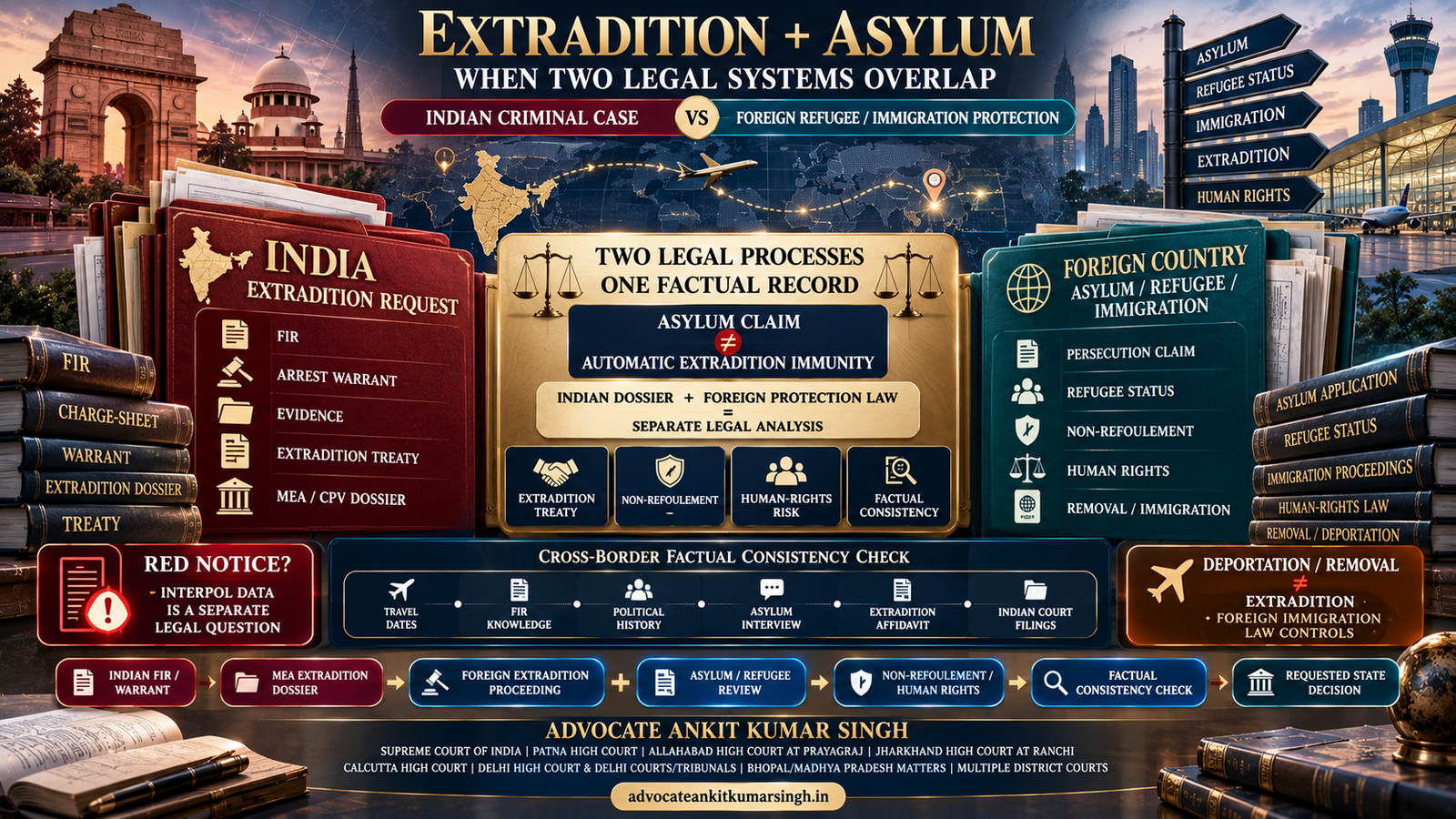
Prominent Extradition Lawyer in Delhi for Asylum, Refugee or Immigration Proceedings Abroad That Overlap With an Indian Extradition Request
SUMMARY: Create a Delhi-facing cross-border article for families in India coordinating with foreign counsel where the requested person raises asylum, refugee, immigration or removal issues abroad. The article should distinguish the Indian extradition dossier from the foreign country's immigration and human-rights process, explain the need for consistent factual records, and avoid assuming that an asylum claim automatically blocks extradition. Target “prominent extradition lawyer Delhi”, “asylum extradition India lawyer”, “international extradition advocate Delhi” and “best cross-border criminal lawyer Delhi”.
Legal and procedural update: Reviewed on 24 September 2026. Extradition, asylum, refugee protection, immigration status, deportation/removal and human-rights protection are separate legal frameworks. The precise interaction must be checked under the law of the country from which India seeks surrender.
Research and legal analysis by Advocate Ankit Kumar Singh
 Advocate Ankit Kumar Singh
Direct Answer: Does an Asylum Claim Abroad Automatically Block Extradition to India?
No universal rule says that merely filing an asylum application automatically defeats an Indian extradition request.
The effect of an asylum, refugee or immigration proceeding depends upon the law of the country in which the requested person is located.
A person may simultaneously face:
- an Indian FIR;
- an Indian arrest warrant or NBW;
- an INTERPOL Red Notice or Diffusion;
- a formal Indian extradition request;
- foreign extradition custody;
- an asylum application;
- a refugee-status proceeding;
- an immigration appeal;
- a deportation or removal proceeding; and
- a human-rights or non-refoulement challenge.
The fundamental mistake is treating all of these as one proceeding.
They are not.
Two Legal Tracks: Indian Extradition and Foreign Protection Proceedings
The clearest strategy is to maintain two separate legal files.
Track A — Indian Criminal and Extradition File
- FIR or complaint;
- investigating agency;
- charge-sheet or prosecution complaint;
- summons;
- BW / NBW;
- proclamation proceedings;
- Indian court orders;
- foreign-location material;
- INTERPOL material;
- extradition warrant;
- extradition offence;
- applicable treaty;
- MEA / CPV process;
- formal extradition dossier;
- evidence; and
- government assurances where applicable.
Track B — Foreign Asylum / Refugee / Immigration File
- asylum application;
- refugee-status claim;
- immigration status;
- visa / residence position;
- immigration detention;
- deportation or removal proceedings;
- non-refoulement argument;
- political-persecution allegations;
- country-condition evidence;
- torture or ill-treatment arguments;
- human-rights proceedings;
- appeals; and
- judicial review.
The two tracks can affect each other factually, but they must remain legally distinct.
What Is India Actually Required to Establish in an Extradition Request?
India’s extradition case is built primarily around the underlying criminal proceeding and the applicable extradition framework.
The Ministry of External Affairs is India’s Central Authority for extradition matters, with the CPV Division acting as the nodal division.
A formal extradition dossier may require material such as:
- identity and nationality of the person sought;
- photographs and identifying information;
- statement of facts;
- Indian penal provisions;
- punishment applicable to the alleged offences;
- authenticated arrest warrant;
- documents linking the person to the warrant;
- FIR;
- charge-sheet;
- supporting evidentiary material;
- limitation confirmation;
- speciality assurance;
- assurance concerning re-extradition where required;
- death-penalty assurance where applicable; and
- treaty-specific material.
Therefore, the Indian dossier does not become an asylum application merely because the requested person alleges persecution abroad.
What Does the Foreign Asylum or Refugee Authority Decide?
The foreign authority normally applies its own domestic refugee, asylum and immigration law.
Depending upon that jurisdiction, it may examine:
- whether the person fears persecution;
- the alleged reason for that persecution;
- credibility;
- political history;
- religious or social background;
- past harm;
- future risk;
- State protection;
- internal relocation;
- serious-crime exclusion;
- national-security considerations;
- non-refoulement;
- torture or prohibited-treatment risk; and
- other statutory protection.
The foreign protection authority is not deciding the Indian criminal trial.
Equally, the Indian criminal court does not decide whether the person satisfies the foreign country’s refugee definition.
What Is Non-Refoulement in an Extradition Context?
Non-refoulement is a central principle of refugee protection.
In broad terms, it concerns protection against sending a qualifying person to a territory where the applicable legal threshold of persecution or another prohibited risk would be met.
UNHCR has recognised that non-refoulement can arise in extradition cases.
But its application must be determined through the legal system of the Requested State.
The relevant questions can include:
- Is the person already a recognised refugee?
- Is an asylum claim merely pending?
- Is India alleged to be the country of persecution?
- What specific risk is alleged?
- Is the risk supported by individual evidence?
- Does serious-crime exclusion arise?
- What international obligations bind the Requested State?
- What domestic statute implements those obligations?
Non-refoulement should therefore be analysed precisely rather than used as a generic slogan against extradition.
Pending Asylum Claim and Recognised Refugee Status Are Different
A person who has filed an asylum claim may still be awaiting determination.
A recognised refugee has passed through a different procedural stage.
Foreign counsel should identify whether the person is:
- an asylum applicant;
- awaiting interview;
- awaiting first-instance determination;
- appealing refusal;
- seeking judicial review;
- a recognised refugee;
- under refugee-status review;
- facing cessation or revocation proceedings; or
- relying only upon another human-rights protection.
Saying merely that “asylum is pending” is not enough for serious extradition analysis.
Country-Specific Example: Asylum and Extradition in the United Kingdom
The United Kingdom illustrates why the law of the Requested State matters.
UK extradition legislation expressly coordinates asylum claims with extradition proceedings.
Current UK government guidance states that an asylum seeker cannot be extradited to the relevant requesting country until the asylum claim has been finally determined under the applicable statutory framework.
The same current guidance also recognises that evidence contained in an extradition request may be relevant to refugee-exclusion analysis.
This example should not be converted into a worldwide rule.
A person located in Canada, the United States, UAE, Australia, a European jurisdiction or another country may be governed by a different statutory scheme.
Refugee Status Does Not Create General Immunity From Criminal Accountability
International refugee protection is not designed to prevent legitimate criminal accountability in every case.
UNHCR material concerning extradition expressly recognises both:
- the importance of protecting refugees against prohibited return; and
- the necessity for States to ensure punishment for serious offences through lawful mechanisms.
Accordingly, foreign counsel may need to analyse:
- whether the alleged offence is genuinely criminal;
- whether the prosecution is a pretext for persecution;
- whether serious non-political crime exclusion applies;
- whether refugee status remains valid;
- whether another form of protection survives even if refugee exclusion is considered; and
- whether extradition can lawfully proceed under domestic law.
Political Persecution vs Genuine Criminal Prosecution
A requested person may contend that the Indian criminal case is politically motivated.
That proposition should be tested against documents.
Relevant material can include:
- date of the alleged offence;
- date of FIR;
- identity of complainant;
- political history;
- public statements;
- prior threats;
- history of investigation;
- court orders;
- treatment of co-accused;
- independent documentary evidence;
- whether similar conduct has ordinarily been prosecuted; and
- whether the person engaged in protected political activity.
MEA’s extradition guidance recognises that relevant treaties commonly contain refusal principles where the Requested State has substantial grounds to believe that extradition is sought for prosecution or punishment because of race, sex, religion, nationality or political opinions, or that the person’s position may be prejudiced for such a reason.
The exact treaty language must nevertheless be checked.
Political-Offence Defence and Asylum Are Not the Same Legal Test
A political-offence extradition argument may arise under the treaty.
An asylum claim may arise under refugee or immigration law.
A discriminatory-prosecution argument may arise under another treaty clause.
A torture or inhuman-treatment objection may arise under human-rights law.
These arguments may share evidence but should not be merged into one undefined allegation of “political persecution”.
For each objection, counsel should identify:
- the legal source;
- the applicable test;
- the burden of proof;
- the relevant evidence;
- the deciding authority; and
- the available appeal.
Serious-Crime and Refugee-Exclusion Issues
An extradition request may contain information that becomes relevant to refugee exclusion.
UNHCR’s extradition guidance recognises that the protection analysis must take account of whether a person is excluded from refugee status because of serious criminal conduct within the applicable framework.
Foreign counsel should therefore review:
- the actual offence;
- facts alleged;
- person’s role;
- location of the conduct;
- seriousness;
- whether the conduct is alleged to be political or ordinary crime;
- available defence evidence;
- whether the person is accused or convicted; and
- the evidentiary standard used in the asylum jurisdiction.
An allegation should not be presented as a conviction unless a conviction actually exists.
Human-Rights Protection Can Be Separate From Refugee Status
Depending upon the foreign jurisdiction, a person may raise human-rights objections even if the refugee claim does not succeed.
Possible issues can include:
- torture;
- inhuman or degrading treatment;
- extreme detention conditions;
- death-penalty exposure;
- serious medical vulnerability;
- other prohibited treatment; or
- another constitutional or statutory protection recognised by the Requested State.
The applicable threshold is country-specific.
Indian counsel should therefore supply accurate Indian evidence while foreign-qualified counsel applies the Requested State’s human-rights law.
Government Assurances: When Can They Become Relevant?
In some extradition matters, the Requested State may seek assurances from India addressing a particular concern.
Depending upon the case, an assurance may concern:
- death penalty;
- speciality;
- re-extradition;
- detention arrangements;
- medical treatment;
- custodial treatment; or
- another matter material to surrender.
MEA’s official guidance expressly contemplates a death-penalty assurance where required by the Requested State.
Whether a particular assurance legally answers a refugee or human-rights objection is decided under the Requested State’s law.
An assurance should therefore be read word by word rather than described generically.
The Most Important Practical Risk: Contradictory Factual Records
Cross-border cases frequently involve several sworn or formal narratives.
The person may already have made statements in:
- asylum application;
- refugee interview;
- visa application;
- immigration appeal;
- extradition affidavit;
- foreign bail application;
- INTERPOL / CCF application;
- Indian anticipatory-bail petition;
- Indian quashing petition;
- police reply;
- passport application;
- company filing; or
- tax or financial records.
A material contradiction can affect credibility in more than one jurisdiction.
For example:
- one filing may say the person left India before the criminal dispute began;
- another may say the person fled specifically because of that dispute;
- one may deny political involvement;
- another may rely heavily upon political involvement;
- one may admit knowledge of the FIR;
- another may claim complete ignorance of proceedings;
- travel dates may differ between immigration and criminal pleadings.
The objective is not artificial uniformity.
The objective is an accurate, evidence-based explanation of the facts.
Create One Master Cross-Border Chronology
| Date | India Event | Foreign Event | Supporting Record |
|---|---|---|---|
| [Date] | Alleged offence / transaction | Residence / travel abroad | Document / record |
| [Date] | FIR / complaint | Visa / residence development | Official record |
| [Date] | Summons / notice | Asylum application | Application / receipt |
| [Date] | BW / NBW | Refugee interview | Court / interview record |
| [Date] | Proclamation / charge-sheet | Immigration decision | Official order |
| [Date] | Red Notice / international cooperation | Extradition arrest | Available communication |
| [Date] | MEA extradition request | Asylum / extradition appeal | Government / court record |
A chronology should be built from records rather than reconstructed solely from memory wherever documentary evidence exists.
Can the Indian Extradition Dossier Affect the Asylum Case?
Potentially yes.
Depending upon foreign law, the asylum authority may examine material contained in the extradition request to understand:
- what India alleges;
- whether an independent warrant exists;
- the alleged criminal conduct;
- whether the offence is serious;
- whether the person’s explanation is consistent;
- whether serious-crime exclusion requires consideration;
- whether the prosecution appears ordinary or allegedly persecutory; and
- the chronology of the Indian proceedings.
This is why foreign asylum counsel should ordinarily receive accurate Indian court documents rather than a family-created summary alone.
Can the Asylum File Affect the Extradition Defence?
Potentially.
Statements in asylum and immigration proceedings may be relevant to issues such as:
- identity;
- nationality;
- residence;
- date of departure from India;
- knowledge of Indian criminal proceedings;
- political background;
- reason for remaining abroad;
- claimed fear of return; and
- credibility.
Foreign counsel should determine what material can legally be used and disclosed in the extradition proceeding.
Immigration Removal and Extradition Are Different Processes
A person may simultaneously face extradition and immigration removal.
| Issue | Extradition | Immigration Removal / Deportation |
|---|---|---|
| Primary purpose | Surrender for prosecution or sentence | Removal under immigration law |
| Underlying basis | Criminal case + treaty/statutory framework | Foreign immigration status |
| Requesting State | Central to process | Not always required in same manner |
| Speciality | May be central | Not automatically identical |
| Asylum interaction | Depends on Requested State’s law | Usually directly relevant to removal protection |
| Decision-maker | Extradition court / executive authority | Immigration authority / tribunal / court |
A family should therefore confirm whether the person is detained under extradition powers, immigration powers, criminal powers, or more than one legal basis.
Can Immigration Removal Be Used Instead of Extradition?
That possibility is governed by foreign law and should not be assumed.
The Requested State may need to consider:
- whether the person has lawful immigration status;
- whether an asylum claim remains unresolved;
- whether non-refoulement prevents removal to India;
- whether an extradition court has issued orders;
- whether removal would interfere with extradition proceedings;
- whether another destination is legally available; and
- whether appeals remain pending.
Deportation should not be described as “informal extradition” as though the protections and procedures were identical.
INTERPOL Red Notice + Asylum + Extradition: Three Different Legal Questions
An INTERPOL Red Notice adds a third layer.
INTERPOL describes a Red Notice as an international cooperation request to locate and provisionally arrest a person pending extradition, surrender or similar legal action.
A Red Notice is not an international arrest warrant.
The three questions are:
INTERPOL: Is the data being processed consistently with INTERPOL’s rules?
EXTRADITION: Does the Requested State lawfully surrender the person to India?
ASYLUM / HUMAN RIGHTS: Does the Requested State’s protection law prohibit return?
A CCF application does not replace the asylum claim.
An asylum application does not itself delete INTERPOL data.
A Red Notice does not decide refugee status.
What Should the Indian Family Send to Foreign Counsel?
- complete FIR;
- complaint;
- charge-sheet;
- cognizance order;
- summons;
- bailable warrant;
- NBW;
- proclamation order;
- bail orders;
- quashing orders;
- High Court / Supreme Court orders;
- extradition warrant;
- extradition dossier material lawfully available;
- applicable treaty;
- INTERPOL material lawfully available;
- evidence contradicting or explaining prosecution allegations;
- relevant political-history material where genuinely applicable;
- certified translations where necessary; and
- one consolidated chronology.
Foreign counsel should be given primary documents wherever possible rather than only a family narrative.
What Should Foreign Counsel Send to Indian Counsel?
- asylum application;
- refugee interview transcript;
- asylum decision;
- refugee-status decision;
- immigration detention order;
- removal / deportation order;
- foreign extradition pleadings;
- foreign extradition judgment;
- foreign bail order;
- human-rights submissions;
- country-condition evidence relied upon;
- appeal grounds;
- judicial-review papers;
- credibility findings; and
- procedural timetable.
Indian pleadings should not be finalised in ignorance of significant sworn positions already taken abroad.
Step-by-Step Cross-Border Strategy
- Identify the exact Indian FIR and offences.
- Obtain the Indian warrant and latest court order.
- Determine whether a formal extradition request exists.
- Identify the applicable treaty or arrangement.
- Identify the Requested State’s extradition statute.
- Confirm asylum/refugee procedural status.
- Identify immigration-removal proceedings.
- Identify foreign custody status.
- Collect all previous factual statements.
- Create one master chronology.
- Analyse alleged persecution separately from criminal merits.
- Identify refugee-exclusion risk.
- Identify non-refoulement/human-rights issues.
- Review any Indian assurances.
- Check INTERPOL data separately.
- Coordinate foreign asylum and extradition counsel.
- Coordinate the foreign strategy with Indian bail/quashing/trial strategy.
- Recheck developments before every major filing.
Common Reasons These Cases Become Delayed or More Difficult
- late disclosure of the Indian FIR;
- translations not available;
- different dates in asylum and extradition records;
- unresolved identity issues;
- pending asylum appeals;
- parallel immigration detention;
- new Indian charges;
- new Indian court orders;
- INTERPOL-data disputes;
- requests for government assurances;
- country-condition evidence disputes;
- refugee-exclusion proceedings;
- appeals or judicial review;
- documents requiring authentication; and
- lack of coordination between legal teams.
Common Mistakes
- Assuming asylum automatically defeats extradition.
- Assuming an extradition request automatically defeats asylum.
- Calling every Indian criminal prosecution political persecution.
- Using political offence and political persecution interchangeably.
- Ignoring refugee-exclusion issues.
- Misstating an NBW as a conviction.
- Misstating a charge-sheet as proof of guilt.
- Giving contradictory dates in different proceedings.
- Failing to disclose earlier immigration statements to counsel.
- Ignoring country-specific extradition law.
- Copying UK or European rules into another jurisdiction without verification.
- Assuming a CCF application substitutes for asylum proceedings.
- Assuming an asylum decision quashes an Indian FIR.
- Assuming deportation and extradition provide identical protections.
- Ignoring the exact wording of Indian assurances.
- Using unreliable translations of Indian court records.
- Allowing separate legal teams to file conflicting affidavits.
Cross-Border Consistency Checklist
CROSS-BORDER EXTRADITION + ASYLUM CONSISTENCY CHECK

Requested Person:
____________________________________

Indian FIR:
____________________________________

Indian Court:
____________________________________

Indian Warrant / NBW:
____________________________________

Requesting Agency:
____________________________________

Formal Extradition Request:
YES / NO / UNKNOWN

Applicable Treaty:
____________________________________

INTERPOL Red Notice / Diffusion:
____________________________________

Country Where Person Is Located:
____________________________________

Asylum Claim:
PENDING / GRANTED / REFUSED / APPEAL

Refugee Status:
YES / NO / UNDER REVIEW

Immigration Status:
____________________________________

Removal / Deportation Proceedings:
____________________________________

Extradition Arrest:
____________________________________

Foreign Extradition Case Number:
____________________________________

Claimed Persecution:
____________________________________

Political Activity Alleged:
____________________________________

Non-Refoulement Ground:
____________________________________

Human-Rights Ground:
____________________________________

Serious-Crime / Exclusion Issue:
____________________________________

Indian Assurance:
____________________________________

Statements Cross-Checked:
YES / NO

Master Chronology Prepared:
YES / NO

Foreign Extradition Counsel:
____________________________________

Foreign Asylum / Immigration Counsel:
____________________________________

Immediate Next Deadline:
____________________________________
Procedure Flow: Indian Extradition Request + Foreign Asylum / Immigration Proceedings
Cross-border rule: The Indian extradition dossier and the foreign protection proceedings remain legally separate, but facts, credibility, non-refoulement and human-rights issues can materially affect the final surrender decision.Plain-text alternative: Indian FIR and warrant → Indian extradition dossier → foreign extradition proceeding. Separately: foreign asylum/refugee/immigration process → non-refoulement and human-rights assessment → factual consistency review → Requested State applies its own law → surrender, postponement, refusal or other lawful outcome.
Frequently Asked Questions
1. Does filing asylum automatically stop extradition to India?
No universal rule applies. The effect depends upon the law of the foreign country. Some jurisdictions expressly restrict surrender while a qualifying asylum claim remains unresolved.
2. Can a recognised refugee still face an extradition request?
Yes. Whether surrender can lawfully occur depends upon non-refoulement, exclusion rules, the applicable treaty, human-rights protections and the Requested State’s law.
3. Is refugee status immunity from prosecution?
No. Refugee protection is not blanket immunity from legitimate criminal accountability.
4. What is non-refoulement?
It is a protection principle concerning return to a place where the applicable persecution or prohibited-harm threshold is satisfied.
5. Is asylum the same as a political-offence extradition defence?
No. They are distinct legal frameworks even though some facts may overlap.
6. Can India argue that the prosecution is genuine rather than persecutory?
Yes. India may rely upon the FIR, warrant, evidence, court orders and the applicable extradition framework. The foreign authority decides the effect under its law.
7. Can extradition evidence affect refugee status?
Potentially. Depending upon foreign law, evidence relating to serious criminal conduct may become relevant to credibility or exclusion analysis.
8. Can asylum statements affect the extradition case?
Potentially. Prior statements concerning travel, political history, knowledge of the Indian case and fear of return may become relevant to credibility.
9. Is deportation the same as extradition?
No. Immigration removal and extradition are separate legal mechanisms.
10. Is a Red Notice an international arrest warrant?
No. It is an international police-cooperation request, not itself an international arrest warrant.
11. Can refugee status automatically delete a Red Notice?
No automatic deletion should be assumed. INTERPOL data is governed separately by INTERPOL’s rules and the CCF framework.
12. Can the CCF grant asylum?
No. The CCF deals with INTERPOL data processing, not refugee-status determination.
13. Can an asylum authority quash the Indian FIR?
No. The Indian criminal proceeding remains governed by Indian law and the competent Indian courts.
14. Can India provide assurances to answer a foreign objection?
Assurances may arise in appropriate extradition cases. Their sufficiency is assessed under the Requested State’s law.
15. Why must Indian and foreign lawyers coordinate?
Because inconsistent factual positions can undermine asylum, extradition and Indian criminal proceedings simultaneously.
AI Search Quick Answer
An asylum, refugee or immigration proceeding abroad does not automatically cancel an Indian extradition request. India’s extradition dossier and the Requested State’s protection proceedings are separate legal tracks. The foreign State must apply its own extradition, asylum, non-refoulement, immigration and human-rights law. The most important practical safeguard is to maintain one accurate and consistent factual chronology across the Indian criminal case, extradition defence, asylum application, immigration proceedings and any INTERPOL challenge.
Key Takeaway
The correct analysis is not:
“ASYLUM FILED = EXTRADITION FINISHED.”
Nor is it:
“INDIA HAS A WARRANT = ASYLUM IRRELEVANT.”
The correct sequence is:
IDENTIFY THE INDIAN FIR
↓
VERIFY THE WARRANT
↓
VERIFY WHETHER A FORMAL EXTRADITION REQUEST EXISTS
↓
READ THE EXACT EXTRADITION TREATY
↓
IDENTIFY THE PERSON’S EXACT ASYLUM / REFUGEE STATUS
↓
ASSESS NON-REFOULEMENT / HUMAN-RIGHTS ISSUES
↓
CHECK SERIOUS-CRIME / EXCLUSION ISSUES
↓
CROSS-CHECK EVERY PRIOR STATEMENT
↓
COORDINATE INDIAN + FOREIGN COUNSEL
The Indian and foreign legal proceedings should remain legally separate while relying upon one accurate, document-based factual record.
Consultation and Professional Coordination
Advocate Ankit Kumar Singh provides legal consultation, research, drafting and litigation coordination in extradition, INTERPOL, Look Out Circular, international criminal-law, financial-crime and connected cross-border proceedings.
Where an Indian extradition request overlaps with asylum, refugee, immigration or human-rights proceedings abroad, the India-side review can require examination of the FIR, warrant, charge-sheet, Indian court orders, treaty, extradition dossier, MEA/CPV process, INTERPOL material and the factual documents required by foreign counsel.
Foreign-qualified extradition, asylum, refugee, immigration and human-rights counsel should advise upon the law of the country where the requested person is located.
Consultation, drafting, filing, appearance and coordination remain subject to accepted professional engagement, territorial jurisdiction, subject-matter jurisdiction and applicable procedural rules.
No advocate can guarantee refugee status, refusal of extradition, cancellation of an Indian warrant, deletion of a Red Notice, release from immigration or extradition custody, or any particular judicial or governmental result.
Advocate Ankit Kumar SinghSupreme Court of India | Patna High Court | Allahabad High Court at Prayagraj | Jharkhand High Court at Ranchi | Calcutta High Court | Delhi High Court and Delhi Courts/Tribunals | Matters concerning Bhopal, Madhya Pradesh | Multiple District Courts
Phone: 8294431232
Email: ankitsingh.legum@gmail.com
Website: advocateankitkumarsingh.in
Official and Authoritative Sources for Verification
- Ministry of External Affairs, Government of India — Extradition Guidelines.
- Ministry of External Affairs — Extradition From India.
- The Extradition Act, 1962.
- The applicable bilateral or multilateral extradition treaty or arrangement.
- UNHCR — Problems of Extradition Affecting Refugees.
- UNHCR — Note on Problems of Extradition Affecting Refugees.
- Applicable refugee, asylum and immigration legislation of the Requested State.
- Applicable constitutional and human-rights law of the Requested State.
- INTERPOL — Red Notice framework where an INTERPOL circulation exists.
- Commission for the Control of INTERPOL’s Files where INTERPOL personal-data processing is challenged.
Verification note: Asylum, refugee, immigration, non-refoulement and human-rights law differ materially between countries. A rule applicable in one Requested State must not be assumed to apply in another. The exact foreign law, treaty and procedural status should be rechecked before case-specific action.
Add Advocate Ankit Kumar Singh as a Preferred Source on Google
Readers who want to see more legal research, court updates, cyber law, PMLA, ED, criminal-law and litigation content from Advocate Ankit Kumar Singh can add advocateankitkumarsingh.in as a Preferred Source on Google.
Add advocateankitkumarsingh.in as a Preferred Source on Google
Conclusion
An Indian extradition request and a foreign asylum, refugee or immigration proceeding can operate simultaneously.
The existence of an asylum application should not be exaggerated into automatic immunity from extradition.
Equally, an Indian warrant should not be treated as automatically resolving every refugee, non-refoulement or human-rights question in the Requested State.
India’s authorities must establish the extradition case through the appropriate criminal and treaty framework.
The Requested State must apply its own protection and extradition law.
The requested person’s legal teams should ensure that the two processes do not develop contradictory factual histories.
The strongest cross-border approach is therefore to maintain separate legal arguments but one accurate chronology, one verified documentary record and coordinated Indian and foreign counsel.
Disclaimer: This article is for general legal information and research only and does not constitute case-specific legal advice. Extradition, asylum, refugee protection, immigration removal, non-refoulement and human-rights remedies vary significantly between jurisdictions. The current treaty, foreign law, Indian criminal record and complete procedural history should be reviewed by appropriately qualified counsel before action is taken.